
SAP Ariba vs. Coupa at a glance
SAP Ariba is a SAP-native source-to-pay suite. Coupa is an ERP-agnostic spend management platform. The right choice depends on your ERP estate, your spend mix, and your appetite for a multi-month rollout. There is no universal winner. Both share one blind spot: neither is built to clean the procurement data it runs on.
SAP Ariba and Coupa are the two names on almost every enterprise source-to-pay shortlist. They solve broadly the same problem, bringing sourcing, buying, invoicing, suppliers, and spend onto one governed platform, but they come at it from opposite starting points.
SAP Ariba is a modular source-to-pay suite built around the SAP ecosystem, with native links to SAP S/4HANA and SAP ERP and access to the SAP Business Network, one of the largest structured B2B supplier networks in the world (S1, S30).
Coupa is a cloud-native, ERP-agnostic business spend management platform that aims to put every spend category (procurement, invoicing, expenses, treasury, contingent labour) on a single system, with AI trained on a very large pool of anonymized community spend data. (S6, S8)
The right choice depends on your ERP estate,
- How centralised your operating model is,
- How much of your spend is direct versus indirect,
- How much your teams will tolerate during a multi-month rollout.
And because that data blind spot sits outside what either suite is built to fix, the table below adds a third option: ewiz procure, our own procurement data-intelligence and execution layer, which works alongside Ariba or Coupa rather than replacing them (more on where it fits later in the guide).
Here is the fast decision:
| Choose SAP Ariba if… | Choose Coupa if… | Consider ewiz procure as an add-on if… |
| You run SAP S/4HANA or SAP ERP and want native integration, shared master data, and the SAP Business Network for supplier discovery. ( S1 , S2) | You run a mixed or non-SAP ERP estate and want one ERP-agnostic platform across procurement, expenses, treasury, and contingent labour. (S8, S9) | Your data is the bottleneck (messy supplier masters, fragmented catalogs, unclassified spend, low adoption) and you need that fixed and governed, alongside Ariba or Coupa, not instead of them. |
| Direct materials and tight production-to-supplier alignment matter, and procurement must sync with BOM/MRP processes. (S24) | Usability and fast user adoption are decisive, and you want a consumer-style buying experience with minimal training. (S15) | You face data quality, supplier onboarding, catalog adoption, tail-spend visibility, sourcing-execution, AI-readiness, or analytics-trust gaps that a suite alone has not closed. |
| You have an internal IT/procurement-ops team to run a complex, governance-heavy platform. (S34) | You want to avoid being tied to a single ERP vendor’s roadmap and prefer pre-built ERP connectors. (S8) | You want a modular, expert-governed layer that activates the data foundation across sourcing, catalogs, suppliers, and analytics, without a rip-and-replace. |
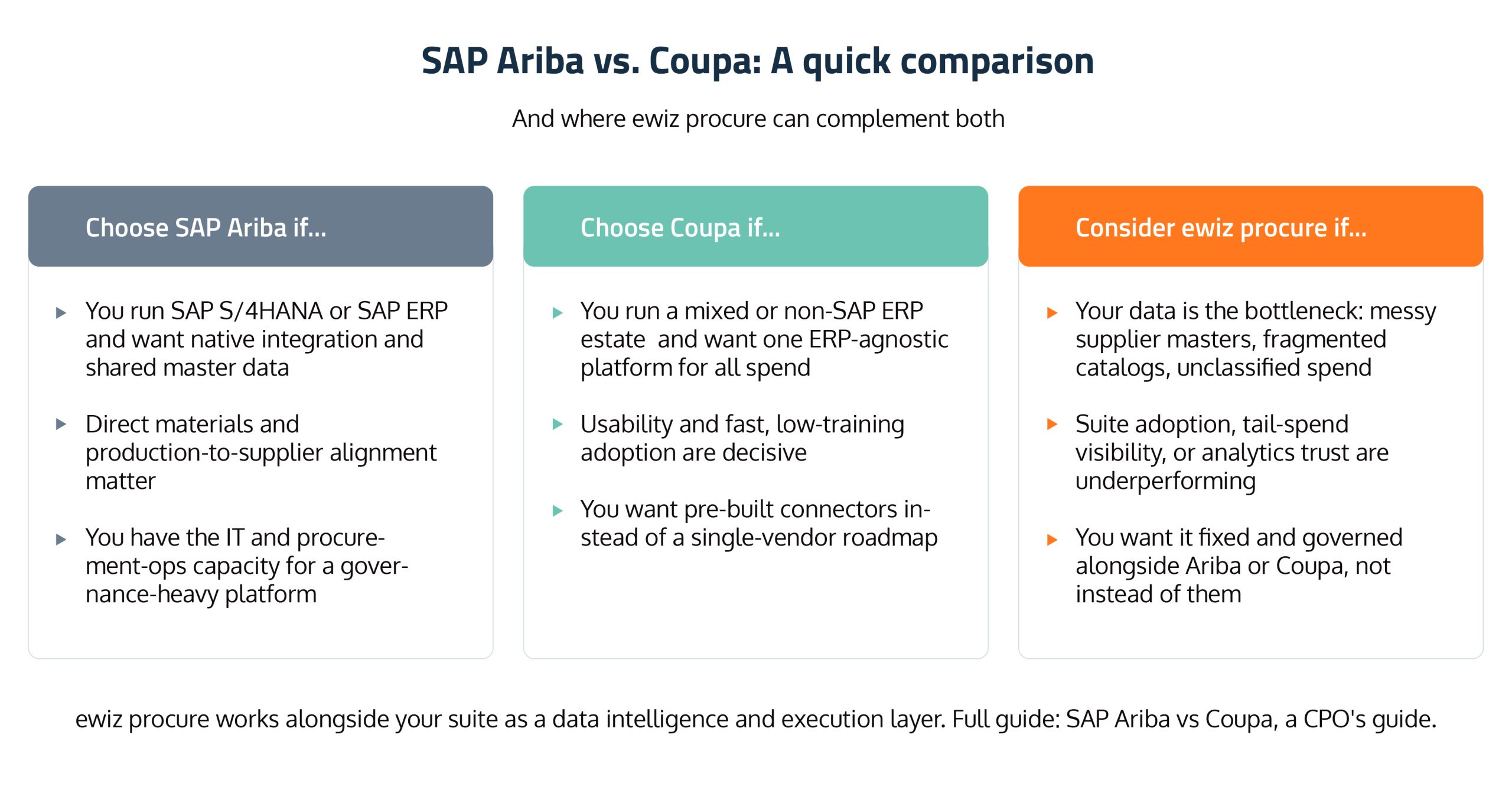
The guide explains how to make that call with evidence rather than instinct.
How this guide is different
Most “Ariba vs Coupa” pages are ratings tables. They tell you Coupa scores a little higher on ease of use and Ariba wins on SAP integration, then leave you to guess what that means for your organization.
This guide is written for the person who has to defend the decision to a CFO and a CIO. It converts review sentiment into buyer implications, refuses to crown a universal winner, date-stamps every volatile fact, and labels vendor-commissioned studies clearly. And it carries the decision one step past the platform choice, into the data and adoption realities that decide whether either platform pays off. That last part is where most comparisons go quiet, and it is the part a CPO most needs.
How we compared SAP Ariba and Coupa
This comparison is built from five evidence types, in this order of trust:
- Official product documentation from SAP and Coupa, for what each platform claims to do.
- Independent review platforms, G2, Capterra, Gartner Peer Insights, TrustRadius, and Software Advice, for verified user sentiment, grouped by theme rather than cherry-picked.
- Public customer stories for named proof, used only where the source is on the record.
- Buyer-community questions from Gartner Peer Insights discussion threads, treated as intent signals, not proof of capability.
- Third-party comparisons and benchmarks for pricing and implementation reference points, with vendor-commissioned studies flagged.
Two things to keep in mind when you weigh the evidence below.
Ratings and pricing move: the G2 and Gartner Peer Insights figures cited here were read directly off those platforms in June 2026, sub-scores and pricing benchmarks are drawn from secondary analyses and marked as such, and either can shift by the time you evaluate, so confirm anything decision-critical against the live source. And neither vendor publishes list pricing, which is normal for this category, not a gap in the research; the pricing section focuses on what actually drives total cost of ownership instead of a number neither vendor will confirm.
A quick note on the category.
Gartner defines the source-to-pay suite market as an integrated, modular, ERP-agnostic set of solutions to source, contract, request, procure, receive, and pay for goods and services. (S20) Both products live here. Ariba was founded in 1996 and acquired by SAP in 2012. (S4) Coupa was founded in 2006 and taken private by Thoma Bravo in 2023. (S10) Both are mature platforms with deep enterprise footprints.
SAP Ariba: overview
What it is and who it’s for
SAP Ariba is a cloud-based source-to-pay suite. It manages the procurement lifecycle from sourcing and supplier collaboration through buying, invoicing, and payment, and it connects buyers and suppliers through the SAP Business Network. (S1, S4) It is built for medium to large organisations with complex purchasing, and it is at its strongest inside the SAP ecosystem, where it shares master data and processes with SAP S/4HANA and SAP ERP. (S2, S4)
Core modules in SAP Ariba
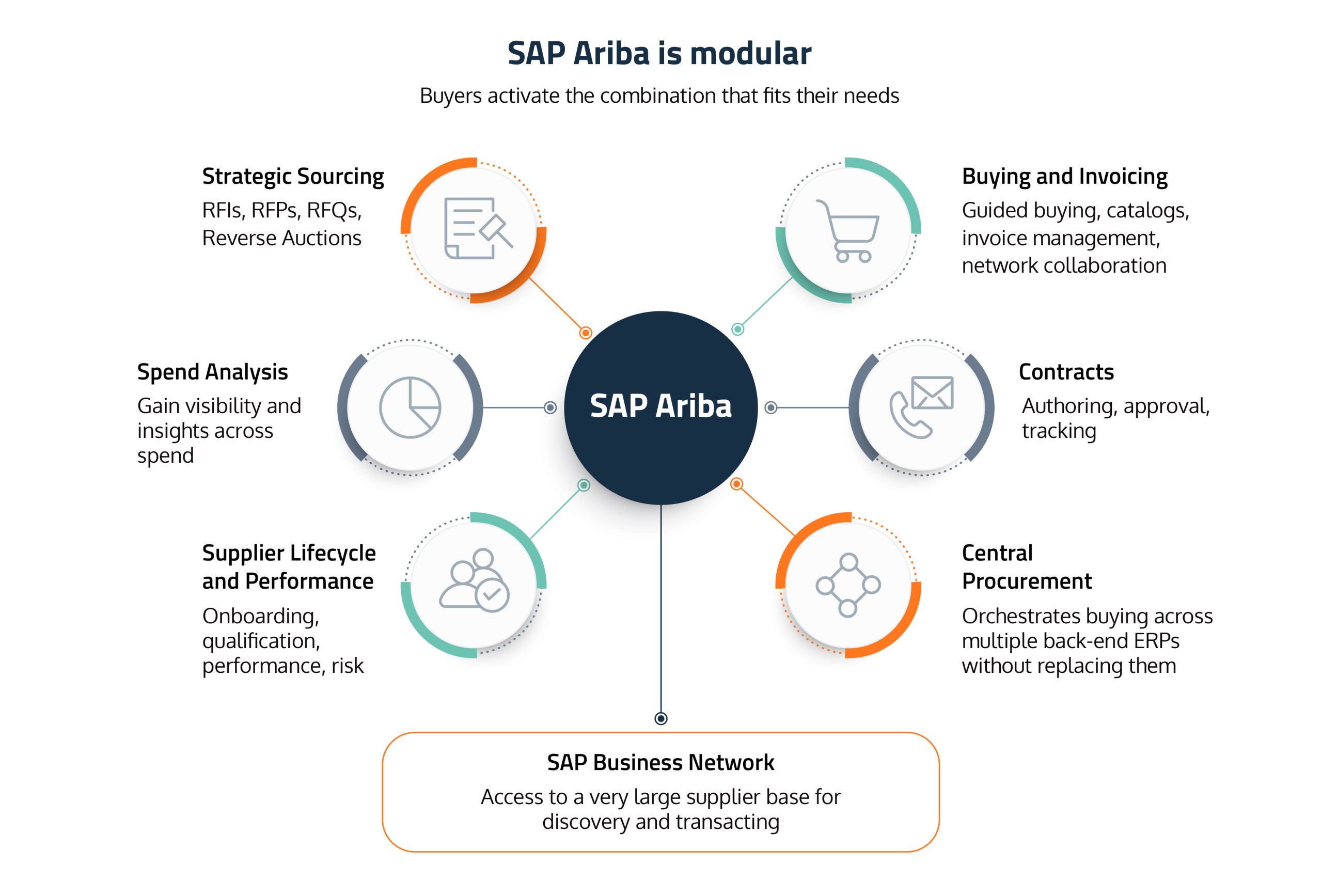
Ariba is modular. Buyers typically activate some combination of:
- Strategic Sourcing (RFIs, RFPs, RFQs, reverse auctions)
- Buying and Invoicing (guided buying, catalogs, invoice management, network collaboration)
- Contracts (authoring, approval, tracking)
- Supplier Lifecycle and Performance (onboarding, qualification, performance, risk)
- Spend Analysis
- Central Procurement, which orchestrates buying across multiple back-end ERPs without replacing them. (S1,S2, S5)
The SAP Business Network sits underneath, giving access to a very large supplier base for discovery and transacting. (S30)
Best-fit profile
Ariba fits enterprises that are SAP-centric, that manage significant direct-materials and supplier complexity, and that have the internal IT and procurement-operations capacity to run a governance-heavy platform. It is frequently chosen in manufacturing, retail and consumer goods, pharmaceuticals and healthcare, energy, and the public sector. (S31)
Reviewers consistently value its process discipline, auditability, and the depth of its supplier collaboration, though they also describe a steep learning curve and a complex implementation. (S34, S17)
Screenshots and demo

Demo Link: SAP Ariba Source-to-Pay Software | Request a demo
Coupa: overview
What it is and who it’s for
Coupa is a cloud-native business spend management (BSM) platform. It aims to put every spend category, procurement, invoicing, expenses, supplier management, treasury, and contingent workforce, on one platform, with AI built on a very large pool of anonymised community spend data. (S3)
It is ERP-agnostic by design and connects to multiple ERPs through pre-built connectors. (S8) It serves mid-sized and enterprise organizations, with a review base that skews heavily enterprise. (S28, S18)
Core modules of Coupa
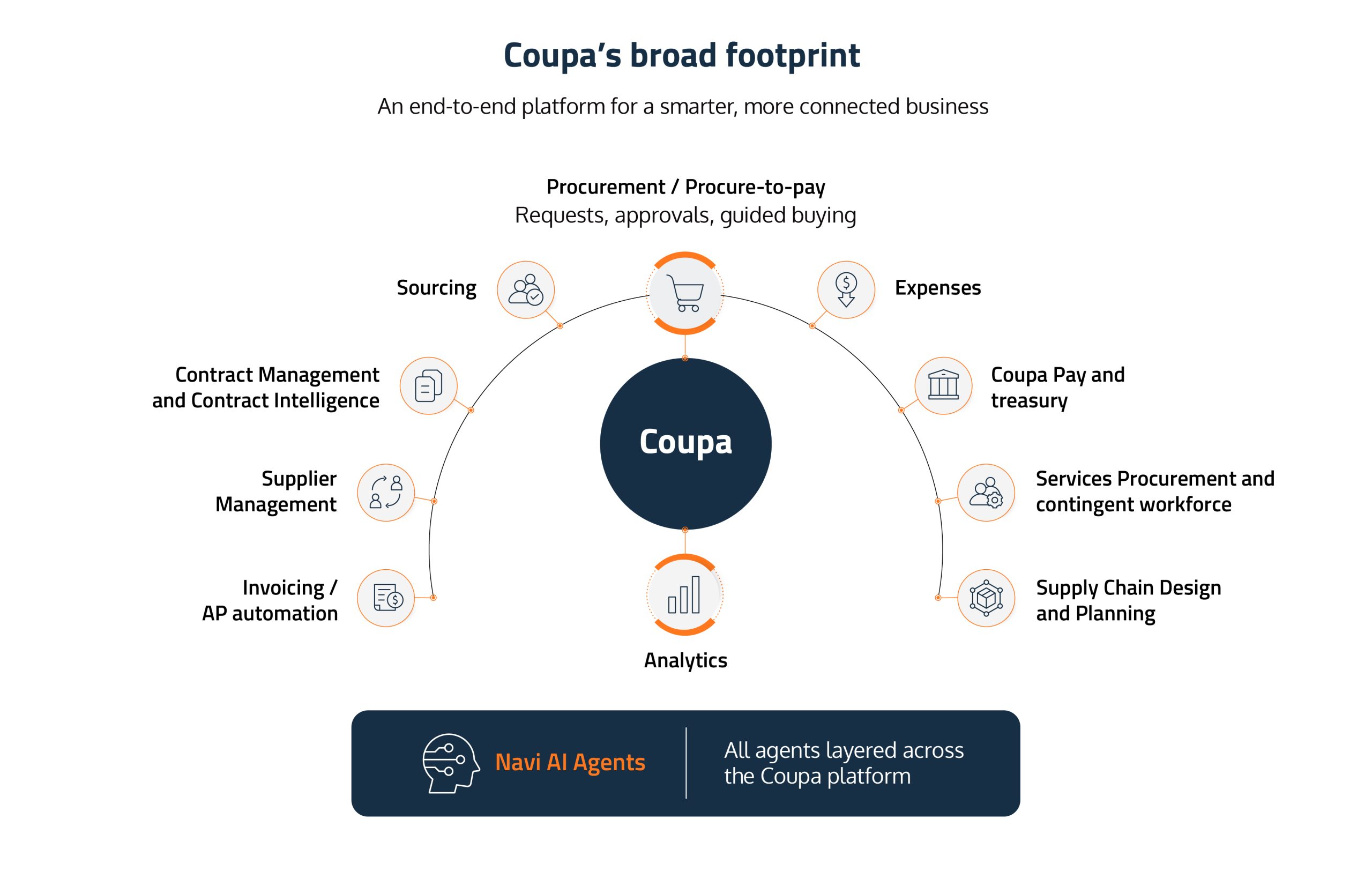
Coupa’s footprint is broad:
- Procurement / Procure-to-Pay (requests, approvals, guided buying)
- Sourcing
- Contract Management and Contract Intelligence
- Supplier Management
- Invoicing / AP automation
- Expenses
- Coupa Pay and treasury
- Services Procurement and contingent workforce
- Supply Chain Design and Planning (added through the Llamasoft acquisition in 2020)
- and Analytics, with the Navi AI agents layered across the platform. (S8)
In October 2025 Coupa shipped a large set of AI enhancements alongside a redesigned interface. (S11)
Best-fit profile
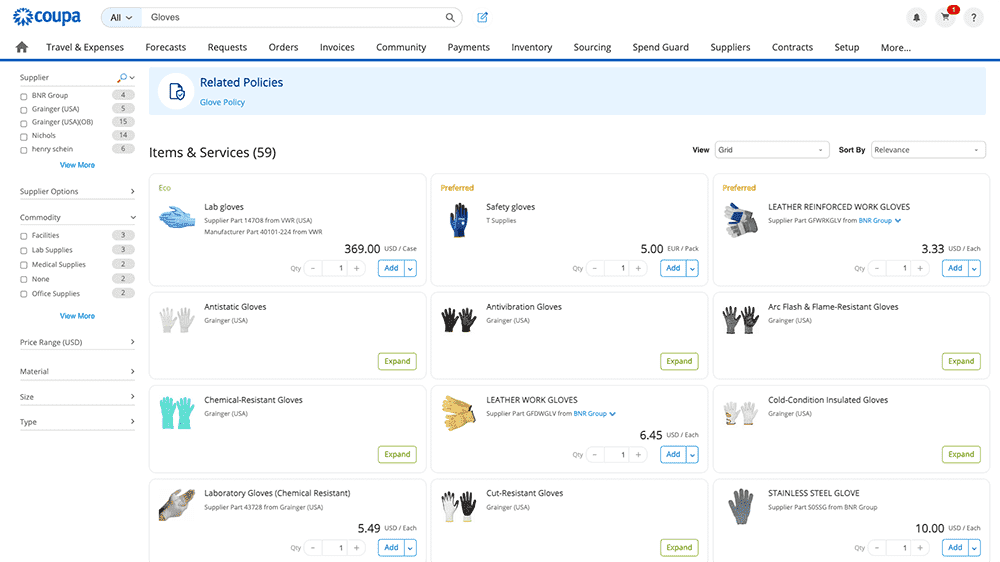
Coupa fits organizations with mixed or non-SAP ERP estates that want one platform across all spend, and teams for whom usability and fast adoption are decisive. Reviewers repeatedly praise its modern interface, configurability, and stability, and its consumer-style buying experience is a consistent adoption advantage. (S15)
It is also one of the few enterprise procurement platforms with standalone FedRAMP Moderate authorization, which matters for public-sector buyers..
Screenshots and demo
Demo Link: Take a Tour of Total Spend Management | Coupa
Ratings and reviews snapshot
Ratings move and differ by platform and by Gartner market category. Treat the table below as a June 2026 snapshot, not a fixed score, and re-check before you quote or decide.
| Review platform | SAP Ariba | Coupa | What this means for buyers |
| G2 | 4.1 / 5 (791 reviews) (S13, read Jun 2026) | 4.2 / 5 (~569 reviews) (G2, S14, read Jun 2026) | Effectively neck and neck; both review bases are almost entirely enterprise. |
| Gartner Peer Insights (Source-to-Pay Suites market) | 4.3 / 5 (~546 reviews, listed as “SAP”) (S19, read Jun 2026) | 4.8 / 5 (~693 reviews) (S19) ; Coupa reports 4.8 / 687 (S7) | Coupa rates higher on satisfaction; SAP/Ariba carries a large absolute footprint. Both sit in the 2026 Gartner Magic Quadrant for S2P Suites. |
| Capterra | Listed; strong on audit/compliance, dated UI a common con (S17) | Listed; centralisation praised, learning curve a common con (S18) | Capterra now sits under G2 ownership after the January 2026 acquisition of Gartner Digital Markets. |
| TrustRadius | Strong on integration + supplier management; UI dated for ~20% of reviewers (S21) | Strong on ease of use, configurability, stability; supplier-portal friction noted (S22) | Sentiment splits along the same line everywhere: Ariba depth vs Coupa usability. |
| G2 sub-scores | CLM 8.4; Invoice Approvals 8.8; Ease of Use 8.0; Ease of Setup 7.8 (S24) | Ease of Use 8.3; Mobile 8.0; CLM 6.8 (S24) | Ariba leads on contract and invoice depth; Coupa leads on usability and mobile. These sub-scores come from secondary analyses; re-read on G2 if you cite them. |
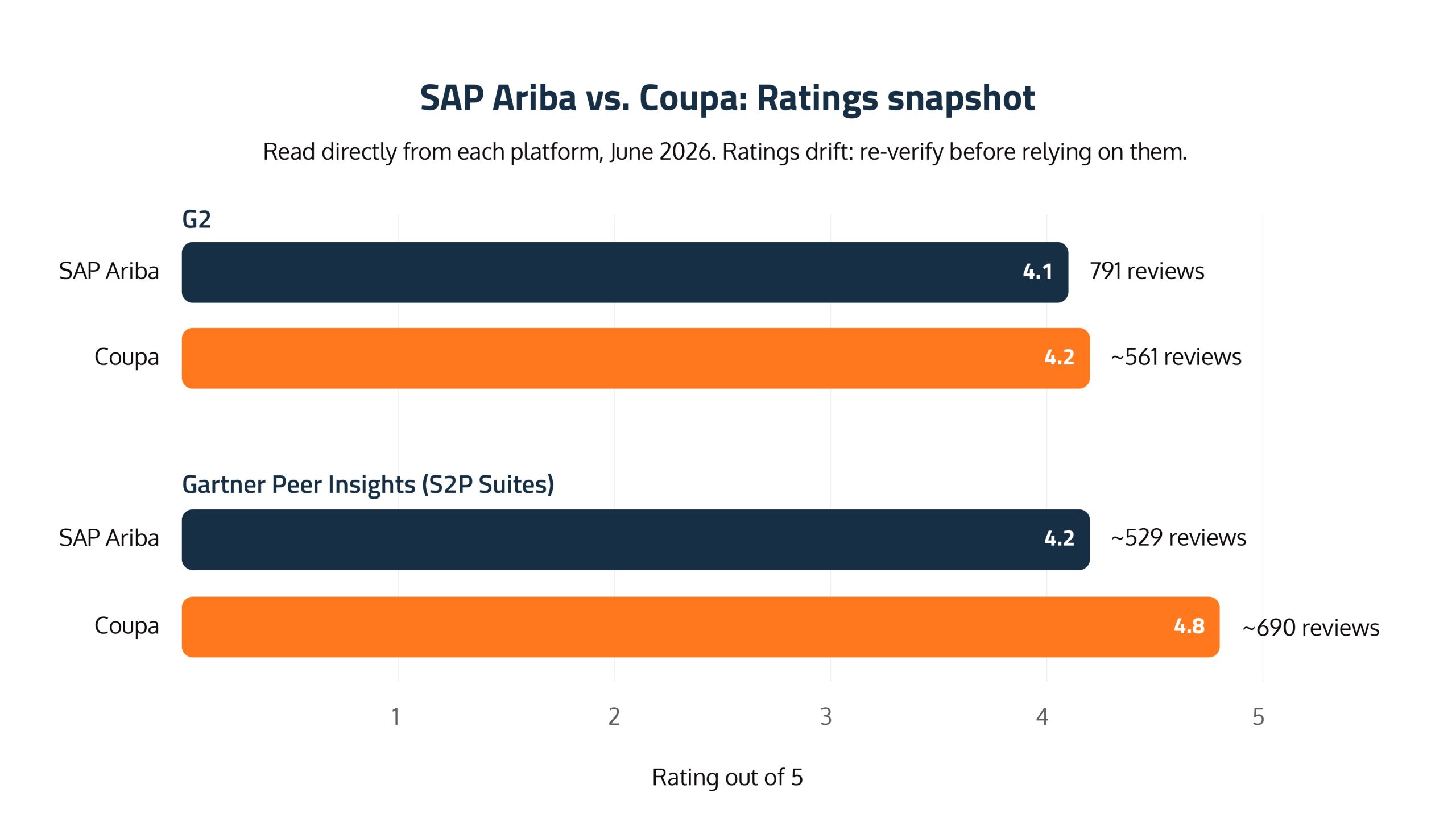
Two things are worth knowing before you weigh these numbers.
First, the review landscape consolidated in early 2026.
G2 announced on 29 January 2026 that it would acquire Capterra, Software Advice, and GetApp from Gartner, and the deal closed on 5 February 2026 for about $110 million. The brands still operate separately for now, but a large share of software-review influence now sits under one owner, which is a reason to read across platforms rather than trusting one. Note that Gartner Peer Insights is a separate Gartner product and was not part of that sale.
Second, Gartner Peer Insights and G2 measure different populations.
Gartner Peer Insights verifies enterprise reviewers and skews to large organisations, while G2 carries higher volume across company sizes. So a higher Gartner satisfaction score for Coupa and a near-tie on G2 are not in conflict. They describe different rooms. The practical takeaway for a CPO is to use ratings to confirm the directional pattern, which is Ariba depth and integration against Coupa usability and breadth, and then validate it against references in your own industry and size band, which no rating page can give you.
What real users say about SAP Ariba and Coupa
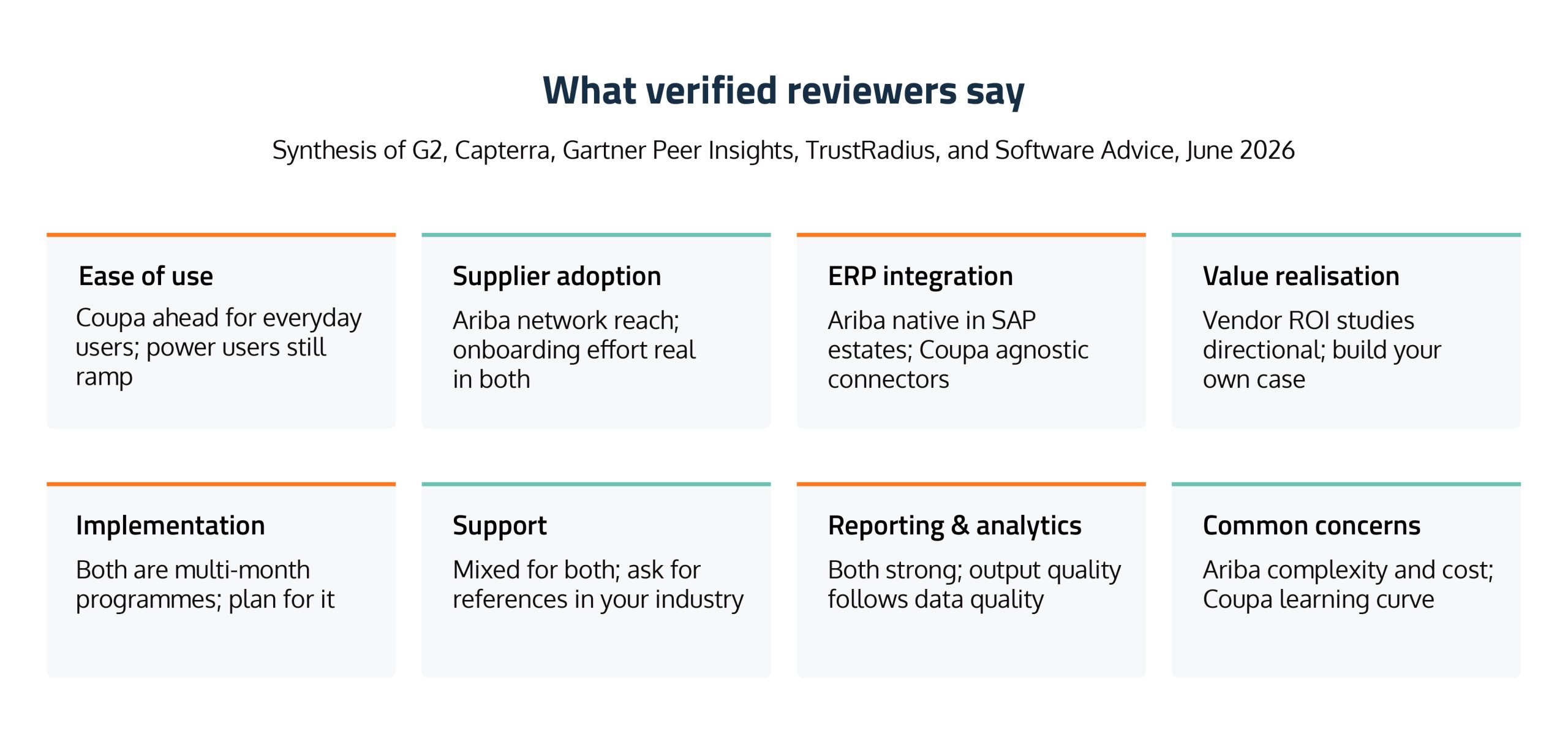
Grouping reviews by theme is the only fair way to read them. Here is what verified users repeatedly report, with the buyer implication for each.
Ease of use
Coupa is the consistent winner on usability. Reviewers describe a modern, intuitive interface and quick adoption for everyday requesters. (S15) The caveat: power users in procurement ops or AP still face a real learning curve, and the risk module in particular is described as hard to master. (S29) Ariba is repeatedly described as powerful but complex, with navigation that can feel dated and click-heavy, and a steeper ramp for new hires. (S13, S17)
Buyer implication: If broad, low-training adoption across casual users is your priority, Coupa starts ahead; if your core users are procurement specialists, the gap narrows.
Implementation
Both are multi-month enterprise program, not plug-and-play. Ariba offers a rapid-deployment option targeting go-live in as few as 10 weeks for fixed scope, but standard rollouts run 3–6 months for a single region and 9–18 months for global multi-entity deployments, and the lift is heavier outside the SAP ecosystem (Teem, S24). Coupa deployments are typically reported at 6–18 months and often involve external consultants. (S38, S39)
Buyer implication: Budget for a programme, not a project, and assume integration with non-SAP systems will add time and cost on the Ariba side.
ERP integration
This is Ariba’s clearest structural advantage and Coupa’s clearest design philosophy. Ariba integrates natively with SAP S/4HANA and SAP ERP and shares master data through SAP’s integration tooling (S2) Integration with non-SAP ERPs is possible but requires additional technical effort. Coupa is ERP-agnostic and connects through pre-built connectors across many ERPs. (S8) Notably, 66% of TrustRadius reviewers said the ability to integrate with other systems was a critical factor in their decision. (S21)
Buyer implication: if you are an SAP shop, Ariba’s native integration is hard to beat; if you run a heterogeneous estate, Coupa’s agnostic connectors reduce friction.
Reporting and analytics
Both deliver enterprise spend analytics. Ariba’s reporting is built on SAP’s HANA foundation and is often integrated with SAP Analytics Cloud or BI tools for deeper analysis. (S4, S5) Coupa’s analytics surface anomalies, duplicate spend, and savings opportunities, and draw on its community spend data for benchmarking. (S8, S31)
Buyer implication: Analytics quality on either platform is only as good as the underlying spend and supplier data, a point this guide returns to.
Supplier adoption
Ariba’s strength here is reach: the SAP Business Network connects a very large supplier base for discovery and transacting. (S40) Coupa provides supplier onboarding, risk, and performance management through its Supplier Portal, though some suppliers report the portal as a point of friction when they only need to submit an invoice. (S9, S18, S22)
Buyer implication: Supplier adoption is an operational program on either platform; the network reach differs, but onboarding effort is real in both.
Support
Sentiment is mixed for both. Some Ariba customers report slow support response and a dependence on the quality of their account team. (S30) Coupa support draws similarly mixed feedback, with some customers citing slow or vague responses. (S18)
Buyer implication: Factor support tier and partner quality into your evaluation, and ask for named references in your industry.
Value realization
Coupa points to a vendor-commissioned Forrester Total Economic Impact study (2024) reporting 276% ROI over three years with payback inside 10 months, useful as a directional signal, but commissioned by Coupa and not independently equivalent for Ariba. (S24) Named scale outcomes include a manufacturer growing managed indirect spend substantially on Coupa.
Buyer implication: Treat vendor ROI studies as directional, build your own business case on your spend baseline, and ask each vendor for outcomes from customers your size and in your sector.
Common concerns
Across platforms, the recurring concerns are: Ariba’s complexity, cost, and the “suite-first” tilt that can leave non-SAP customers feeling under-served (S16); and Coupa’s learning curve for power users, limited customization relative to Ariba, occasional mobile-app issues, and cost as modules and seats accumulate. (S18)
Buyer implication: None of these is disqualifying, but each is a real line item to plan for.
Feature-by-feature comparison of SAP Ariba and Coupa
| Capability | SAP Ariba | Coupa | What buyers should evaluate |
| Architecture | Modular S2P suite, SAP-ecosystem-centric (S1) | Cloud-native, ERP-agnostic unified BSM (S8) | Does your ERP estate favour native SAP integration or agnostic connectors? |
| ERP integration | Native to SAP S/4HANA / SAP ERP; non-SAP needs added effort (S2, S24) | Pre-built connectors across many ERPs (S8) | Map your actual ERP landscape before scoring this. |
| Strategic sourcing | RFIs, RFPs, RFQs, reverse auctions; deep (S1, S5) | Sourcing with AI-guided awards (S8) | How complex are your sourcing events? |
| Guided buying / catalogs | Guided buying + punchout catalogs (S1, S31) | Guided buying + standardized catalog interface (S31) | Catalog quality and adoption matter more than the feature itself. |
| Contract lifecycle management | Strong; G2 CLM 8.4; Icertis partnership (S41, S42) | Present; G2 CLM 6.8; Contract Intelligence (S43) | Depth of CLM needs varies by industry. |
| Invoicing / AP | 2/3-way matching; G2 Invoice Approvals 8.8 (S44, S1) | AP automation + AI anomaly detection (S8) | Volume, exception handling, compliance needs. |
| Expenses / treasury | Requires separate SAP apps (e.g. Concur) (S44) | Native expenses + Coupa Pay / treasury (S8) |
Do you want one platform for all spend? |
| Contingent workforce | Via separate SAP application (S46) | Native services procurement (S9) | Relevant if services/contingent spend is large. |
| Supplier network | SAP Business Network, very large reach (S40) | Supplier Portal; onboarding + risk (S9) | Supplier discovery vs onboarding effort. |
| AI / data | AI grounded in SAP master data context (S24) | AI on large anonymised community spend data (S47) | Which data philosophy fits your need? |
| Certifications | ISO 27017, ISO 27018; GDPR, SOC (S48, S49) | FedRAMP Moderate, PCI DSS, HIPAA, TISAX; SOC, GDPR (S50) | Match to your contractually required standards. |
| Usability | Powerful, complex; G2 Ease of Use 8.0 (S13) | Modern, intuitive; G2 Ease of Use 8.3 (S24) | Who are your primary users? |
A caveat on this table: feature parity is not the same as fit. Both platforms tick most boxes. The decision is rarely won on a missing feature. It is won on architecture fit, adoption, and whether the data underneath is good enough for the features to work.
Pricing and total cost of ownership
Is pricing public?
No. Neither SAP nor Coupa publishes list pricing. Both use subscription, quote-based models that vary by modules selected, number of users, transaction volume, number of entities, and scope. (S26, S23) Any figure you see online is a third-party benchmark or an individual deal point, not an official rate.
For reference only and clearly labelled as third-party estimates: one benchmark put a mid-sized Ariba deployment (around 500 suppliers, 5 users on the supplier lifecycle module) starting near $25,000 per year, with full enterprise deployments reaching up to roughly $250,000. For mid-market scope, another source estimated Ariba total cost of ownership in the six-to-seven-figure range annually once licensing, implementation, integration, and support are counted. A separate blog cited Capterra research suggesting Coupa packages can start around $2,500 per month.
Note: These are directional, unverified by the vendors, and should never be quoted as official pricing.
What actually drives the bill (TCO)
The sticker is the smallest part. The real total cost of ownership is driven by:
- Modules activated, each added module (sourcing, CLM, supplier management, analytics, expenses, treasury) changes the price.
- Users and entities, seat counts and multi-entity, multi-currency scope scale the licence.
- Transaction and supplier fees, volume-based components and supplier onboarding effort.
- Data migration and cleansing, moving and fixing supplier masters, item data, and spend history.
- Integration, connecting to your ERP estate; native for SAP shops on Ariba, additional technical effort for non-SAP integration. (S25, S27)
- Implementation partners, most enterprise rollouts use external consultants, especially for non-SAP integration. (S28)
- Training and change management, the larger and less intuitive the platform, the higher this line.
- Support tier and ongoing administration. Premium support and admin headcount are recurring costs.
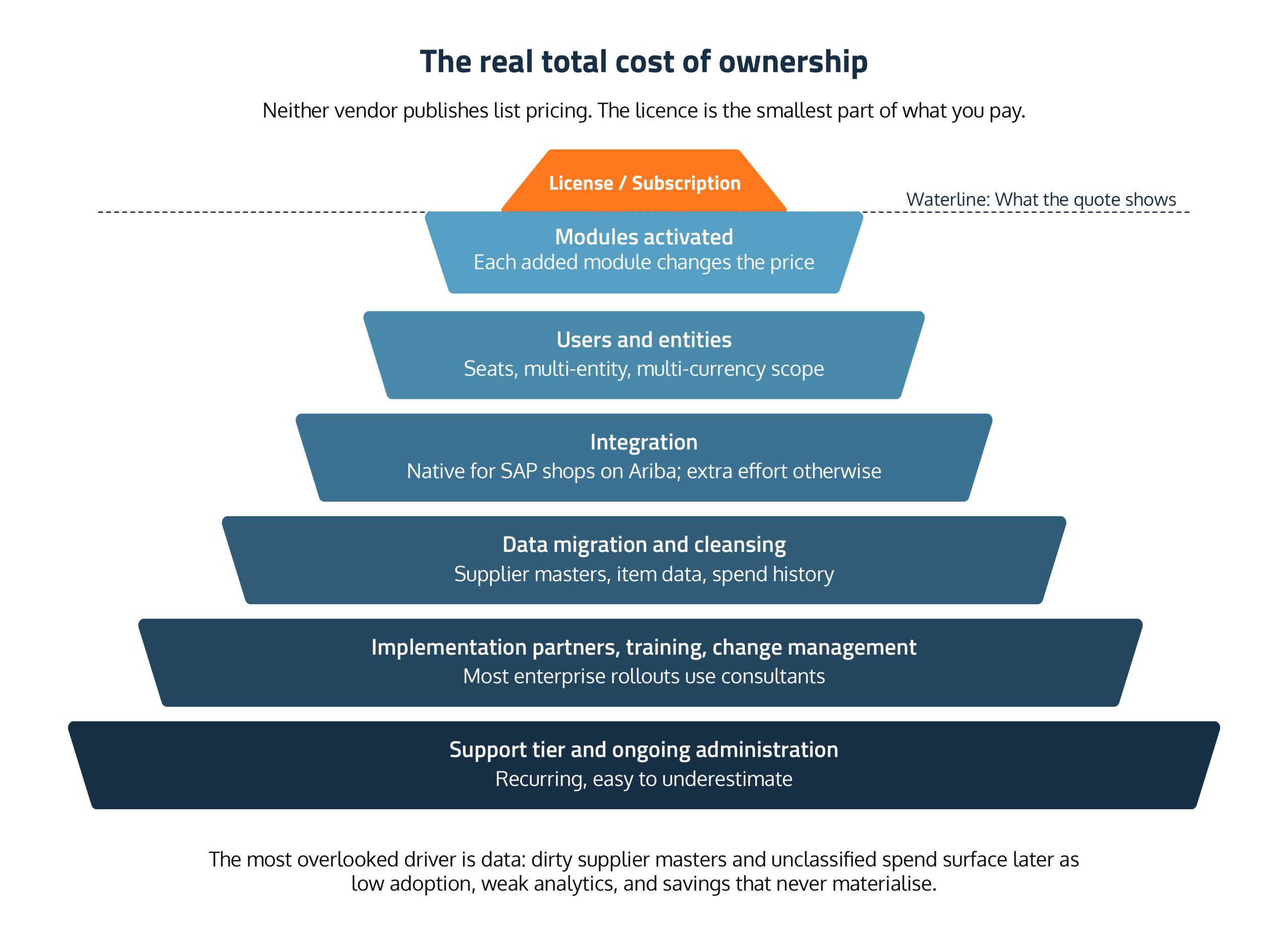
The single most overlooked TCO driver is data. A platform priced and implemented perfectly will still underperform if the supplier master is duplicated, the catalogs are stale, and half the spend is unclassified. That cost shows up later as low adoption, weak analytics, and savings that never materialise, and it is exactly the gap discussed below.
Customers and proof points
Every enterprise procurement suite has marquee logos, so a customer list proves little on its own. What tells you something is the shape of the proof: the industry it comes from, whether the outcome is quantified, and whether it maps to the problem you are trying to solve. Read the references below that way, and apply the same test to any reference a vendor puts in front of you in a sales cycle.
SAP Ariba
The most relevant on-record proof sits in regulated manufacturing. Smith+Nephew, a global healthcare and medical-technology manufacturer, standardized global procurement on SAP Ariba and grew spend captured through the platform by around $400 million across 2021 and 2022, an increase of roughly 70%, reaching over 90% first-pass requisition approvals and over 80% automated invoice matching.
Coca-Cola Consolidated, the largest US Coca-Cola bottler, used SAP Ariba to improve spend compliance and visibility, and SAP names Churchill Downs and American Eagle Outfitters among its customers. (S12)
For a CPO, the Smith+Nephew numbers are the useful part: they are specific, sit in a compliance-heavy manufacturing environment, and describe adoption and matching rates you can benchmark against your own.
Coupa
Coupa’s strongest on-record proof is scale in manufacturing. Jabil, a global manufacturing and supply-chain services company, grew managed indirect spend on Coupa from around $2 billion to over $6 billion annually during its rollout, which Coupa attributes to the visibility and control the platform gave over indirect spend.
Avient, a specialty materials manufacturer, migrated from SAP Ariba to Coupa in a Coupa-hosted account centered on scalability and supplier adoption. The Avient reference is worth weighing carefully if you are comparing the two: it is a real switch between the platforms you are evaluating, though it is told through Coupa’s lens, so treat it as one data point, not a verdict.
What pattern tells you.
Both vendors have credible, quantified proof inside manufacturing and healthcare-adjacent industries, which are close to the verticals this guide targets. Neither published proof set, however, speaks to the data-foundation work that determines whether those outcomes are reachable in the first place. A spend-capture jump or a first pass-match rate is the result of clean suppliers and catalog data as much as the platform itself.
That data layer is where ewiz procure works, and it is the one place procurement teams struggle the most; because every digital transformation initiative needs clean data to succeed. (We have covered ewiz procure in detail in the section – Where ewiz procure fits)
Best-fit by industry
SAP Ariba and Coupa are strong enterprise platforms, but industry fit often depends on the quality of the data, catalogs, suppliers, and workflows sitting underneath them. That is where ewiz procure can complement the core stack.
For example, let’s consider the accuracy of procurement data.
In instances like these, our customers have found ewiz procure as a layer to help with data cleansing, procurement catalog for indirect spend or custom PR to PO workflows.
Hence, we have mentioned ewiz procure alongside the two suites below. It is NOT a third option to choose between.
The first two columns help narrow the platform decision, and the third is what has to be true underneath for the platform you choose to actually work in your sector.
| Industry / situation | SAP Ariba fit | Coupa fit | How ewiz procure works with SAP Ariba or Coupa |
| FMCG / consumer goods | Strong fit for SAP-run FMCG enterprises with complex sourcing, high supplier volumes, and global procurement governance needs. | Strong where usability, guided buying, and faster multi-market adoption matter; modern UI can support rollout across business users. |
|
| Manufacturing / industrial | Often a natural fit where direct materials, production planning, supplier collaboration, and SAP ERP alignment are central. (S32) | Proven at scale for manufacturing-led procurement transformation; Avient migrated from Ariba to Coupa for scalability and adoption. (S51) |
|
| Pharma | Relevant for pharma and healthcare procurement where governance, auditability, supplier controls, and compliance-heavy buying are important. (S31) | Relevant in regulated procurement environments where compliance, controls, and user adoption need to scale across functions. (S24) |
|
| Consumer goods / retail / durables | Strong fit for SAP-centric retail and consumer-goods supply chains with complex supplier, category, and procurement governance needs. (S31) | Strong for unified spend visibility, guided buying, and faster user adoption across distributed business teams. (S8) | Data Cleansing: fixes supplier master, SKU, category, and spend taxonomy issues so category teams work with trusted data. Procurement Catalog: builds structured catalogs for indirect, services, marketing, POSM, facility, and operational buying. PR-to-PO: streamlines routine purchases and reduces manual follow-ups. eAuctions: supports competitive events for packaging, marketing, logistics, and indirect spend. Supplier Management: improves onboarding, document collection, vendor profiles, and supplier performance visibility. |
| Chemicals | Strong fit for SAP-run chemical enterprises with complex sourcing, compliance, supplier governance, and plant-linked procurement needs. (S33) | Strong where ERP-agnostic spend unification, analytics, and procurement visibility are priorities. (S8) |
|
| Multi-ERP or fragmented procurement environments | Works well when SAP remains the procurement backbone, but complexity increases when business units operate across multiple systems. | Strong where procurement needs a unified spend layer across ERPs, entities, categories, and geographies. |
|
| Mid-market / upper-mid-market procurement teams | May be too heavy if the organization does not need full enterprise S2P transformation or deep SAP-led procurement architecture. | Can be a strong option, but may still be broader than required if the immediate need is modular procurement execution. | Data-first modular fit: ewiz procure helps teams start with the highest-value gap: data cleansing, sourcing, catalogs, supplier onboarding, PR-to-PO, eAuctions, or analytics. It works alongside existing ERP/S2P systems and avoids a full rip-and-replace approach. |
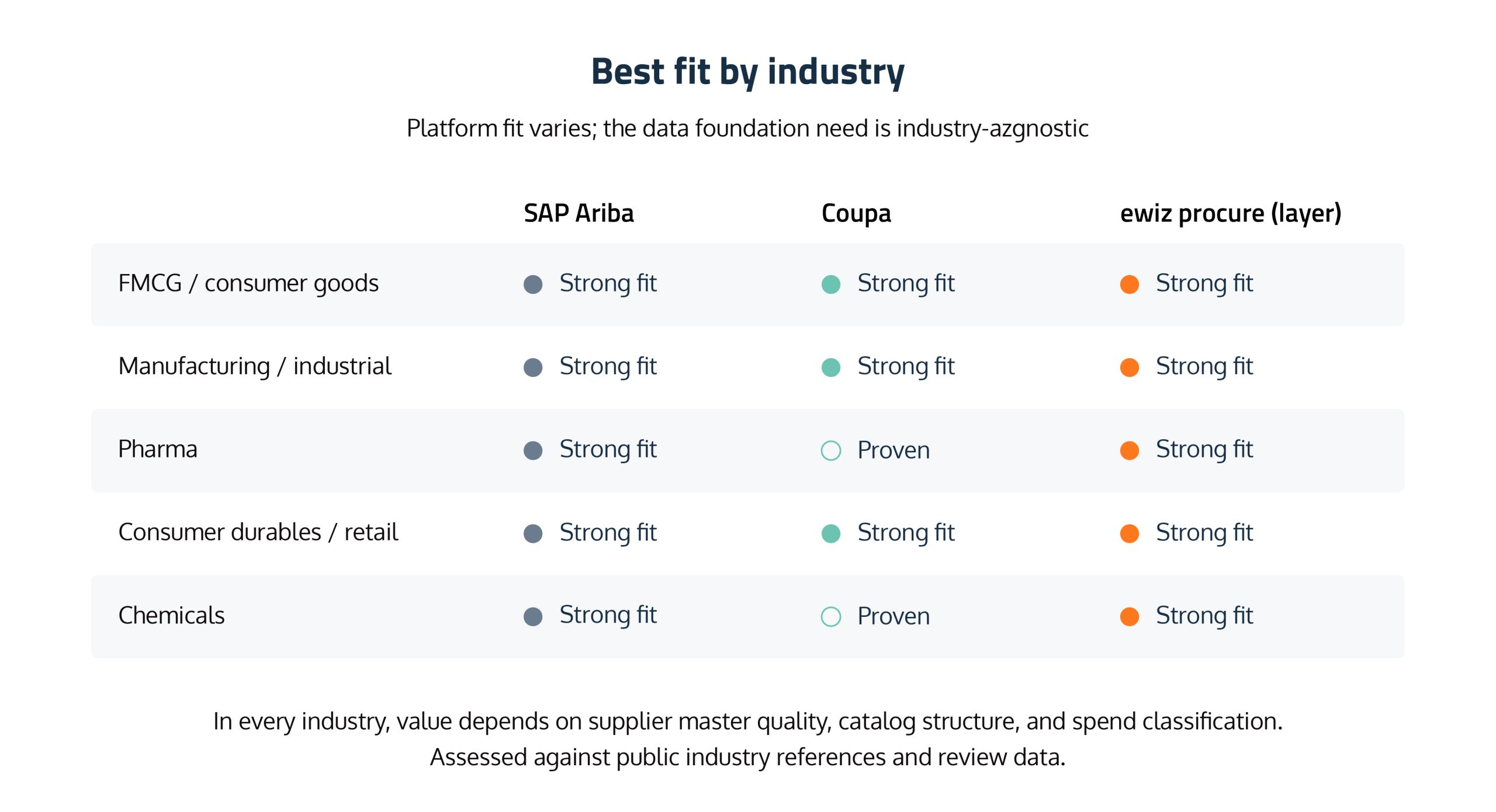
The pattern is consistent: the platform decision is real, but in every industry the value depends on a data foundation that neither suite is designed to build.
Common enterprise procurement gaps after S2P implementation
This section uses deliberately neutral framing. These are not weaknesses of SAP Ariba or Coupa. Both are capable, well-rated platforms. They are common enterprise gaps that tend to surface after a large source-to-pay platform goes live, regardless of vendor.
1. Supplier master data remains fragmented
Implementing an S2P platform does not automatically eliminate duplicate suppliers, inconsistent naming conventions, missing tax or compliance information, or fragmented supplier records across business units. When supplier data is unreliable, sourcing, supplier onboarding, compliance reporting, and spend analytics become less effective. Gartner identifies supplier information and performance management as a core capability of S2P suites, but organizations still need ongoing governance to keep supplier data accurate and complete.
2. Catalogs become outdated after go-live
Many organizations invest significant effort in launching procurement catalogs but struggle to keep them accurate over time. New products, supplier changes, pricing updates, and inconsistent product descriptions often lead users back to free-text purchasing or off-contract buying. SAP and Coupa both emphasize catalog buying and guided purchasing, but maintaining catalog quality remains an ongoing operational challenge.
3. Manual sourcing still exists despite digital procurement
Even after deploying an S2P platform, many procurement teams continue to manage RFQs through email, spreadsheets, and manual commercial comparisons, particularly for indirect spend or business-specific sourcing events. This slows sourcing cycles and reduces auditability.
4. PR-to-PO workflows don’t match business processes
Standard procurement workflows often cannot accommodate every business scenario. Regional approval matrices, plant-level buying, category-specific sourcing rules, emergency purchases, CAPEX approvals, or compliance-driven processes frequently require custom workflows that extend beyond standard S2P configurations.
5. Supplier onboarding remains a bottleneck
Supplier onboarding is frequently one of the most manual procurement activities. Vendors may delay registration, submit incomplete documentation, or require repeated follow-ups before becoming procurement ready. While enterprise procurement platforms provide supplier portals, successful onboarding still depends on process ownership and data quality.
6. Indirect and tail spend remain difficult to control
A significant proportion of indirect spend continues to be purchased outside preferred channels because items are poorly classified, suppliers are duplicated, or catalogs are incomplete. This reduces negotiated savings and limits procurement visibility.
7. Procurement analytics cannot be fully trusted
Dashboards are only as reliable as the underlying procurement data. Inconsistent supplier names, duplicate items, missing category mappings, and fragmented master data often produce reports that procurement and finance interpret differently.
8. AI initiatives expose procurement data quality issues
Many procurement platforms now offer AI capabilities for sourcing, purchasing, and supplier management. However, AI is only as effective as the data it receives. Incomplete supplier records, inconsistent item descriptions, fragmented categories, and poor taxonomy significantly reduce AI accuracy. SAP, Coupa, Oracle, Ivalua, and other leading vendors increasingly position AI as part of their procurement strategy, making clean procurement data even more important.
9. Post-implementation governance is often overlooked
Software implementation is typically treated as the finish line, while procurement data, catalogs, suppliers, and workflows continue to evolve long after go-live. Without ongoing governance, data quality deteriorates, catalogs become outdated, supplier information becomes incomplete, and adoption declines.
These gaps are predictable and fixable. They are not reasons to avoid Ariba or Coupa. They are reasons to plan for a data and execution layer alongside whichever you choose.
How ewiz procure helps you fix common enterprise procurement gaps
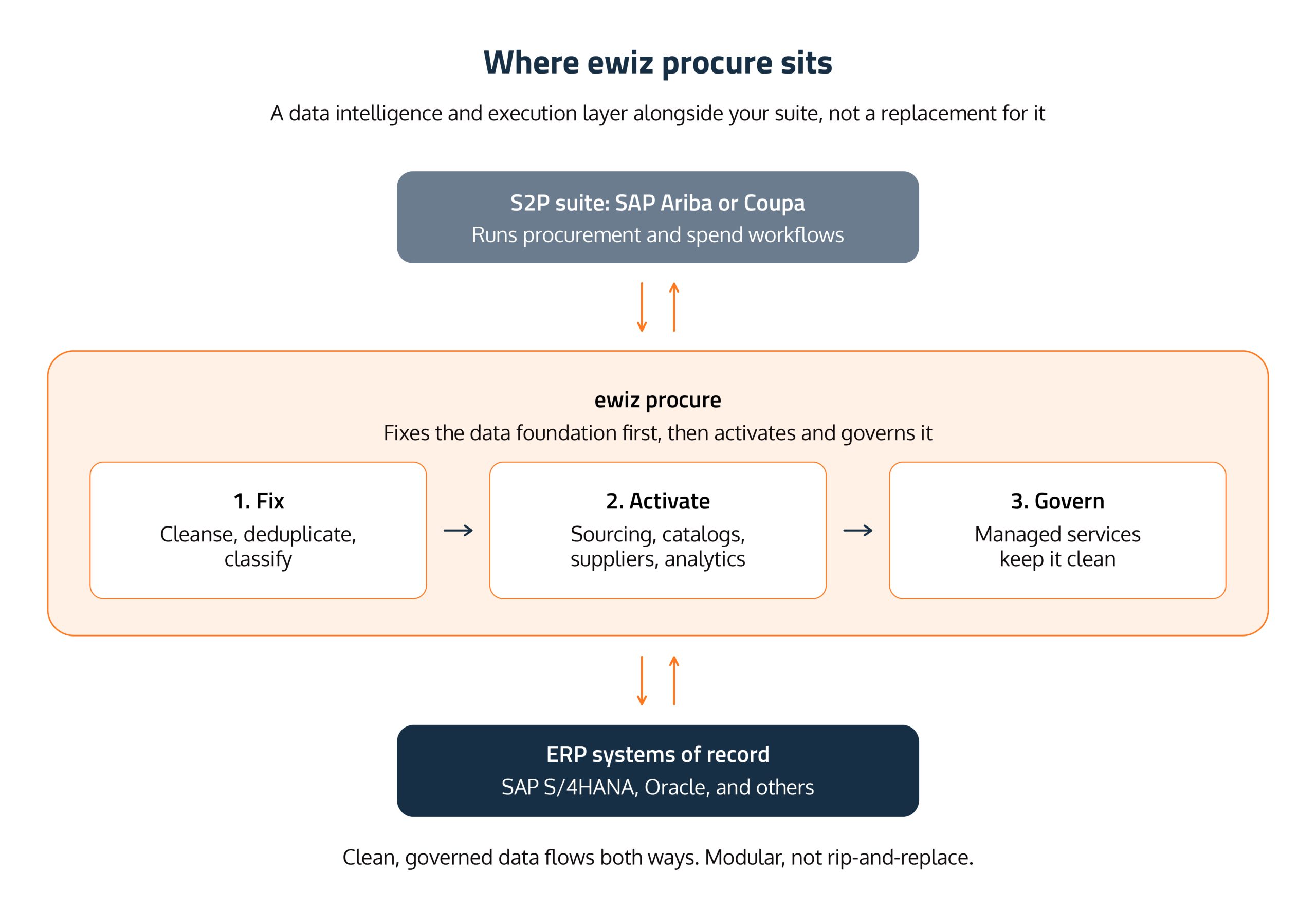
Most procurement technology assumes the data is clean. ewiz procure fixes it first.
The nine gaps above persist through upgrades, re-implementations, and vendor switches because they are data problems, and source-to-pay suites are not built to solve data problems. SAP Ariba and Coupa help enterprises run procurement and spend workflows.
ewiz procure helps procurement teams fix the data foundation, activate it across sourcing, catalogs, suppliers, and analytics, and keep it governed through managed services. It is not a replacement for either suite. It is a procurement intelligence and execution layer that sits alongside your ERP and your S2P system, modular by design, not rip-and-replace, and it integrates with SAP, Oracle, Coupa, and other platforms without disrupting them.
| Common gap | What it looks like in practice | How ewiz procure helps |
| Poor supplier master data | Duplicate suppliers, inconsistent naming, missing tax/compliance fields, fragmented supplier records across systems. | Cleanses, normalizes, enriches, and governs supplier records so sourcing, onboarding, compliance, and analytics work on trusted data. |
| Stale or fragmented catalogs | Catalogs go live once but are not maintained; users cannot find the right items; non-catalog buying continues. | Structures, enriches, and maintains procurement catalogs with clean SKU data, taxonomy, supplier mapping, and ongoing catalog governance. |
| Manual RFQs and sourcing events | Buyers still manage RFQs through email, spreadsheets, and manual quote comparisons despite having an S2P platform. | Supports structured RFx, eAuctions, supplier comparisons, audit trails, and sourcing workflows for faster, more transparent sourcing execution. |
| Low buyer adoption | Business users bypass the system because buying workflows feel complex, slow, or disconnected from their day-to-day needs. | Improves guided buying, catalog usability, PR-to-PO workflows, supplier availability, and adoption support so users transact through governed channels. |
| Supplier onboarding bottlenecks | Suppliers delay registration, miss documents, fail compliance checks, or need manual follow-ups from procurement teams. | Provides supplier onboarding support, document governance, supplier profile management, validation, and managed follow-ups. |
| Weak indirect and tail-spend visibility | Spend is buried under generic categories, one-time suppliers, free-text descriptions, and inconsistent cost classifications. | Cleanses and classifies spend, maps taxonomy, standardizes categories, and improves visibility into unmanaged and tail-spend categories. |
| Custom workflow gaps | Standard S2P workflows do not fully match local approval rules, plant-level buying, category-specific sourcing, compliance steps, or regional business exceptions. | Builds modular, procurement-specific workflows for PR-to-PO, sourcing, eAuctions, supplier onboarding, catalog governance, and analytics while working alongside the existing ERP or S2P stack. |
| Analytics that leadership cannot fully trust | Dashboards exist, but finance, category, and procurement teams question the numbers because the underlying data is inconsistent. | Improves the data foundation through cleansing, harmonization, taxonomy mapping, and governed analytics so reporting becomes decision-ready. |
| AI readiness gaps | AI initiatives stall because supplier, item, category, contract, and spend data are incomplete, unstructured, or poorly governed. | Creates AI-ready procurement data through classification, enrichment, standardization, governance rules, and human-validated quality assurance. |
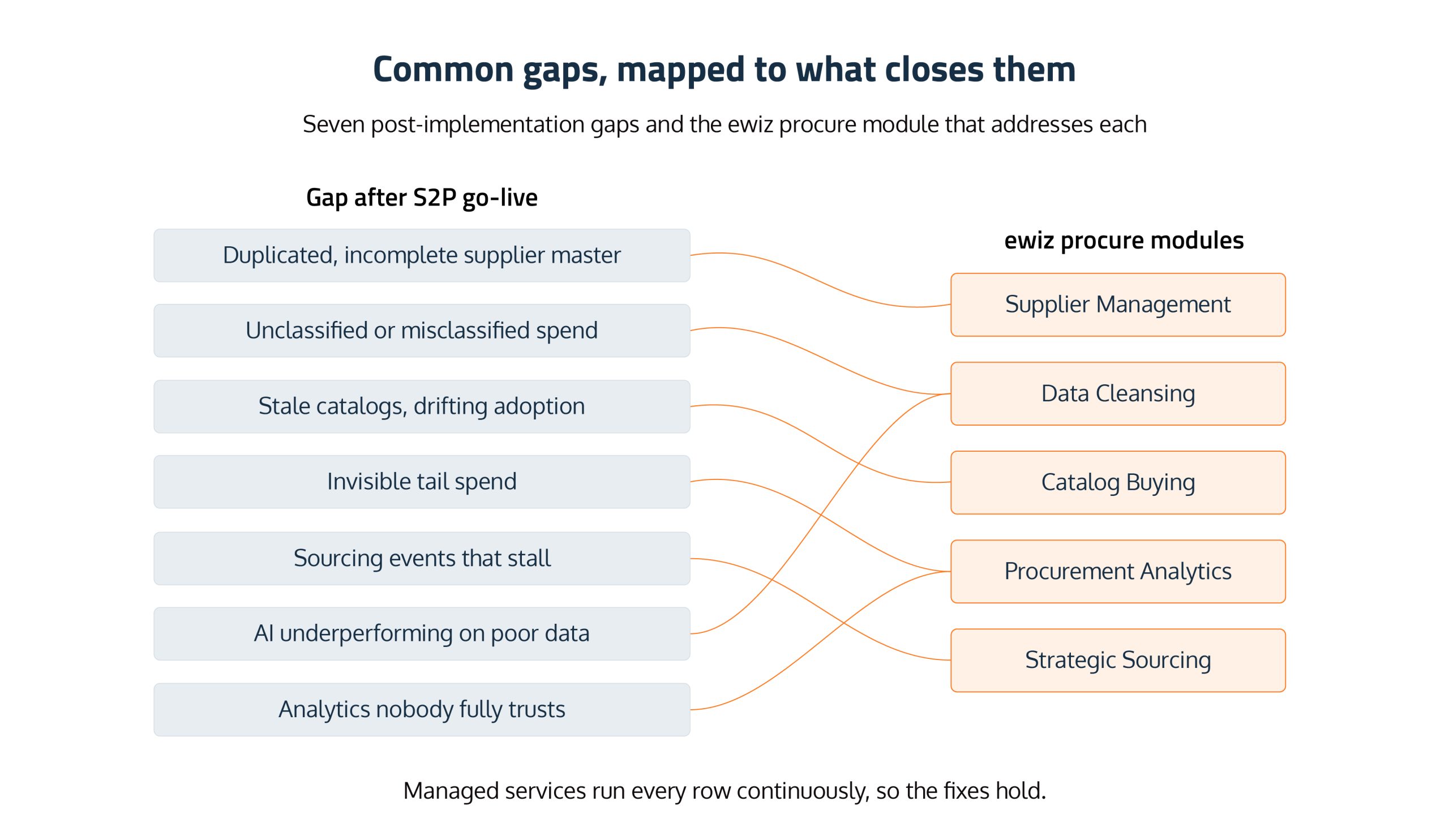
The managed-services model is what makes each row durable: cleansing, classification, catalog maintenance, supplier onboarding, governance, and reporting are run by people who do it for a living, not left as a task your team never gets to.
All this, without disrupting your Coupa or SAP environment.
The operating sequence: Fix, Activate, Govern
The order matters more than the tooling.
- Fix. Deduplicate and enrich the supplier master, classify the spend, structure the catalogs. This is the foundation both suites assume already exists.
- Activate. Put the clean data to work across sourcing events, catalog buying, supplier programmes, and analytics, inside and alongside your existing suite.
- Govern. Keep it clean through managed services, because procurement data decays; supplier details change, catalogs age, and new spend arrives unclassified every month.
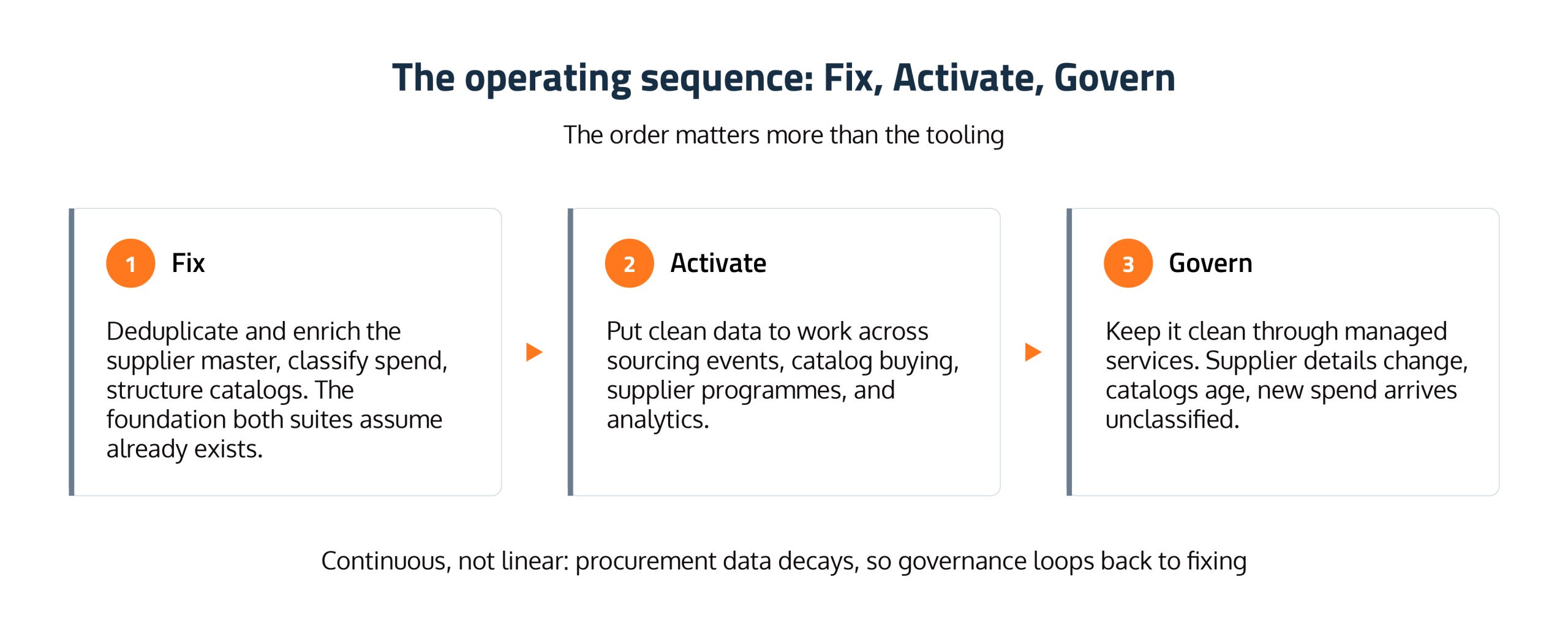
That is the order in which procurement data actually starts to pay off, whichever suite you run on top of it.
What this looks like in practice
Rather than replacing SAP Ariba or Coupa, ewiz procure strengthens the data, workflows, supplier operations, and adoption around them.
For a global beverage leader using Coupa, ewiz procure standardized and enriched 8,496 SKUs across 274 catalogs, mapped 65%+ of SKUs to manufacturer data, simplified 70%+ of product descriptions, identified 22% previously uncategorized spend, and delivered 100% indirect-spend visibility across key suppliers. The enriched catalogs were then uploaded directly into Coupa, improving the quality and usability of the existing platform.
Read detailed case study: Global Beverage Case Study
For a global merchandise company operating across Coupa and SAP Ariba environments, ewiz procure deployed 120+ sourcing portals, standardized 28,000+ SKUs, and supported 1.5 million+ transactions annually across 15+ countries, 15+ languages, and 10+ currencies. Punchout integrations connected governed catalogs, supplier data, inventory, and localized buying experiences to the client’s existing procurement stack.
Read detailed case study: Global Merchandise Case Study
For a global FMCG major with Coupa at the core of its procurement ecosystem, ewiz procure supported $900 million in indirect spend over seven years across 50+ countries, onboarded 5,000+ suppliers, trained 1,000+ users, maintained 3,000+ active products, and handled 10,000 support conversations annually. Coupa remained the transaction platform, while ewiz procure added curated catalogs, supplier onboarding, integrations, analytics, and managed services for indirect spend to drive scale and adoption.
Read detailed case study: FMCG Case Study
(Figures are anonymized and NDA-bound estimates from the engagement record.)
What ewiz procure is not
ewiz procure is not a source-to-pay suite and does not aspire to be one; if you need enterprise-wide P2P workflows, buy Ariba or Coupa. It is not an ERP or a system of record for finance. And it is not a one-time cleanup project, because data cleaned once and left alone is dirty again within a year or two; the governance layer is the point, not an add-on.
Want to know how ewiz procure can work with SAP Ariba or Coupa?
Shortlisted one already? Or are you already using SAP Ariba or Coupa, but still facing gaps in procurement data, catalogs, supplier onboarding, sourcing workflows, PR-to-PO, eAuctions, or analytics?
ewiz procure can work alongside your existing platform to address these operational gaps without replacing your core S2P or ERP environment.
Speak to us for a free discovery chat to explore where ewiz procure can complement your current procurement stack.
SAP Ariba vs Coupa: Which eProcurement direction fits your business situation?
| Your business situation | Recommended direction |
| You run SAP S/4HANA or SAP ERP and want close integration with your existing SAP landscape | Prioritize SAP Ariba. It is likely to offer the strongest architectural fit for SAP-led procurement transformation. Before implementation, assess supplier, item, catalog, category, and approval data readiness so the platform is not forced to operate on inconsistent master data. |
| You operate a mixed or non-SAP ERP estate and want one spend-management layer across procurement and finance | Prioritize Coupa. It may be a stronger fit where cross-ERP spend visibility, guided buying, and finance-procurement alignment matter. Plan supplier onboarding, catalog preparation, integration design, and change management as separate workstreams. |
| Ease of use and broad adoption with limited training are decisive | Evaluate Coupa strongly. Its user experience is often a key part of its market positioning. Still test the platform with real requisitioners, approvers, category managers, suppliers, and procurement power users before deciding. |
| Direct materials, production-linked procurement, and supplier collaboration dominate | Evaluate SAP Ariba first, particularly in an SAP-led environment. Also compare Ivalua, JAGGAER, and other suites with strong direct-material and manufacturing workflows before finalizing the shortlist. |
| You need public-sector or regulated-cloud compliance requirements such as FedRAMP Moderate | Evaluate Coupa and other vendors with the required current certifications. Verify the exact certification scope, deployment environment, geography, and modules directly with each vendor before treating compliance as a deciding factor. |
| Your main bottleneck is duplicated supplier masters, stale catalogs, inconsistent item descriptions, or unclassified spend | Add ewiz procure alongside the selected ERP or S2P suite. Start by cleansing, classifying, enriching, and governing procurement data so sourcing, catalogs, suppliers, analytics, and AI workflows operate on a reliable foundation. |
| You already have SAP Ariba, Coupa, or another suite, but adoption, tail spend, sourcing execution, or analytics trust remain weak | Use ewiz procure as a modular execution and governance layer. It can support catalog management, PR-to-PO workflows, RFx and eAuctions, supplier onboarding, data governance, and procurement analytics without replacing the core platform. |
| Standard platform workflows do not reflect regional, plant-level, category-specific, or compliance-driven processes | Keep the core suite and add targeted custom workflows. ewiz procure can support configurable workflows across PR-to-PO, sourcing, eAuctions, catalogs, supplier management, and approvals while working alongside the existing stack. |
| You need procurement automation but do not require a full enterprise S2P transformation | Evaluate modular and mid-market eProcurement tools. Compare Procurify, Precoro, Kissflow Procurement, ProcureDesk, ProcurementExpress.com, and ewiz procure based on the specific problem being solved, rather than suite breadth. |
| You are early in the evaluation and are not yet sure which category or platform fits | Do not start with vendor demos. First complete a need assessment study covering business processes, spend categories, ERP landscape, supplier base, data quality, integration needs, compliance, adoption, and target outcomes. You may find that one or two modules solve the immediate problem more effectively than a full-suite implementation. |
Mid-market alternatives for SAP Ariba and Coupa
This tier rates higher than Ariba or Coupa on user satisfaction and publishes real prices. Both facts are true and both are relevant.
| Vendor | G2 | Capterra | Published entry price | Implementation claim | Enterprise ERP (SAP / Oracle) |
| Precoro | 4.7 / 211 | 4.8 / 255 | $499/mo (Core) | 2–8 weeks | No |
| Ewiz procure | No G2 product listing | 4.7/7 | $400/month | 1 week | Yes |
| Procurify | 4.6 / 394 | 4.6 / 203 | Quote only | 4–12 weeks | No |
| ProcurementExpress.com | 4.7 / 61 | 4.7 / 423 | $415/mo (≤$10k monthly spend) | Not published | No |
| Fraxion | 4.3 / 65 | 4.4 / 130 | Quote only | 1–3 months (category claim) | No |
| ProcureDesk | 4.4 / 40 | 4.8 / 38 | $498/mo (10 users) | 2–4 weeks | No |
| Tradogram | 4.2 / 35 | 4.5 / 109 | $99/mo (from) | Not published | No |
| Kissflow Procurement Cloud | No G2 product listing | 4.2 / 88 | Not published by vendor | “Weeks rather than quarters” | NetSuite only |
What the ratings don’t tell you
Every vendor above scores higher on G2 than SAP Ariba (4.1) or Coupa (4.2). That’s a real signal about requisition-to-PO usability, and a misleading one about enterprise fit.
These ratings reflect SAP Ariba and Coupa’s complete S2P (Source-to-Pay) module, so you can’t directly compare them to point solutions. Each tool serves a different scope, operates in a different category, offers different capabilities, and caters to a different market.
Before making a decision, evaluate each solution against the specific capabilities you need.
Final recommendation
There is no single best procurement platform. There is the platform that fits your ERP estate, your operating model, your spend mix, and your users. If you are SAP-centric with heavy direct materials, SAP Ariba’s native integration and supplier network make it hard to beat. If you run a mixed ERP estate and value usability and unified spend, Coupa’s ERP-agnostic design and adoption advantage put it ahead. Both are mature, capable, and well-rated; both require a multi-month programme; and both will under-deliver on the same condition: that the procurement data underneath them is not clean, structured, and governed.
That is the part most comparisons skip. Whichever suite you choose, the data foundation determines whether it pays off. Fix that first, activate it across sourcing, catalogs, suppliers, and analytics, and keep it governed, and the platform you chose finally does what the business case promised.
Speak to us: If your real bottleneck is procurement data (messy supplier masters, fragmented catalogs, unclassified spend, low adoption, or analytics you do not fully trust), that is exactly where ewiz procure helps, alongside Ariba or Coupa, not instead of them.
Sources:
| # | URL |
| S1 | https://sap.com/products/spend-management/procure-to-pay.html |
| S2 | https://sap.com/products/spend-management/centralized-procurement.html |
| S3 | https://www.coupa.com/https://www.coupa.com/products/procure-to-pay/ |
| S4 | https://www.ibm.com/think/topics/sap-ariba |
| S5 | https://www.rapidviews.io/en/blog/sap-ariba-en/sap-ariba-module-overview |
| S6 | https://www.coupa.com/ |
| S7 | https://www.coupa.com/products/procure-to-pay/procurement/ |
| S8 | https://www.coupa.com/products/procure-to-pay/ |
| S9 | https://coupa.com/products/procure-to-pay/services-procurement/ |
| S10 | https://en.wikipedia.org/wiki/Coupa |
| S11 | https://www.coupa.com/newsroom/coupas-newest-release-expands-agentic-ai-collaboration-and-orchestration-capabilities/ |
| S12 | https://service-2.ariba.com/Supplier.aw/ad/eduPortalDoc?key=MTAyMjY5fGJDM1Q5NjNmZTQ1Mjh5eDk1NTd4NDIz |
| S13 | https://www.g2.com/products/sap-ariba/reviews |
| S14 | https://g2.com/products/coupa-software-coupa/reviews |
| S15 | https://www.g2.com/compare/coupa-software-coupa-vs-sap-ariba |
| S16 | https://g2.com/products/sap-ariba/reviews?qs=pros-and-cons |
| S17 | https://www.capterra.com/p/227334/SAP-Ariba/reviews/ |
| S18 | https://www.capterra.com/p/115928/Coupa/ |
| S19 | https://gartner.com/reviews/market/source-to-pay-suites/compare/coupa-vs-sap |
| S20 | https://gartner.com/reviews/market/source-to-pay-suites |
| S21 | https://www.trustradius.com/products/sap-ariba/reviews/all |
| S22 | https://trustradius.com/products/coupa/reviews/all |
| S23 | https://www.sap.com/products/spend-management/ariba-sourcing/pricing.html |
| S24 | https://blog.teem.finance/product-comparison-report-sapariba-vs-coupa/ |
| S25 | https://help.sap.com/docs/sisgw/sap-ariba-cloud-integration-gateway-installation-guide/overview-of-integrating-sap-erp-or-sap-s-4hana-with-sap-ariba-solutions-using-sap-integration-suite-managed-gateway-for-spend-management-and-sap-business-network |
| S26 | https://www.coupa.com/contact-us/ |
| S27 | https://community.sap.com/t5/spend-management-blog-posts-by-sap/sap-ariba-integration-scenarios-with-sap-s-4hana-public-cloud-system/ba-p/13665100 |
| S28 | https://www.pivotapp.ai/blog/top-7-coupa-alternatives-to-explore-in-2026 |
| S29 | https://www.g2.com/products/coupa-software-coupa/reviews/coupa-review-9747302 |
| S30 | https://zip.com/compare/coupa-vs-sap-ariba |
| S31 | https://procuredesk.com/ariba-vs-coupa-procurement/ |
| S32 | https://www.sap.com/products/spend-management/direct-procurement-software.html |
| S33 | https://www.sap.com/industries/chemicals.html |
| S34 | https://www.gartner.com/reviews/product/sap-ariba |
| S35 | https://powerweave.storylane.io/share/sraj6w4eaqa0 |
| S36 | https://www.powerweave.com/ |
| S37 | https://www.prnewswire.com/news-releases/g2-to-acquire-capterra-software-advice-and-getapp-from-gartner-302673901.html |
| S38 | https://www.ibm.com/think/topics/sap-ariba |
| S39 | https://community.sap.com/t5/spend-management-blog-posts-by-sap/go-live-with-your-sap-ariba-solutions-in-10-weeks/ba-p/13452736 |
| S40 | https://www.sap.com/products/business-network.html |
| S41 | https://www.icertis.com/company/news/icertis-expands-partnership-with-sap-to-bring-ai-native-contract-intelligence-to-public-sector-and-government-contractors/ |
| S42 | https://www.businesswire.com/news/home/20250520049431/en/Icertis-and-SAP-Deepen-Partnership-to-Accelerate-Time-to-Value-with-AI-Powered-Contract-Intelligence |
| S43 | https://www.coupa.com/newsroom/new-ai-driven-features-from-coupa-power-supplier-collaboration-and-streamline-business-operations/ |
| S44 | https://help.sap.com/docs/CENTRAL_INVOICE_MANAGEMENT/2d22ad0ea68d496fb12869ecf4761972/01a6fdbb9d90465090bb15c3deb6628c.html |
| S45 | https://www.sap.com/products/financial-management/travel-and-expense-management.html |
| S46 | https://www.sap.com/products/hcm/contingent-workforce-management.html |
| S47 | https://ai.coupa.com/ |
| S48 | https://www.sap.com/documents/2025/06/d660469d-0b7f-0010-bca6-c68f7e60039b.html |
| S49 | https://www.sap.com/documents/2025/06/7c259e73-0e7f-0010-bca6-c68f7e60039b.html |
| S50 | https://www.coupa.com/compliance-security/ |
| S51 | https://coupa.com/resources/from-sap-to-coupa-a-seamless-transition-for-better-scalability/ |
