
You don’t need to replace your ERP to modernize sourcing, you need to fix the fragmented work happening around it. A company can run a leading ERP and still have a largely manual sourcing process, because the ERP captures the requisition and the purchase order well, but the work in between, rfqs, supplier responses, bid comparison, approvals, often still depends on emails, spreadsheets, calls, and manual follow-ups.
This sounds contradictory, but it’s common in complex procurement environments. The problem isn’t the ERP. It’s the gap around it.
Key takeaways:
- On paper, sourcing looks like PR → Sourcing → PO. In practice, it often looks like ERP → Email → Suppliers → Email → Excel → Approvals → ERP.
- Simplifying sourcing and procurement processes can increase transformation success by 42% (Gartner), while conventional approaches are 26% more likely to hit complexity.
- A real-world SAP deployment cut PR-to-PO activity from 141 minutes to 19 minutes, and supplier onboarding from ~79 hours to 3.6 hours — without replacing the ERP.
- The fix follows a simple progression: Clean → Govern → Activate → Measure your procurement data, then modernize the sourcing layer around the ERP.
The problem: A strong ERP doesn’t guarantee a modern sourcing process
The requisition is already digital. The purchase order is eventually digital. But the work between those two points can still depend on emails, spreadsheets, calls, and manual follow-ups.
The ERP does exactly what it was designed to do. But friction still happens around it.
On paper, the process looks simple:
PR → Sourcing → PO
But the sourcing work in between can still look like:
ERP → Email → Suppliers → Email → Excel → Approvals → ERP
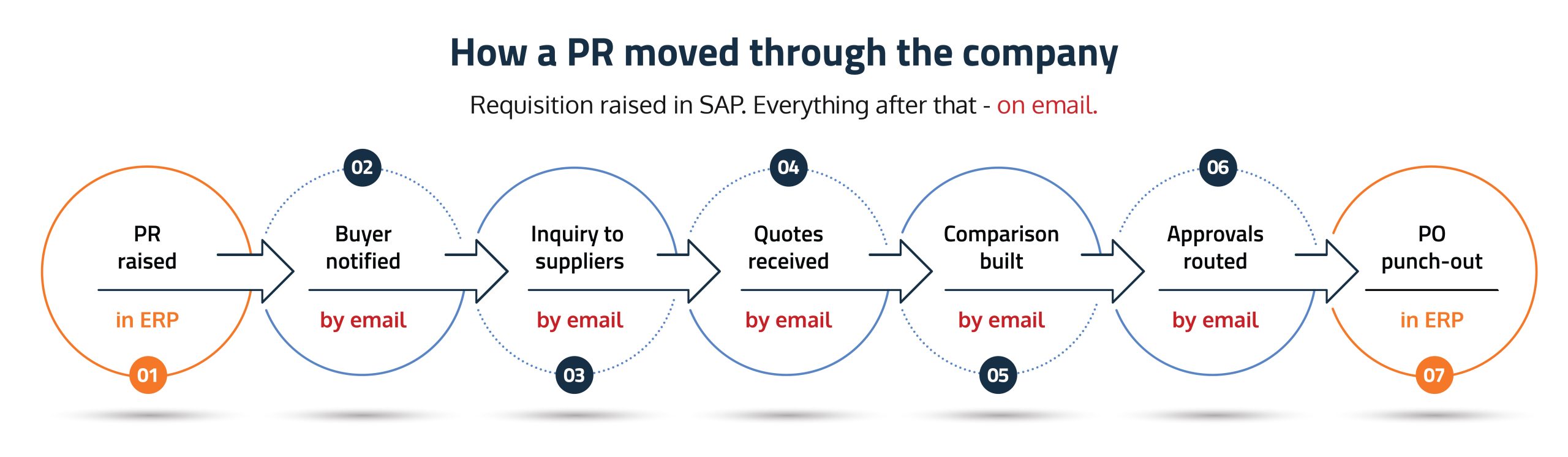
The ERP captures the transaction. The sourcing work around it remains fragmented.
Each step may feel manageable in isolation. Across a large enterprise, however, the same work is repeated across buyers, categories, suppliers, business units, and locations.
The problem isn’t the ERP – It’s the gap around it
An ERP can be a strong transactional backbone and still leave sourcing teams working across disconnected tools.
- A buyer may start with a requisition in the ERP
- Then the sourcing process moves somewhere else
- The RFQ may be created through email
- Supplier responses arrive in different formats
- Quotes are consolidated in Excel
- Comparisons happen manually
- Approvals move through emai
And once the sourcing decision is made, the transaction returns to the ERP
Nothing is necessarily broken. But the process is fragmented.
That creates several problems:
- Sourcing cycles take longer than they need to
- Buyer capacity gets consumed by coordination
- Supplier competition is harder to manage consistently
- Price discovery becomes dependent on individual experience
- Historical sourcing information is difficult to reuse
- Audit trails become harder to reconstruct
The question is therefore not: “Does the enterprise have an ERP?”
It is: “How much sourcing work still happens outside it?”
What does this friction actually cost?
Consider an enterprise running 300 competitive sourcing events a year.
If manual coordination, response consolidation, comparison, and approvals consume just two avoidable buyer hours per event, that represents 600 hours of procurement capacity released annually. At a fully loaded cost of ₹1,500 per hour, that is approximately ₹9 lakh of procurement capacity.
But process efficiency is only one part of the opportunity.
Suppose ₹100 crore of spend passes through competitive sourcing. Even a small improvement in price discovery, supplier competition, or negotiation outcomes can create meaningful value:
| Improvement | Potential Value |
| 0.25% | ₹25 lakh |
| 0.50% | ₹50 lakh |
| 1.00% | ₹1 crore |
The business case for sourcing modernization therefore should not be judged only by software cost. It should consider:
- Buyer capacity
- Sourcing cycle time
- Supplier competition
- Price discovery
- Governance
- Quality of sourcing decisions
- Data quality
The opportunity is not simply to digitize another procurement step. It is to make the sourcing process itself more productive.
Why does this matter now?
The instinct with procurement transformation is often to think bigger, more modules, more processes, more change at once.
But complexity itself can become a transformation risk.
Gartner reports that organizations following conventional procurement processes are 26% more likely to encounter complexity in transformation efforts, while simplifying sourcing and procurement processes can increase transformation success by 42%.
That points to a simpler approach: you do not need to transform everything. You need to fix the friction where it matters.
What this looks like in practice
Consider a large, multi-business enterprise using a leading ERP as its transactional backbone.
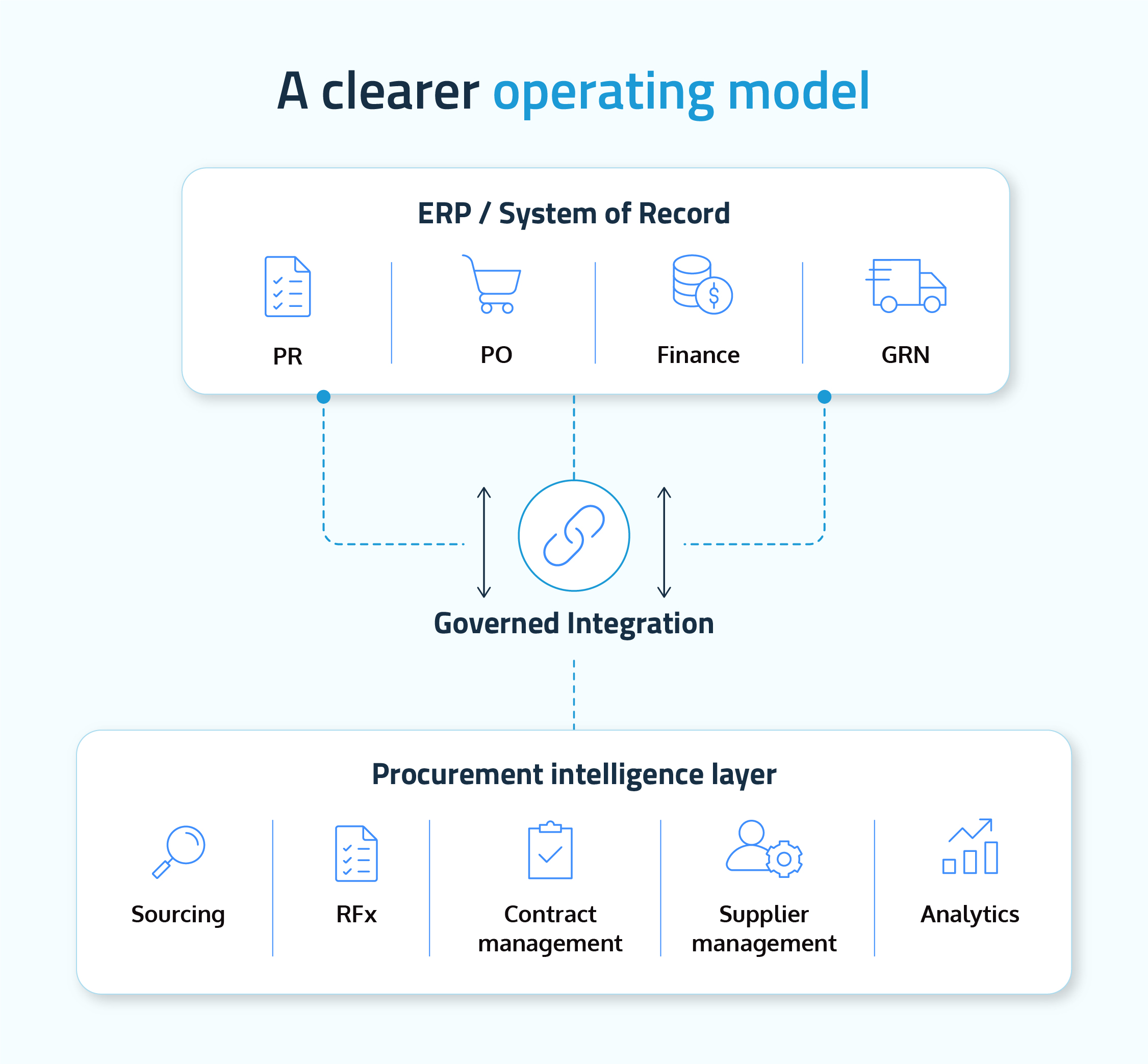
The ERP already manages:
- Purchase requisitions
- Purchase orders
- Goods receipts
- Finance
- Enterprise controls
But procurement still has to:
- Turn requirements into competitive rfqs
- Engage suppliers
- Collect technical and commercial responses
- Run auctions where appropriate
- Compare bids
- Route decisions for approval
- Onboard suppliers
- Retain pricing and award history
If much of that activity still happens through inboxes, spreadsheets, and manual coordination, replacing a functioning ERP solves the problem at the wrong layer.
Keep the ERP at the core. Modernize the sourcing and supplier layer around it.
That creates a clearer operating model: the ERP continues to provide the transactional backbone, while the procurement layer manages the sourcing and supplier work that needs greater speed, collaboration, visibility, and control. Because the ERP stays in place, the enterprise does not need to redesign its core or move every procurement process before improving sourcing.
One condition: Don’t automate bad procurement data
Another issue is easy to overlook. A digital workflow will not produce better decisions if the data underneath it cannot be trusted.
- Duplicate supplier records
- Inconsistent categories
- Incomplete supplier profiles
- Fragmented pricing history
These issues make sourcing harder to compare and harder to learn from.
That is why sourcing modernization should follow a simple progression:
Clean → Govern → Activate → Measure
At ewiz procure, the starting point is the procurement data underneath the workflow. Then that data is activated across sourcing and suppliers, and kept governed after go-live.
How ewiz procure Fixes This: 4 Connected Areas
1. Move RFQs from manual coordination to structured sourcing
Rfqs should not depend on inboxes, spreadsheets, and repeated supplier follow-ups.
A structured sourcing workflow can bring rfx creation, supplier engagement, response collection, and evaluation into one governed process. That gives buyers greater visibility into where an event stands and reduces the coordination work around every sourcing event.
2. Move bid comparison from spreadsheets to structured evaluation
Supplier responses are easier to evaluate when they are captured in a consistent structure.
Instead of manually consolidating quotes in Excel, buyers can compare supplier responses through a structured evaluation process. That means faster decisions, and more importantly, more defensible decisions.
3. Move supplier engagement and auctions into the sourcing workflow
Supplier participation should be part of the sourcing process rather than another disconnected activity.
Etendering, supplier engagement, and reverse auctions can help procurement create greater competition and better price discovery where appropriate. The goal is not simply to run more events. It is to get more value from the events already being run.
4. Turn sourcing activity into procurement intelligence
Every sourcing event creates information: supplier responses, quoted prices, award decisions, negotiation outcomes, and supplier participation.
But when this information remains scattered across emails and spreadsheets, it is difficult to use again. A structured sourcing layer creates the foundation for:
- Historical price visibility
- Supplier comparison
- Sourcing analytics
- Savings tracking
- Better negotiation intelligence
- Stronger auditability
The sourcing event should not end when the PO is created. It should create intelligence for the next sourcing decision.
The real shift: From ERP replacement to ERP coexistence
This is not about replacing the ERP with another procurement system. It is about changing what happens around the ERP.
| From | To |
| ERP transaction | Connected sourcing workflow |
| Manual rfqs | Structured rfx |
| Excel comparison | Guided evaluation |
| Manual auctions | Digital eauction |
| Supplier follow-ups | Supplier engagement |
| Historical data | Sourcing intelligence |
| ERP replacement | ERP coexistence |
For procurement leaders, the value is simple:
- Less time spent coordinating sourcing events
- Faster sourcing cycles
- Better supplier competition
- Faster and more defensible decisions
- Better price discovery
- Greater visibility into sourcing history
- More structured procurement data
Because the goal of sourcing modernization is not to create another system. It is to make the sourcing process around the system work better.
Your ERP should continue to do what it does well. Your sourcing process should do more than it does today.
What the numbers look like after digital transformation
In one ewiz procure deployment for a global manufacturing enterprise, SAP remained the core ERP while the sourcing process around it was digitized.
Before: PR in SAP → Supplier inquiry by email → Quotes by email → Word/Excel comparison → Approvals by email → PO in SAP
After: PR information synchronized into ewiz procure → RFx → Supplier responses → Comparison → Approvals → PO back to SAP
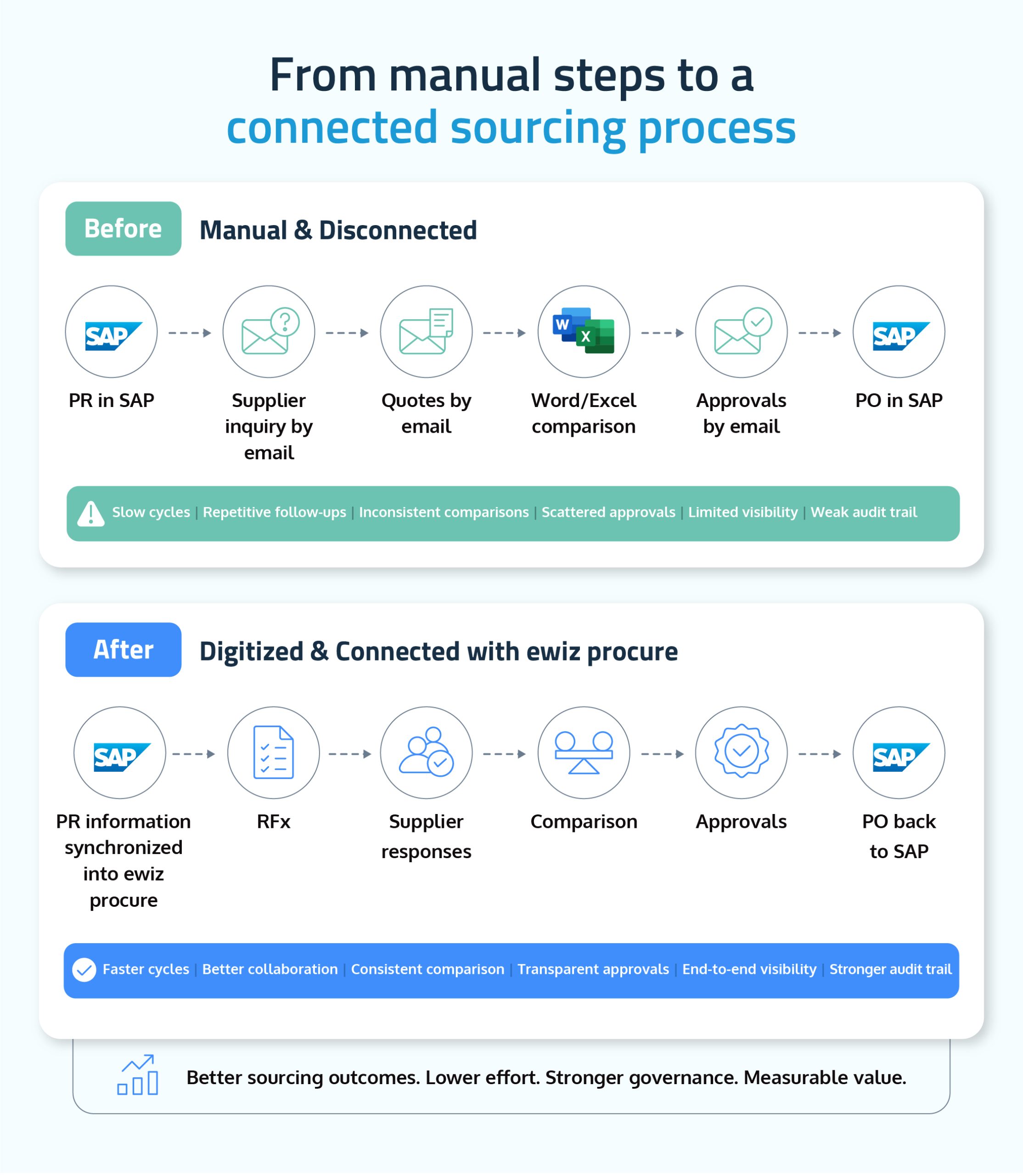
The ERP stayed in place. There was no ERP disruption.
- Measured PR-to-PO activity reduced from 141 minutes to 19 minutes per requisition — more than two hours saved per cycle.
- Supplier onboarding reduced from approximately 79 hours to 3.6 hours per supplier, covering document collection, verification, approvals, and follow-ups.
The ERP stayed. The friction around it changed.
Where to start: Measure before you transform
A wider transformation does not need to be the first step.
Start with one meaningful sourcing workflow. Take a recent sourcing event and trace it from requisition to purchase order. Then ask:
- Where was the RFQ created?
- Where did supplier responses arrive?
- Where were bids compared?
- Where were sourcing approvals recorded?
- Could the buyer easily see previous pricing and award decisions?
Then measure the process:
| What to Measure | What to Compare |
| RFQ cycle time | Current process vs. Digitized workflow |
| Buyer effort per event | Hours spent coordinating, comparing, and following up |
| Supplier response rate | Participation and completion |
| Evaluation turnaround | Time from bid close to recommendation |
| Approval turnaround | Time and traceability |
| Supplier onboarding effort | Documents, validation, approvals, and follow-ups |
| Price discovery | Ability to compare and negotiate using structured history |
| Audit completeness | Whether the sourcing decision can be reconstructed end to end |
Run the process. Measure the result. Then decide whether to scale based on evidence. That gives procurement, finance, operations, and IT a clearer basis for the next decision.
The Question to Ask
The question isn’t simply: “Do we need a new procurement system?”
It is: “Where does our ERP stop and manual sourcing begin?”
If the answers span the ERP, inboxes, spreadsheets, and individual teams, another ERP transformation may not be the first thing you need.
Keep the system of record. Fix the friction around it. Prove the outcome. Then scale.
No rip-and-replace discussion. Just a practical conversation about where sourcing friction exists today, what can be digitized around your ERP, and where measurable value can be created first.
