
Procurement is investing heavily in AI, automation, and new systems right now. Almost all of that investment rides on one thing: the quality of the spend, supplier, contract, and catalog data these tools run on.
When data is fragmented, stale, or duplicated, the cost is quiet but real; savings missed, compliance slipping, sourcing decisions slowed, migrations that overrun. And it isn’t only an AI problem. Every sourcing event, catalogue, supplier onboarding, and dashboard draws on the same underlying records, so one weak foundation undercuts all of them at once.
To put it in real numbers, we measured how much procurement leaders actually trust their own data today, and how far that sits from what AI and modern systems demand.
A quick note before you read on: This is a small sample from a single summit, not a census, and self-assessments tend to run generous; people tick what they hope is true. If anything, real conditions across the industry are probably a little worse than what’s reported here, not better.
Who this is for
- CPOs and procurement directors weighing an AI, automation, or system investment
- Sourcing and category managers responsible for spend visibility and supplier performance
- Digital transformation and IT leaders scoping ERP, source-to-pay, or analytics upgrades
- Finance and operations leaders who rely on procurement data for forecasting and compliance
How we ran the procurement data trust survey
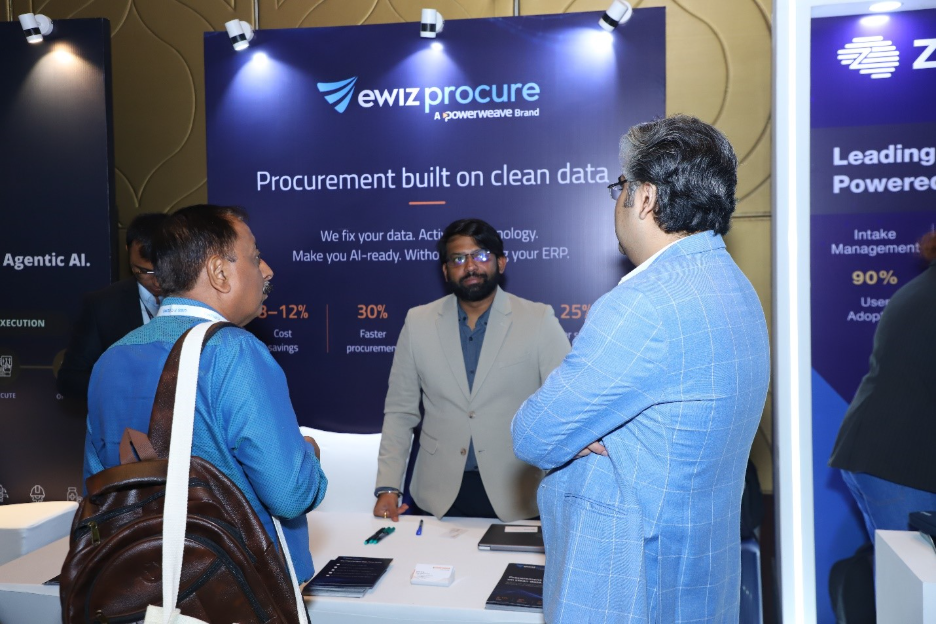
On 8 July 2026, at the Procurement Excellence Summit (The Westin, Gurgaon), ewiz procure’s team ran a quick exercise at our booth.
We invited senior procurement leaders to complete a five-statement data-trust scorecard, face to face, in about 60 seconds. Each statement checks one basic, verifiable sign of healthy procurement data. Respondents ticked only the statements that were true for their organization today.
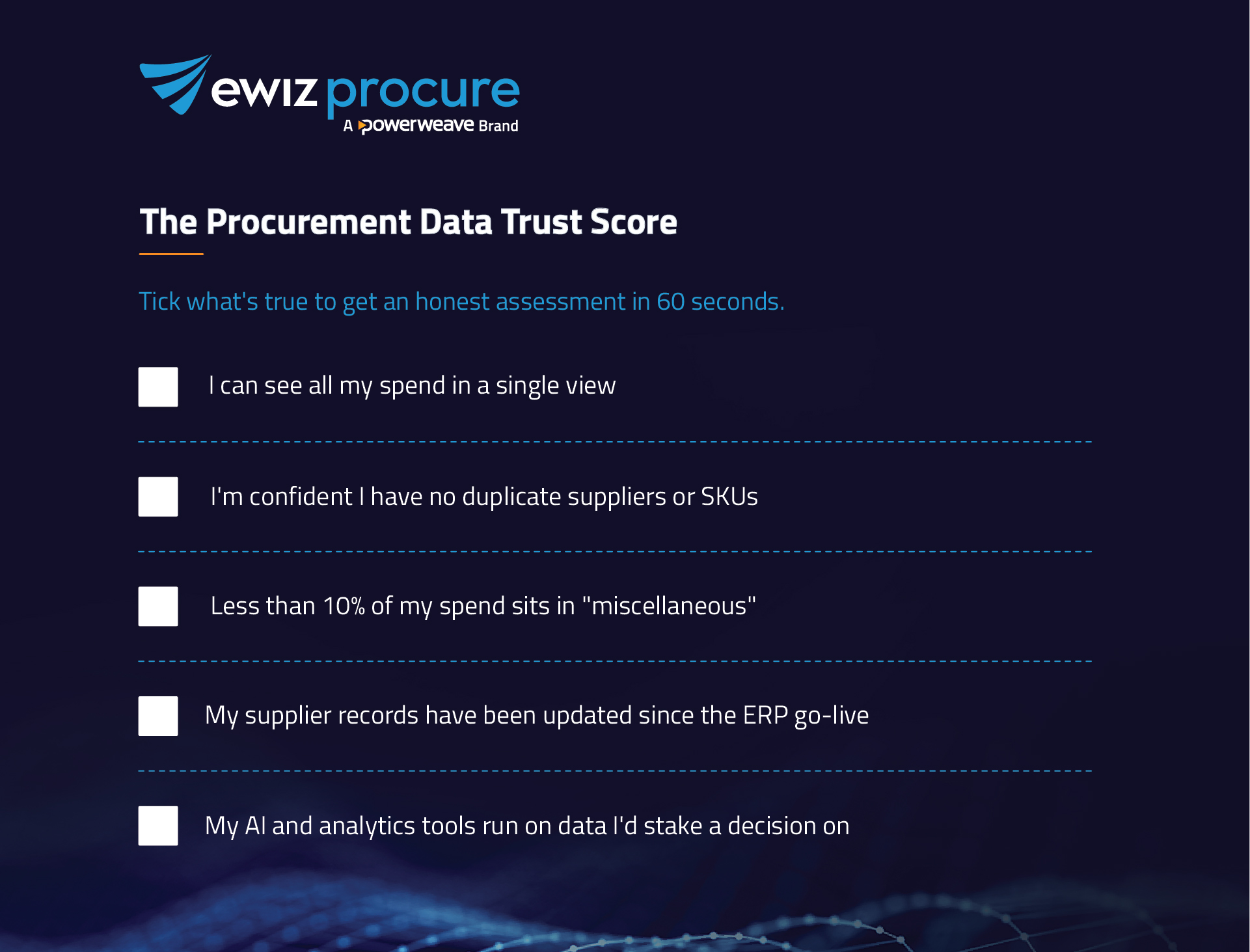
The five statements:
- I can see all my spend in a single view
- I’m confident I have no duplicate suppliers or SKUs
- Less than 10% of my spend sits in “miscellaneous”
- My supplier records have been updated since the ERP go-live
- My AI and analytics tools run on data I’d stake a decision on
We received honest inputs from 23 procurement professionals, heads of procurement, directors, general managers, and senior sourcing leaders, working across automotive components, energy and oil, telecom, consumer durables, chemicals and fertilizers, dairy, travel, real estate, lighting, medical devices, and technology services. All 23 scorecards were complete and are included in the analysis below.
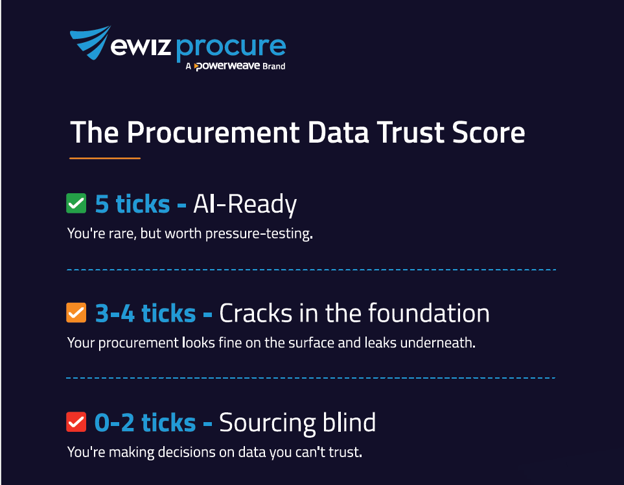
How we scored it: each confirmed statement earned one point, giving every organization a data-trust score from 0 to 5, grouped into three bands:
| Score | Band | What it means |
| 5 | ✅ AI-Ready | Rare — but worth pressure-testing |
| 3–4 | ⚠️ Cracks in the Foundation | Looks fine on the surface, leaks underneath |
| 0–2 | 🚩 Sourcing Blind | You’re making decisions on data you can’t trust |
What procurement leaders shared on their data status
As leaders read the five statements, the same reaction came up again and again:
“We deal with dirty, messy data all the time, and we can’t yet trust it blindly enough to decide on.”
Several had taken corrective action on one piece or another, a deduplication drive here, a classification project there. Almost none described a standing plan to fix their data and then keep it governed over time. That gap, between one-off clean-ups and sustained governance, runs through everything that follows.
What the procurement data trust scores reveal
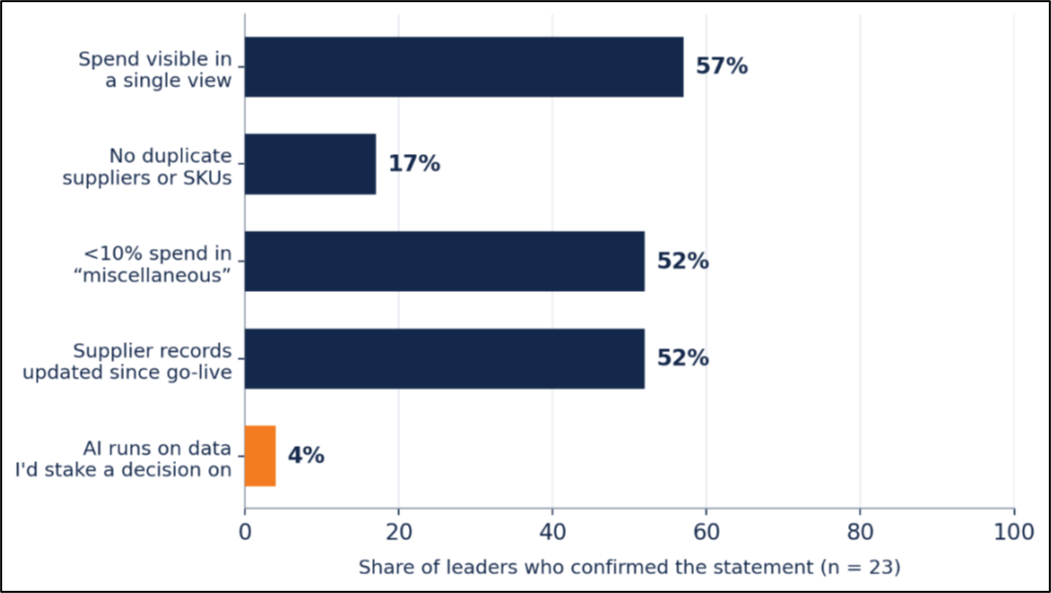
Across all 23 scorecards, five numbers capture where the room actually stands:
- 0% considered their procurement data AI-ready
- 83% couldn’t confidently rule out duplicate suppliers or SKUs
- 48% are still relying on supplier records last updated at ERP go-live
- 48% have more than 10% of their spend hidden under “Miscellaneous”
- 96% would not stake a decision on the data feeding their AI
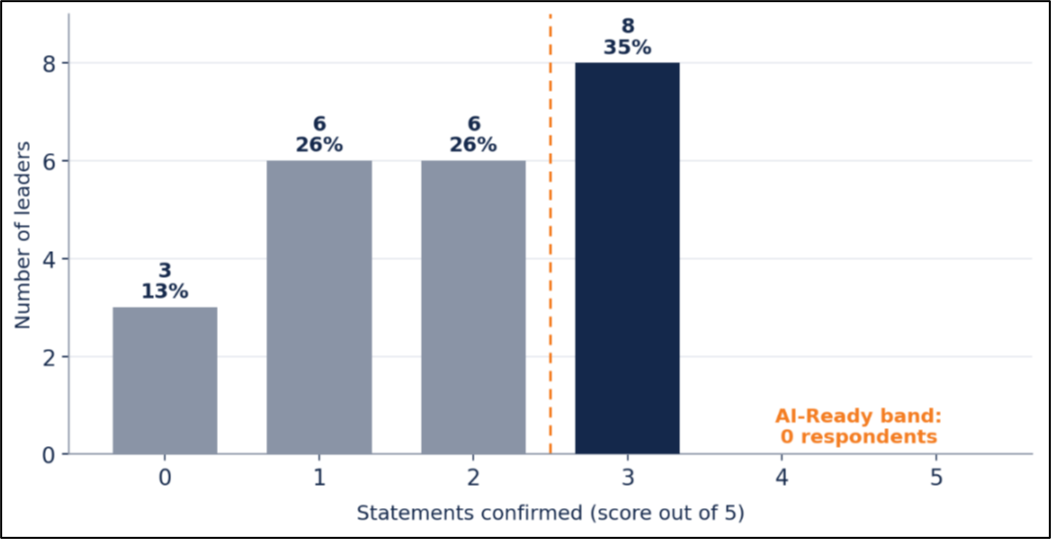
Not a single leader in the room scored a full 5/5. The most common outcome was 3 out of 5, “cracks in the foundation” territory, where procurement looks fine from the outside but is quietly compromised underneath.
The five pillars of procurement data health
Each statement maps to one pillar of data health, a single, checkable sign that data is fit to act on.
Pillar 1: Spend Visibility (43% struggling)
“I can see all my spend in a single view.”
This was the strongest result of the five, and it still means nearly half of senior leaders cannot produce one consolidated view of what their organization buys. Without that view, demand consolidation, the basis of every negotiating position, stays theoretical.
Pillar 2: Supplier & SKU Deduplication (83% struggling)
“I’m confident I have no duplicate suppliers or SKUs.”
More than four in five leaders could not rule this out. Duplication is the most universal and least visible defect in procurement data: it inflates supplier counts, splits purchase volumes, and hides the true price paid for the same item bought under different names.
Pillar 3: Spend Classification (48% struggling)
“Less than 10% of my spend sits in ‘miscellaneous.'”
Half the room conceded that a meaningful share of spend sits in a bucket nobody can source from. Unclassified spend can’t be tendered, benchmarked, or aggregated, it’s simply paid.
Pillar 4: Supplier Data Freshness (52% struggling)
“My supplier records have been updated since the ERP go-live.”
Half the leaders are deciding on records last validated at go-live, in some cases, years ago. Business records decay fast; left untouched, a supplier database is largely stale within about three years.
Pillar 5: Trust in Decision-Ready Data (96% struggling)
“My AI and analytics tools run on data I’d stake a decision on.”
One leader in twenty-three. Set against roughly nine in ten CPOs now investing in AI, this is the quiet reason so many pilots stall and so many transformations overrun. Technology is rarely what holds them back. The data underneath it is.
How our findings compare to published research
Our face-to-face findings line up closely with third-party research. This isn’t an isolated result from one booth; it’s the same gap, seen from a different angle.
| Our findings (n = 23) | Independent benchmark |
| 43% cannot produce a single view of spend | 30–50% of enterprise spend typically sits unmanaged or unclassified |
| 83% cannot rule out duplicate suppliers or SKUs | ~92% of organizations report duplicate records in their data |
| 48% have more than 10% of spend in “miscellaneous” | 50–70% of spend goes unclassified in a typical organization |
| 48% haven’t updated supplier records since ERP go-live | 60%+ of supplier records fall out of date within ~24 months |
| 96% would not stake a decision on the data feeding their AI | Only 4% of GenAI pilots reach scale, due to poor data quality |
Sources: Ardent Partners; Spend Matters; Dataversity; The Hackett Group; Deloitte 2024 Global CPO Survey
The takeaway: Procurement is buying new capability faster than it’s cleaning up what that capability runs on. AI, a new source-to-pay suite, an ERP migration; the story repeats each time. Fix the data first, or the investment underdelivers.
What’s causing these gaps in procurement
The five gaps aren’t five separate problems. They trace back to a handful of root causes we see in almost every procurement organization:
- No single source of truth: Spend and supplier data lives across multiple ERP instances, catalogues, and spreadsheets that never get reconciled.
- No governance at intake: Uncontrolled catalogues and unguided buying let new duplicates and unclassified spend in faster than anyone can clean them out.
- No owner for data hygiene: Deduplication and classification are treated as one-off clean-up projects rather than an ongoing responsibility.
- ERP go-live treated as the finish line: Supplier and catalogue data is validated once, at go-live, and rarely touched again.
- Technology layered too early: Analytics, AI, and new modules get switched on before the underlying data is fit to run them.
What low data trust actually costs
- Savings left on the table: Fragmented spend keeps negotiating leverage theoretical, and inconsistent catalogues push buyers off contract. Industry data puts the loss at 10–20% of targeted savings lost to maverick buying.
- Compliance erosion: Average contract compliance across enterprises sits at about 59.5%, against 74.9–91% among top performers. The gap comes from unguided buying and supplier data that has drifted from what the contracts actually say.
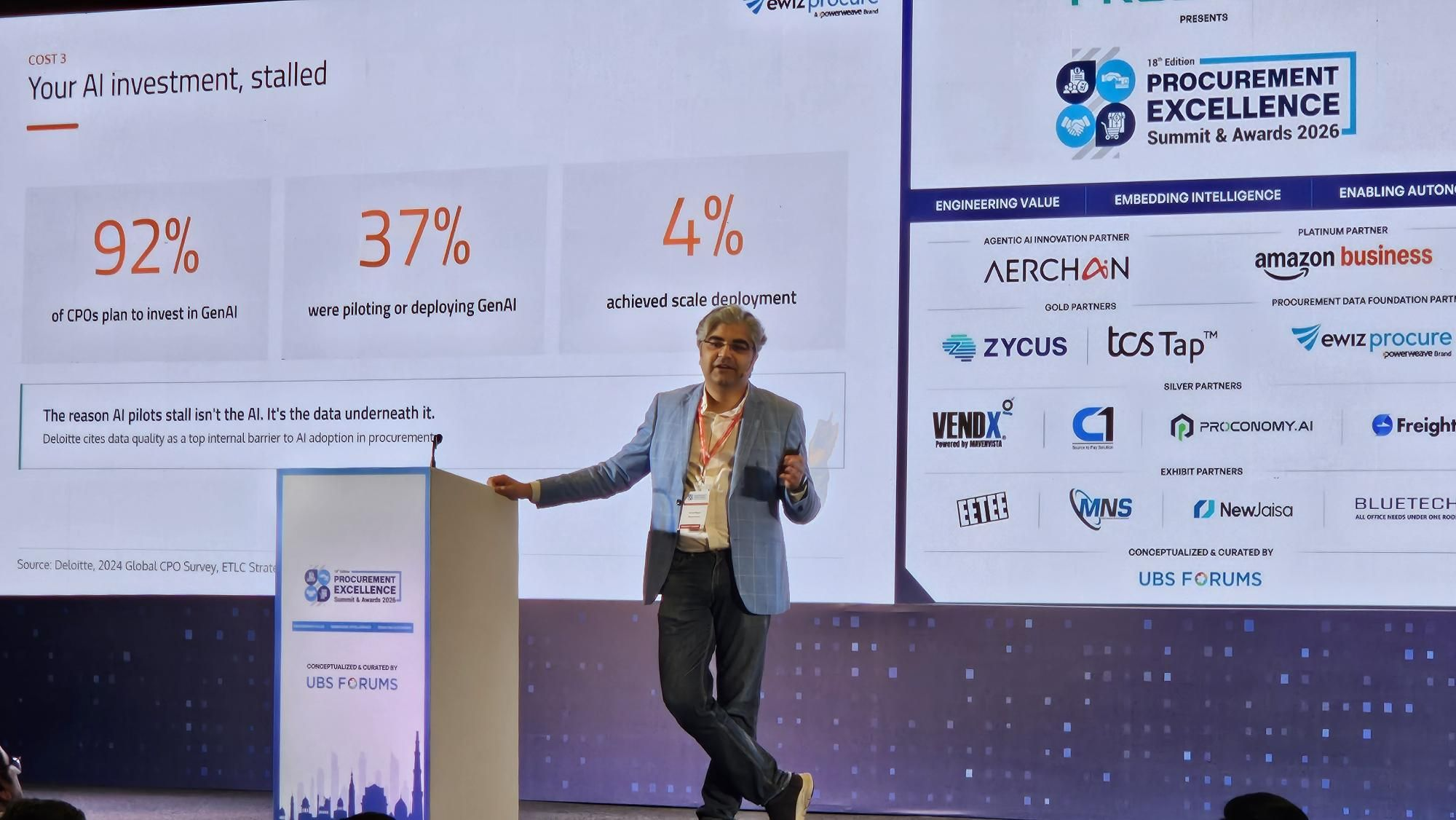
- Stalled technology investment: Around 92% of CPOs plan to invest in generative AI, and 37% are already piloting it, but only about 4% have reached scaled deployment. Data quality is a top internal barrier, according to Deloitte. And it isn’t only AI: ERP upgrades, source-to-pay rollouts, and data migrations stall or overrun the same way when they’re built on data that has to be cleaned mid-project.

How to score your own organization
Whatever you’re weighing right now, an AI pilot, a source-to-pay rollout, an ERP migration, or a savings program, it will inherit the state of your data. Two minutes now will show you where you actually stand before you invest.
Use the same five-statement diagnostic from this pulse. Tick only what’s true for your organization today. Treat it as an honest self-evaluation, not a test, the value is in an accurate baseline, not a high score.
- [ ] I can see all my spend in a single view
- [ ] I’m confident I have no duplicate suppliers or SKUs
- [ ] Less than 10% of my spend sits in “miscellaneous”
- [ ] My supplier records have been updated since the ERP go-live
- [ ] My AI and analytics tools run on data I’d stake a decision on
| Your score | Band | Where to start |
| 5 | AI-Ready. Rare – 0 of 23 leaders in this pulse reached this band. | Pressure-test the data before you scale further. |
| 3-4 | Cracks in the Foundation. Looks fine on the surface; leaks underneath. The most common band (61% of respondents). | Fix your two weakest pillars first, then govern them. |
| 0-2 | Sourcing a Blind. You’re deciding on data you can’t verify. This was the position of 39% leaders in this pulse. | Start with visibility: one spends view and a clean supplier master. |
If this sounds familiar
If your own score lands in the lower bands, you’re in the majority, not the exception.
The gap is fixable, and the fix has less to do with any single tool than with sequence. Get the data visible first. Govern what comes next. Switch on intelligence last. Run it in that order, and each layer holds; run it backwards, and every tool inherits the mess. Because the same clean foundation serves every module, the payoff shows up across sourcing, catalogues, supplier management, and analytics.
A three-phase path to fix data gap in procurement
- Make it visible: Classify spend, deduplicate suppliers, map a taxonomy. Outcome: one spend view, a clean supplier master, and a prioritized savings pipeline.
- Govern the inputs: Controlled catalogues, guided buying, and supplier-validation workflows, so the problem doesn’t re-create itself. Outcome: controlled intake and catalogues that stay clean.
- Activate the intelligence: AI scoring, predictive analytics, and benchmarking, switched on only once the first two phases hold. Outcome: AI-scored RFQs and benchmark dashboards that hold up under scrutiny.
This is the work ewiz procure by Powerweave does, combining procurement technology, data and intelligence services, and advisory to help enterprises unlock measurable savings and build procurement maturity, without replacing the ERP or procurement setup already in place. We’re sharing our approach not as a pitch, but so the path is concrete if you decide it’s worth taking.
What ewiz procure offers:
- Master Data Management: cleanse, classify, enrich, and govern procurement data so sourcing, catalogues, suppliers, and analytics all run on trusted information
- Strategic Sourcing: digitize RFx, eTendering, auctions, and PR-to-PO workflows with AI-assisted evaluation and full audit trails
- Procurement Catalog: build compliant, guided buying on clean catalogue data to cut maverick spend
- Supplier Management: onboard, validate, and monitor suppliers with stronger compliance and risk visibility
Clients typically reports:
- 8–12% cost savings
- 30% faster procurement cycles
- 27% lower process costs
- 25% better supplier performance.
What procurement built on clean data has looked like in practice
- A global merchandise company cleansed SKU data and standardized 28,000+ items across 120+ sourcing portals
- A global FMCG major cleansed supplier data to manage $900M+ in indirect spend across 50+ countries
- A consumer goods giant deduplicated its supplier base, cutting SKUs by 80% with zero recalls after clean-up
- A global beverage company classified spend and digitized catalogues, surfacing 22% of spend that had been unclassified
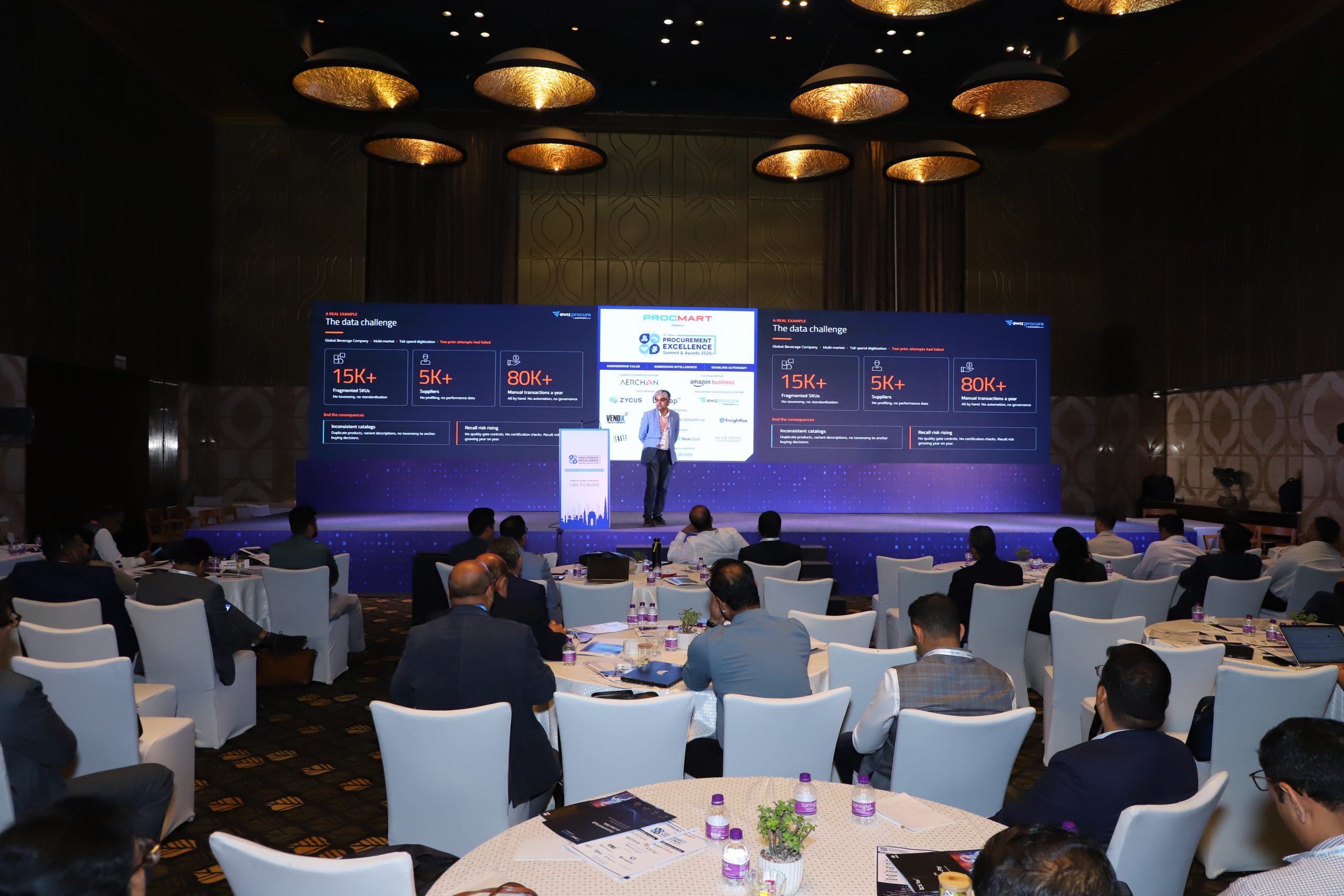
Industrywide data challenge in procurement
Want a clear read on where your own data stands?
Send us a sample spend export. Within 48 hours, you’ll get back a data quality scorecard, duplicate supplier and SKU clusters flagged, spend classified, and a ranked list of what to fix first.
Want to talk it through instead?
Book a 30-minute discovery session
No deck. No pitch. Just a real conversation about where your data stands and what’s worth fixing first.
