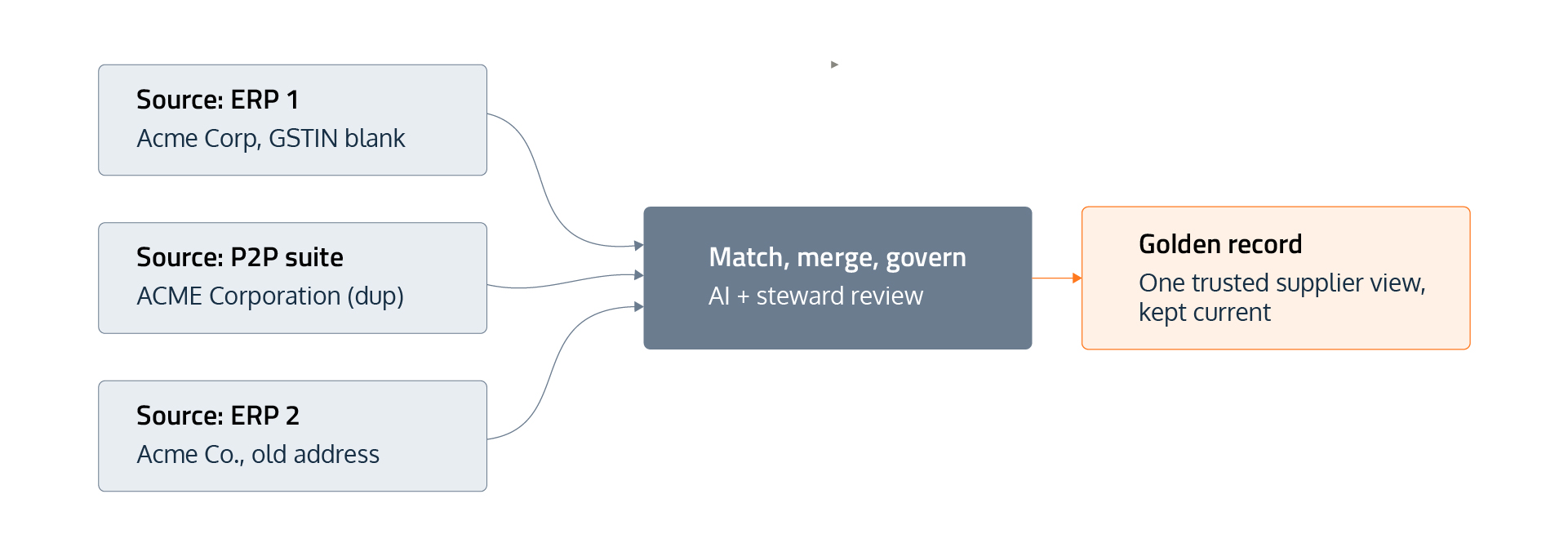
The best master data management (MDM) solution is not the platform with the longest feature list. It is the one that fits your data domains, technology landscape, and ability to govern data after implementation.
For a CPO, the test is practical. Can the solution help procurement work with one reliable view of suppliers, materials, services, categories and catalogs? Can it prevent duplicates, improve spend visibility and feed clean data into sourcing and buying workflows?
MDM is central to procurement data management, but the two terms are not identical. MDM governs shared master records: supplier, material, item, category and reference records. Procurement data management is broader, also covering catalogs, spend, transactions, and documents. This guide covers both and labels the solution type, so buyers do not mistake a multidomain MDM hub, procurement-domain MDM program, industrial-data specialist or supplier-management suite for the same product category.
Which MDM solution fits your procurement needs?
| No. | Solution | Category | Best fit | Procurement domains emphasized |
| 1 | SAP Master Data Governance | ERP-aligned enterprise MDM | SAP-centric enterprises governing business partner, material, finance and other SAP master data | Business partner, supplier, material and finance |
| 2 | Informatica MDM and 360 Applications, from Salesforce | Enterprise multidomain MDM | Large, heterogeneous estates that need MDM, data quality, integration and governance at scale | Supplier, product, finance and reference data |
| 3 | ewiz procure Procurement Data Management | eProcurement solution with procurement-domain MDM | Enterprises that need procurement data cleaned, structured, enriched and governed without replacing ERP or S2P | Supplier, item & material, catalog, and spend & transaction | Supplier, material, category, catalog, spend and transaction |
| 4 | Semarchy Data Platform | Flexible multidomain MDM | Enterprises seeking materials, vendor and reference-data support with flexible deployment | Material, vendor, taxonomy and reference data |
| 5 | Prospecta Master Data Online | Multidomain MDM with industrial and ERP depth | Enterprises that need governed data across ERPs, with strong material, asset and supplier requirements | Material, asset, supplier, location and procurement |
| 6 | Verdantis MDM Suite | Industrial and MRO-focused MDM | Asset-intensive enterprises with complex material, equipment, supplier and services data | Material, MRO, equipment, supplier and service |
| 7 | Reltio Multidomain MDM | Cloud-native multidomain MDM | Large enterprises needing real-time mastering, entity resolution and complex relationship management | Supplier, product, organization, hierarchy and reference data |
| 8 | Ataccama ONE MDM | Multidomain MDM with embedded data quality | Enterprises prioritizing profiling, matching, remediation and stewardship across mixed data estates | Configurable supplier, product and reference-data domains |
| 9 | Stibo Systems STEP | Multidomain MDM | Enterprises governing product, supplier, location, asset and reference data on one platform | Supplier, product, catalog, location, asset and reference data |
| 10 | Profisee MDM | Multidomain and supplier MDM | Microsoft-oriented and multi-ERP enterprises needing governed supplier and supply-chain records | Supplier, hierarchy and supply-chain relationships |
| 11 | PiLog Data Quality & Governance Suite | Industrial and asset-intensive MDM | SAP-connected and asset-intensive enterprises managing material, service, equipment and taxonomy data | Material, service, equipment, MRO and taxonomy |
| 12 | GEP Supplier Management | Source-to-pay suite with supplier-data management | Enterprises that want supplier information governed inside a unified procurement suite | Supplier onboarding, qualification, performance and risk |
| 13 | Zycus Supplier Information Management | Source-to-pay suite with supplier information management | Enterprises seeking supplier onboarding, data integrity, compliance and risk workflows within S2P | Supplier profile, onboarding, compliance and risk |
| 14 | JAGGAER Supplier Management & Performance | Source-to-pay suite with supplier lifecycle management | Direct- and indirect-procurement teams managing onboarding, performance, risk and compliance | Supplier onboarding, lifecycle, performance and risk |
| 15 | OptimizeMRO | MRO master-data services and governance | Asset-intensive enterprises needing a services-backed material-data cleanse and governance program | Material, MRO, taxonomy and governance |
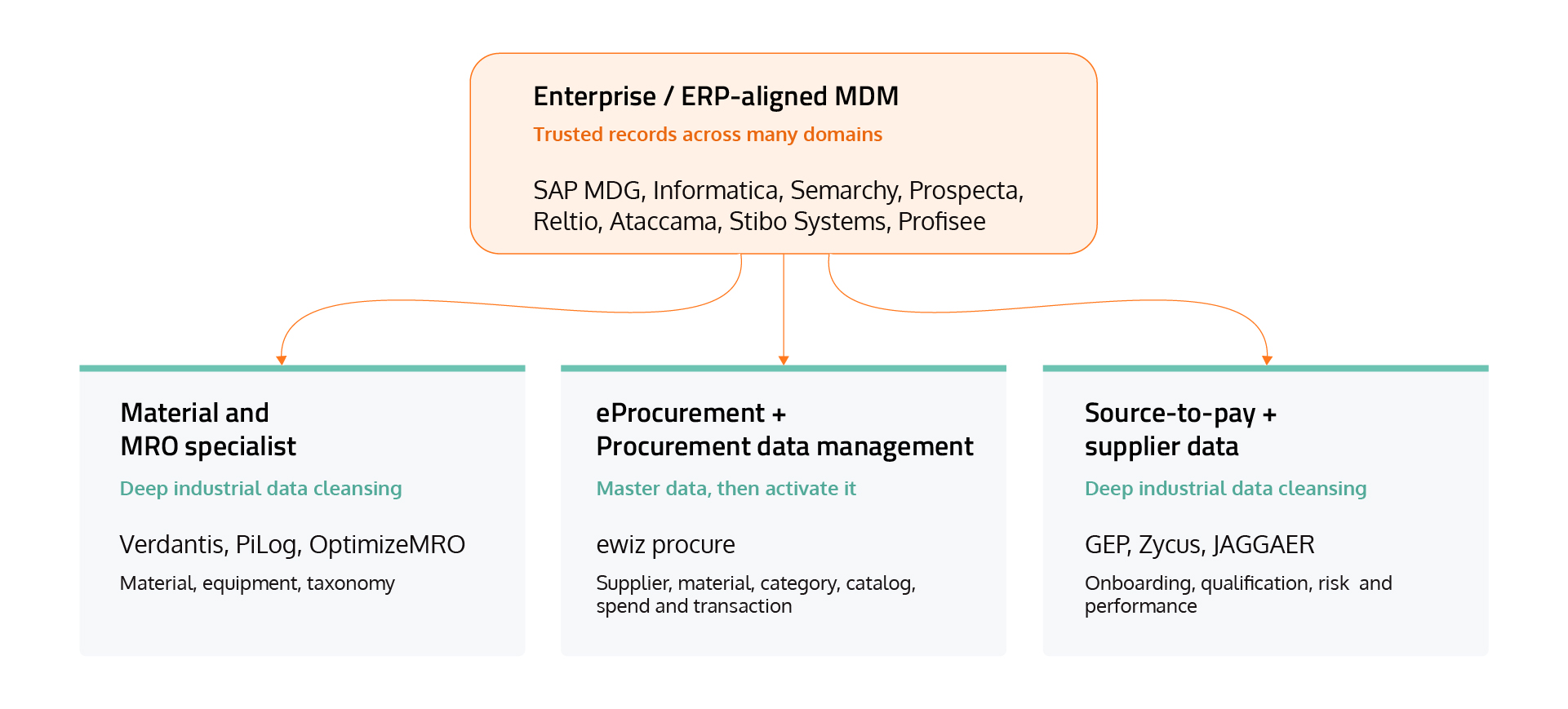
What each category does, and when it fits
- Enterprise / ERP-aligned MDM – Broad platforms that govern trusted records across many domains and systems. Best when the data problem spans the whole enterprise, not procurement alone.
- eProcurement + procurement MDM – Fixes and governs procurement master data, then activates it across sourcing, catalogs and analytics alongside your ERP. Best when the pain is specifically procurement data.
- Material & MRO specialist – Deep, often services-backed cleansing, classification and enrichment of complex items, spare-part and equipment data. Best when messy material or MRO data inflates spend or stalls maintenance.
- Source-to-pay + supplier data – Full procurement suites that govern supplier information inside onboarding, sourcing, risk and performance workflows. Best when supplier data needs to live where buying happens.
How this guide is different, & how we selected the 15
Most “top MDM tools” rankings are written for CIOs and CDOs. They also draw their lists from the enterprise-MDM analyst universe, the Gartner MDM Magic Quadrant and the Forrester Wave, which excludes the procurement-data specialists and source-to-pay suites where much real procurement data work happens. This guide does not reproduce those analyst lists: it applies a procurement lens and blends four solution types rather than treating enterprise MDM as the only category.
Selection parameters- A solution qualifies for this list because it demonstrably does the following, in priority order, not simply because an MDM directory listed it:
- Procurement-domain depth – Native handling of supplier master, material/item/MRO master, spend taxonomy and classification, or catalog data (not “supplier” as one checkbox in a customer-data tool).
- Cleansing and enrichment capability – Proven dedup, standardization, classification and enrichment on dirty procurement data.
- ERP and S2P integration – Prebuilt connectivity to SAP, Oracle, Ariba, Coupa, Ivalua, JAGGAER and similar systems.
- Governance and stewardship model – Workflow, lineage, auditability, and whether governance is tool-only or managed-service-supported.
- AI-readiness of the resulting data – Whether the output is procurement data that AI and analytics tools can reliably use.
- Deployment and residency fit – Deployment flexibility and data-residency options for complex, multi-ERP, multinational estates.
- Delivery depth and references – Evidence of current product investment (as of July 2026) and successful implementations for global enterprises.
Sources for the qualification were current official product pages, public analyst commentary and review-directory category data, cross-checked against these enterprise operating requirements.
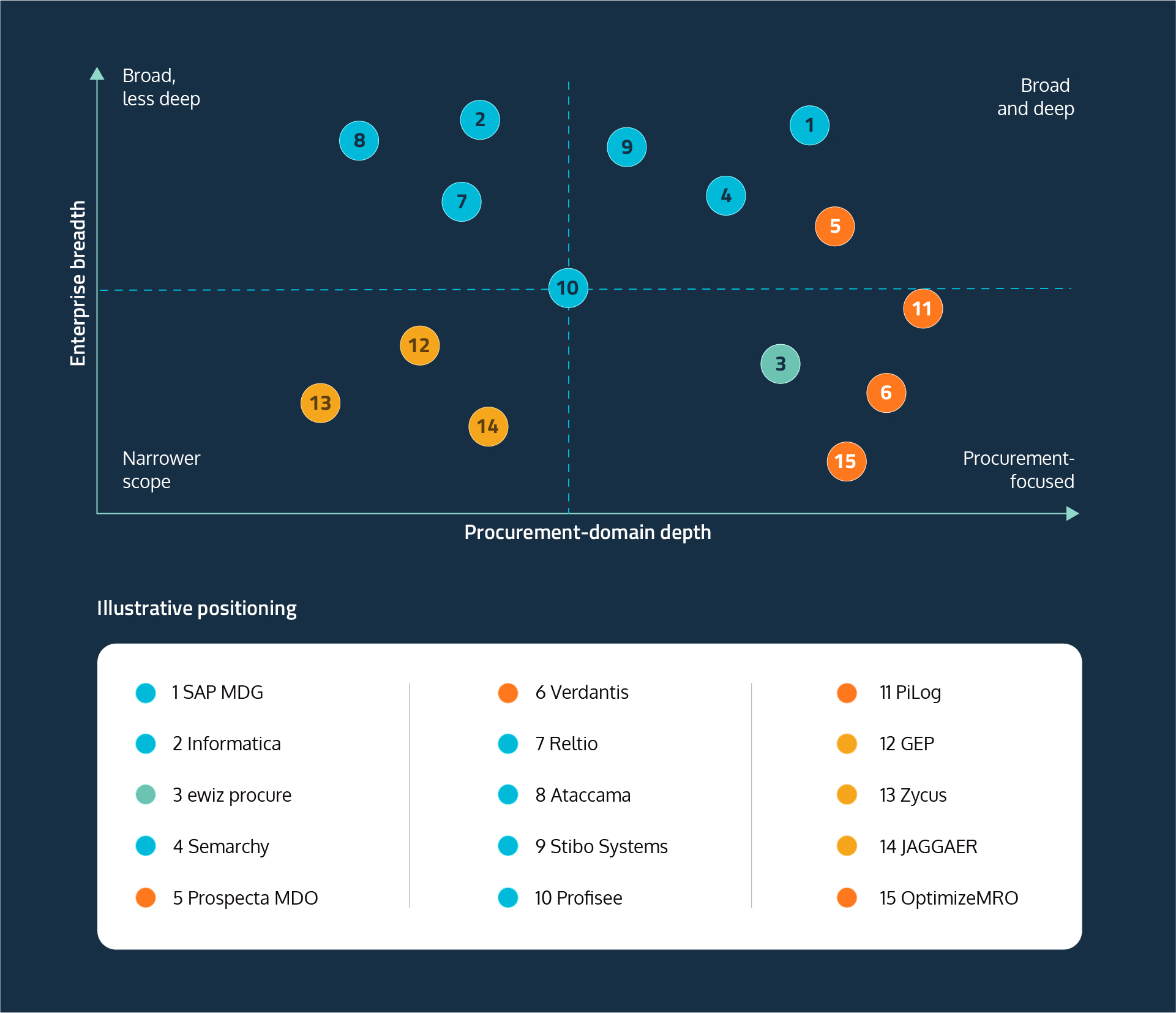
A note on the numbering – Because these 15 span four different solution types, the numbers are for navigation only, not a strict best-to-worst ranking. A material-data cleansing specialist and a source-to-pay suite are not competing for the same buyer. Read the list as a categorized shortlist with explicit fit guidance and use the decision matrix at the end to match your situation to a direction.
This is an evidence-led shortlist, not a laboratory benchmark. Official product documentation supports capability claims. Analyst sources provide market context. Vendor-published customer stories illustrate delivery experience but do not guarantee equivalent outcomes for another enterprise. The 100-point scorecard later in the guide is a suggested buyer framework, not the basis for a market ranking.
Ratings and reviews snapshot
Review ratings are not a universal rank. The shortlist spans different Gartner Peer Insights markets (MDM Solutions and Source-to-Pay Suites) as well as G2 and Capterra, so a single ratings table would imply an apples-to-apples comparison that does not exist. Review coverage is also thin for several specialists. Read the snapshot below within a category only and treat small samples as directional rather than decisive.
| Solution | Category | Review market | Rating | Reviews | Checked |
| SAP Master Data Governance | Enterprise / ERP-aligned MDM | Gartner Peer Insights — MDM Solutions | 4.4 | 153 | Jul 2026 |
| Informatica MDM (Salesforce) | Enterprise multidomain MDM | Gartner Peer Insights — MDM Solutions | 4.4 | 472 | Jul 2026 |
| Semarchy Data Platform | Enterprise multidomain MDM | Gartner Peer Insights — MDM Solutions | 4.6 | 203 | Jul 2026 |
| Prospecta Master Data Online | Multidomain / industrial MDM | Gartner Peer Insights — MDM Solutions | 4.1 | 16 | Jul 2026 |
| Reltio Multidomain MDM | Cloud-native multidomain MDM | Gartner Peer Insights — MDM Solutions | 4.5 | 139 | Jul 2026 |
| Stibo Systems STEP | Multidomain MDM | Gartner Peer Insights — MDM Solutions | 4.3 | 177 | Jul 2026 |
| Ataccama ONE MDM | Multidomain MDM + data quality | G2 | 4.2 | 12 | Jul 2026 |
| Profisee MDM | Multidomain / supplier MDM | G2 | 4.4 | 40 | Jul 2026 |
| PiLog Data Quality & Governance (MDRM) | Industrial / asset-intensive MDM | Gartner Peer Insights — MDM Solutions | 4.8 | 456 | Jul 2026 |
| Verdantis MDM Suite | Material / MRO specialist | G2 | 4.5 | 7 | Jul 2026 |
| GEP (SMART / Quantum) | Source-to-pay suite | Gartner Peer Insights — Source-to-Pay Suites | 4.6 | 214 | Jul 2026 |
| Zycus | Source-to-pay suite | Gartner Peer Insights — Source-to-Pay Suites | 4.6 | 173 | Jul 2026 |
| JAGGAER | Source-to-pay suite | Gartner Peer Insights — Source-to-Pay Suites | 4.4 | 170 | Jul 2026 |
| ewiz procure (Powerweave) | eProcurement + procurement MDM | Capterra | 4.7 | 3 | Jul 2026 |
What real users say about procurement MDM solutions
Verified reviews on Gartner Peer Insights and G2 cluster around a few consistent themes by buyer concern. Treat these as directional signals and confirm current sentiment for the vendors on your own shortlist.
- Ease of use and stewardship – Semarchy is repeatedly praised on Gartner Peer Insights for an intuitive, low-code experience. Among source-to-pay suites, Gartner Peer Insights reviewers’ rate GEP slightly higher than JAGGAER, the comparison page lists GEP at 4.6 stars from 214 reviews and JAGGAER at 4.4 from 213; visible snippets describe GEP as a user-friendly solution, while JAGGAER reviews show generally positive sentiment alongside noted functional limitations.
- Implementation effort – For the large enterprise platforms, setup and configuration complexity is the recurring theme: Informatica reviewers value the depth but frequently cite complexity and SAP MDG is a comparably deep enterprise product, expect substantial implementations, and confirm the effort and any partner requirement in your own evaluation. Zycus rates strongly with positive sentiment on Gartner Peer Insights; verify any specific implementation concerns against current reviews before relying on them.
- Integration and mastering – SAP MDG reviewers highlight tight ERP integration for importing and governing material, customer and vendor records; Reltio reviewers credit its modern, multidomain approach to centralizing and standardizing data across systems in near real time.
- Support and flexibility – Zycus support is frequently described as responsive and dependable; JAGGAER reviewers note the platform can be rigid in places, occasionally requiring workarounds to fit an existing process.
- Specialists and newer entrants – Prospecta MDO reviewers praise usability and multi-environment flexibility while flagging occasional concerns about delivery timelines. Verdantis, PiLog, OptimizeMRO and ewiz procure carry thin public review volumes, so evaluate them through customer references and a scoped pilot rather than review counts.
Why MDM programs underdeliver
Master data programs fail more often than they succeed: Gartner predicts that 80% of data and analytics governance initiatives will fail by 2027, and master data management sits squarely inside that governance remit. The cause is rarely a missing matching or workflow feature. Value slips away when:
- Too many domains are tackled at once, so nothing reaches production quickly;
- Historical cleansing is deferred to a later phase, then becomes the critical path;
- Integrations become the bottleneck across ERP, S2P and analytics systems;
- Stewardship is unfunded, no one owns exception queues after go-live; and
- Success is measured by go-live, not by a business outcome.
For procurement data, technology alone is not enough. Material descriptions, supplier relationships, category structures and industry terminology need contextual judgement, not just rules, so evaluate how each provider combines automation with subject-matter expertise, client inputs, exception review and accountable sign-off.
The fix is to make the first phase a business case, not a technical milestone: pick one domain and set an observable baseline and target: duplicate supplier or material rate, record completeness, classified spend, onboarding time, exception backlog, catalog coverage, or time to publish an approved change. For example, a manufacturer might scope the first phase to one plant’s MRO data, deduplicating spare-part and supplier records and classifying items to a standard taxonomy such as UNSPSC. A practical target: duplicate part numbers down from about 20% to under 5%, 90% of that plant’s indirect spend correctly classified, and supplier onboarding cut from weeks to days, enough to run the category’s first trustworthy spend analysis and begin consolidating suppliers within a quarter, not a vague promise to “improve data quality.”

Four procurement MDM solution types CPOs should distinguish
| Solution type | What it does best | Typical candidates | Main limitation to test |
| Enterprise or ERP-aligned MDM | Governs trusted records across multiple domains and systems | SAP MDG, Informatica, Semarchy, Prospecta, Reltio, Ataccama, Stibo Systems, Profisee | Implementation effort, operating model and procurement-specific depth |
| eProcurement solution with Procurement Data Management | Cleans, structures, enriches and governs procurement data, then activates it across procurement workflows | ewiz procure | Scope and system-of-record boundaries outside procurement data |
| Material and MRO-data specialist | Cleanses, classifies, enriches and governs complex industrial records | Verdantis, PiLog, OptimizeMRO | Breadth outside material, asset, equipment, service and supplier domains |
| Source-to-pay suite with supplier-data management | Keeps supplier information connected to onboarding, sourcing, risk and performance | GEP, Zycus, JAGGAER | Usually supplier-first rather than full multidomain or material MDM |
The right category depends on the scope.
Choose enterprise MDM when the problem spans customer, product, supplier, finance, location and other domains. Evaluate procurement-domain MDM when the required governance depth is concentrated in supplier, material, category, catalog, spend and transaction data. Choose a material specialist when MRO, item descriptions, classifications, and duplicate parts are an urgent problem. Choose an S2P suite where supplier data must stay embedded in onboarding, sourcing, risk and performance workflows.

15 MDM and procurement data solutions to evaluate
1. SAP Master Data Governance
Best for: SAP-centric enterprises that want master-data governance close to SAP business processes.
SAP Master Data Governance in SAP Business Data Cloud is positioned as a central hub that can create governed records, match and merge data, enforce rules, route change requests and maintain an audit trail. It can work with SAP and third-party sources, while its native alignment to SAP semantics is particularly relevant for business partners, finance, material and supplier data. SAP also advises organizations to curate master data before an S/4HANA migration.
Why a CPO should consider it: Procurement teams already operating on SAP can govern material and supplier-related records without introducing a disconnected master-data model.
Evaluate carefully: Test non-SAP source integration, ownership of change requests, mass-change workflows and the effort needed to cleanse historical data before governance begins.
Ongoing governance & maintenance: Governance is built into the product (rules, change workflows, audit). Maintenance needs to be run by your own stewards; SAP provides the tooling, not the maintenance as a service.
Pricing: Licence/subscription via SAP; no public list price (buyers request a demo).
2. Informatica MDM and 360 Applications, from Salesforce
Best for: Large enterprises with multiple ERPs, applications and data domains.
Informatica MDM and 360 Applications, now presented as Informatica from Salesforce following the completion of the acquisition in November 2025, combines multidomain MDM with data integration, quality, governance and 360 applications. Its portfolio includes Supplier 360, Product 360, Finance 360, and Reference 360, with AI-assisted matching and rule recommendations. It is positioned for enterprise-wide data unification rather than a single application ecosystem.
Why a CPO should consider it: It is suitable when supplier and product data must be reconciled across several ERPs, business units and acquired companies.
Evaluate carefully: Define the exact domains and services in scope. Informatica uses consumption-based Informatica Processing Units, and its pricing page says MDM can be measured on a per-domain-record basis. Model record growth, API usage, data-quality services, and implementation effort before comparing quotes.
Ongoing governance & maintenance: Governance is built in with governance and continuous data quality; ongoing maintenance isn’t. It should be run by your stewards or an implementation partner, not a vendor-delivered service.
Pricing: Consumption-based Informatica Processing Units, measurable per domain record; not publicly listed.
3. ewiz procure Procurement Data Management
Best for: Enterprise procurement teams that need to clean and govern procurement master data before scaling sourcing, supplier management, catalog buying, analytics, system migration/ upgradation or AI-led procurement initiatives, without replacing current procurement stack.
ewiz procure Procurement Data Management is a procurement-focused data cleansing and governance service that helps enterprises improve the quality of supplier, material, product, purchase, PO, and transaction data.
The solution combines procurement data management expertise with technology-led extraction, classification, document parsing, entity resolution, deduplication, taxonomy mapping, validation, and governance. It can use industry taxonomies such as UNSPSC, along with client-specific hierarchies where required.
Why a CPO should consider it: CPOs should consider ewiz procure Data Management when procurement performance is being held back by poor data quality rather than a lack of tools. With 25 years of data management experience across 50+ countries, their delivery approach is AI + Human with strict guardrails, ensuring automation is applied only where confidence is high and governance is enforced at every critical decision point.
Evaluate carefully: Evaluate their procurement data strategy around supplier, material, and taxonomy governance depth. Also, assess how AI-led automation is balanced with human stewardship for exception handling and audit-critical decisions. Confirm integration readiness with existing ERP/P2P systems and the availability of APIs for seamless data flow. Finally, role clarity on what is needed to ensure this becomes a success.
Pricing: Pricing is quoted per project. Cost depends on data volume, complexity, scope of cleansing and governance, and whether it is a one-time or ongoing engagement.
4. Semarchy Data Platform
Best for: Enterprises seeking multidomain MDM with specific support for materials, vendors and reference data.
Semarchy combines multidomain MDM, data quality, governance and integration, with SaaS, cloud, Snowflake-native and on-premises options. Its materials-data solution covers deduplication, validation, attributes, hierarchies and synchronization across manufacturing and procurement. Semarchy also provides a vendor-data solution for centralizing and governing supplier records.
Why a CPO should consider it: The explicit material and vendor domains make it relevant to manufacturing, chemicals, pharma and other businesses where item descriptions, classifications and supplier relationships affect operations and compliance.
Evaluate carefully: Match the deployment choice to internal skills. Semarchy promotes a rapid-delivery approach, but buyers should validate the timeline against their number of source systems, data condition and approval complexity. Ask for a sample model using supplier, material and category data.
Ongoing governance & maintenance: Governance is built in (stewardship and data quality). But ongoing maintenance should be run by your own stewards, not a vendor-delivered service.
Pricing: Subscription (SaaS, cloud, Snowflake-native or on-prem); quote-based.
5. Prospecta Master Data Online
Best for: Enterprises seeking multidomain MDM with strong industrial, asset, procurement and ERP depth.
Prospecta’s 2026 MDO overview describes a converged, multidomain platform for profiling, remediation, governance, stewardship and synchronization across ERP systems. Its procurement and supply-chain solution covers material, MRO, supplier and location data, while its documented SAP Materials Management workflows support governed creation, change, extension and approval of material records.
Why a CPO should consider it: Prospecta can support a broader enterprise MDM program while retaining strong operational depth in material, asset, supplier and procurement data.
Evaluate carefully: Test how much of the required model is preconfigured for your ERP, industry and non-industrial domains. Validate the implementation partner, deployment option, stewardship experience and integration design using representative supplier and material records.
Ongoing governance & maintenance: Governance is built in with cross-ERP synchronization. Maintenance should be run by your team, usually partner supported.
Pricing: Subscription; quote-based, not publicly listed.
6. Verdantis MDM Suite
Best for: Asset-intensive enterprises with complex material, MRO, equipment, supplier and services data.
Verdantis combines data standardization and governance in its unified MDM Suite. Harmonize and Integrity now sit within the central suite for cleansing, classification, enrichment, deduplication, validation and change governance. Its published domains include materials, equipment, suppliers, customers, and services.
The Harmonize product page describes category-specific specification sheets, multilingual normalization, classification to UNSPSC, eCl@ss, PIDX or a custom taxonomy, attribute extraction, enrichment and human approval before records are posted to ERP.
Why a CPO should consider it: Verdantis addresses industrial materials, spare parts, equipment, suppliers and services, the domains that broad MDM comparisons often underweight. It also separates historical remediation from ongoing governance.
Evaluate carefully: Confirm whether the requirement extends materially into customer, finance, employee or location data. Ask for proof of concept on your records, validate integration with the target ERP or EAM stack, and test steward usability. Public review coverage remains limited.
Ongoing governance & maintenance: Governance is a dedicated product (Integrity) alongside the Harmonize cleanse. Maintenance should be run in-house or offered by Verdantis as a service.
Pricing: Software plus data services; quote based.
7. Reltio Multidomain MDM
Best for: Large enterprises that need cloud-native, real-time mastering across multiple domains and operational systems.
Reltio Multidomain MDM combines entity resolution, continuous data quality, dynamic survivorship, hierarchy and reference-data management, lineage and auditability. Its multidomain model supports organizations, suppliers, products, assets, locations, and other enterprise entities, with APIs and connectors for distributing governed records to operational and analytical systems.
Why a CPO should consider it: It is relevant when procurement needs trusted suppliers, product and organizational relationships to remain synchronized across several ERPs, business units and downstream applications.
Evaluate carefully: Procurement-specific material attributes, category structures, onboarding workflows and supplier coordination may require configuration or adjacent applications. Demonstrate these use cases with representative supplier and item data and model the integration and SaaS consumption costs.
Ongoing governance & maintenance: Governance, yes, built in continuous data quality, dynamic survivorship. Maintenance should be run by your own stewards, not a vendor-delivered service.
Pricing: SaaS subscription, priced mainly by consolidated profile (record) count and invoiced annually; quote based.
8. Ataccama ONE MDM
Best for: Enterprises that want multidomain MDM closely connected to data quality, profiling and remediation.
Ataccama ONE MDM Supports data profiling, cleansing, enrichment, matching, golden-record creation, stewardship, approval of workflows, reference data and downstream provisioning. Its data-source-agnostic approach can be deployed across cloud and on-premises environments and can model suppliers, product and other domains.
Why a CPO should consider it: Procurement programs with inconsistent records across many systems can combine data-quality discovery and remediation with ongoing mastering rather than treating them as separate tool decisions.
Evaluate carefully: Ataccama’s public examples are broader than procurement. Require a demonstration of supplier hierarchies, material descriptions, tax identifiers, category taxonomies and ERP synchronization, and test how much domain modeling and stewardship design the implementation needs.
Ongoing governance & maintenance: Governance is built in (governance and continuous data quality). But maintenance should be run by your own stewards, not a vendor-delivered service.
Pricing: Subscription; quote-based, not publicly listed.
9. Stibo Systems STEP
Best for: Enterprises that need to govern supplier, product, location, asset and reference data on a shared multidomain platform.
Stibo Systems STEP is a multidomain MDM platform for resolving, governing and distributing trusted records across domains. Current documentation covers data sourcing, modeling, matching, quality, stewardship, workflows, lineage, APIs and downstream delivery. Stibo Systems also publishes 2026 implementation guidance for customer and supplier MDM.
Why a CPO should consider it: STEP can connect supplier and product records with the relationships, hierarchies, locations and reference data needed across procurement, supply chain and digital channels.
Evaluate carefully: Distinguish product information requirements from operational material and MRO mastering. Test supplier onboarding, duplicate resolution, material specifications, catalog structures, and ERP distribution using the same dataset presented to other vendors.
Ongoing governance & maintenance: Governance is built in (workflows, stewardship). Maintenance should be run by your own stewards, not a vendor-delivered service.
Pricing: Subscription by domain/module; quote based.
10. Profisee MDM
Best for: Microsoft-oriented and multi-ERP enterprises that need to govern supplier and supply-chain master data.
Profisee Supplier MDM consolidates supplier data from ERP, procurement and other systems; supports matching, golden records, hierarchies, workflows, audit trails and governance; and distributes governed supplier information to ERP, P2P, SRM and analytical environments. The broader platform is positioned strongly around Microsoft Fabric, Purview, and Azure.
Why a CPO should consider it: Its supplier-specific model is relevant when procurement needs ownership relationships, onboarding, compliance attributes and vendor performance data reconciled across business units.
Evaluate carefully: Confirm depth for material, service, catalog and spend-data use cases in addition to supplier mastering. Test non-Microsoft integration where relevant and determine how much implementation support is required for domain modeling and stewardship.
Ongoing governance & maintenance: Governance is built in (stewardship, audit). Maintenance should be run by your own stewards, not a vendor-delivered service.
Pricing: Subscription by domains, users and environments, with no per-record fees; quote-based.
11. PiLog Data Quality & Governance Suite
Best for: Asset-intensive and SAP-connected enterprises managing complex material, service, equipment and taxonomy data.
PiLog’s Data Quality & Governance Suite combines specialized MDM, data quality, governance, harmonization, migration, and industrial content. Its published capabilities cover material and service masters, equipment and asset data, industry taxonomies, duplicate resolution, classification, enrichment and SAP-connected governance.
Why a CPO should consider it: PiLog is highly relevant to procurement teams in manufacturing, utilities, mining, chemicals, oil and gas and other asset-intensive sectors where poor material and service data affects inventory, sourcing and maintenance.
Evaluate carefully: Separate vendor-reported scale and outcome claims from independently verified results. Confirm the required domains, deployment model, SAP and non-SAP integration, steward experience and the boundary between MDM software, content and project services.
Ongoing governance & maintenance: Governance is part of the Data Quality & Governance suite. Maintenance is typically delivered with PiLog’s content and services.
Pricing: Software, industrial content and services; quote-based.
12. GEP Supplier Management
Best for: Enterprises that want supplier information governed inside a broader source-to-pay platform.
GEP’s procurement suite combines supplier management with sourcing, contracts, purchasing, and spend analysis. Its current supplier-management offering is positioned around onboarding, qualification, performance, risk and supplier intelligence. GEP also publishes dedicated material on supplier master-data management and vendor-master hygiene.
Why a CPO should consider it: Supplier records stay close to the workflows that create and use them, reducing the need to connect a separate supplier-management application to the procurement suite.
Evaluate carefully: Treat it as supplier-focused procurement data management, not as a direct substitute for a multidomain MDM hub or deep material-MRO mastering. Confirm current product packaging, data-governance controls and integration boundaries with ERP.
Ongoing governance & maintenance: Supplier data governance runs continuously inside the suite. But ongoing maintenance isn’t included. It should be run by your own team.
Pricing: SaaS subscription across the suite; quote-based.
13. Zycus Supplier Information Management
Best for: Enterprises that want supplier onboarding, data quality, compliance and risk management inside a source-to-pay suite.
Zycus positions its Supplier Information Management platform around centralized supplier profiles, onboarding, anomaly detection, duplicate checks, normalization, document tracking, audit trails and compliance workflows. These capabilities connect supplier data directly to the wider Zycus source-to-pay environment.
Why a CPO should consider it: It can improve supplier-data quality while keeping procurement teams and suppliers in the same operational workflow.
Evaluate carefully: Zycus is an S2P suite first. If the requirement includes complex material, equipment, customer, finance or location mastering, test whether another MDM or specialist layer is still required.
Ongoing governance & maintenance: Supplier governance (profiles, certificates, renewals) runs inside the suite. Maintenance isn’t. It should be run by your own team.
Pricing: Modular SaaS subscription; quote-based.
14. JAGGAER Supplier Management & Performance
Best for: Direct- and indirect-procurement teams that need supplier onboarding, performance, risk and compliance in one environment.
JAGGAER Supplier Management & Performance provides guided supplier onboarding, configurable workflows, compliance checks, supplier profiles, scorecards, performance monitoring, and risk-related insights. JAGGAER positions the product as part of its broader source-to-pay platform, with connections to sourcing, procure-to-pay and supplier intelligence.
Why a CPO should consider it: It is relevant when supplier lifecycle data must support both direct and indirect procurement decisions, particularly in manufacturing and other supplier-intensive environments.
Evaluate carefully: Supplier lifecycle management is not the same as enterprise MDM. Demonstrate duplicate prevention, ownership hierarchy, enrichment, change approval and ERP synchronization using your own supplier data.
Ongoing governance & maintenance: Continuous supplier-lifecycle governance is inside the suite. Maintenance should be run by your own team.
Pricing: SaaS subscription; quote-based.
15. OptimizeMRO
Best for: Asset-intensive enterprises that need a services-backed material and MRO-data cleanse, classification and governance program.
OptimizeMRO combines data services with technology for MRO data excellence, including audit, cleansing, classification, enrichment, taxonomy and governance. Its published data-transformation process covers legacy-data extraction, audit, data rules, taxonomy standards and governance processes, while its MRO governance offering focuses on keeping the cleaned data usable.
Why a CPO should consider it: The services-led model can suit organizations that lack the internal capacity to cleanse and govern large, inconsistent MRO datasets.
Evaluate carefully: Its center of gravity is MRO and material data, not broad multidomain MDM. Scope supplier, catalog, customer and finance need separately and assess delivery quality through references and a pilot cleanse because public review coverage is limited.
Ongoing governance & maintenance: Yes, to both. Governance and ongoing MRO data maintenance are delivered by the vendor as a managed service.
Pricing: Services-led (project or per-record data services); quote-based.
Platform program or fix procurement data first?

Most comparison articles assume that poor master data automatically requires a new enterprise platform. A CPO should first decide which of these two programs the business actually needs.
Choose a platform program when:
- The problem spans procurement, sales, finance, product, customer and other enterprise domains;
- The company needs one governed architecture across several systems and functions;
- IT and the data office can fund integration, stewardship and change management; and
- The enterprise is prepared to operate MDM as an ongoing capability, not a one-time cleanse.
SAP MDG, Informatica, Semarchy, Prospecta, Reltio, Ataccama, Stibo Systems and Profisee fit this direction. When the enterprise scope is procurement-specific, ewiz procure can be evaluated as a direct domain peer against the same matching, governance, lineage, auditability and integration criteria. GEP, Zycus, and JAGGAER are relevant when the broader transformation is specifically source-to-pay and supplier management.
Fix procurement data first when:
- The urgent problems are duplicate suppliers, inconsistent material descriptions, unclassified spend or stale catalogs;
- The ERP and current procurement platforms are staying in place;
- Procurement needs measurable progress before an enterprise-wide data program can be approved; or
- The organization lacks the capacity to run permanent exception queues and enrichment work internally.
Verdantis, PiLog and OptimizeMRO fit industrial and MRO-led remediation programs. Prospecta can span an enterprise platform program and a material-led first phase. ewiz procure can support either a procurement-domain MDM program or a bounded remediation initiative, depending on the data scope, integrations and delivery model.
A limited first-domain program can also de-risk a later platform implementation. Clean, classified data is easier to migrate, govern, and use in analytics or AI.

Regional RFP considerations: India and the UAE
Regional readiness is a real evaluation layer, not an afterthought. India and the UAE serve as worked examples here. Enterprises operating there should add the following requirements to product demonstrations and commercial evaluation, and buyers in other regulated markets can adapt to the same checklist.
| Requirement Area | India | UAE |
| Identity Capture | Capture & validate GSTIN, PAN, Udyam | Capture & validate TRN, trade license |
| Verification | GST portal & Udyam verification | FTA TRN verification + license checks |
| Language/Format | Indic formats, transliteration | Arabic + English names & fields |
| Data Protection Law | DPDP Act + phased 2025 Rules | Decree-Law 45/2021 + free-zone rules |
| Hosting & Data Residency | Hosting region, subprocessors, transfers | UAE / approved regional hosting |
| Time & Localization Coverage | IST coverage, local implementation | GST-time coverage, Arabic support |
| Post-Launch Maintenance | Post-go-live change governance | License/tax renewals, bilingual upkeep |
Put each requirement into the RFP and contract; a country office does not prove local depth.
Regional readiness is a decision layer to test in the RFP, not a filter you assume.
| Evaluation area | India requirement | UAE requirement |
| Supplier identity | Capture and validate GSTIN, PAN and applicable Udyam details; handle legal-name, address and bank-data variations | Capture and validate TRN, trade licence, legal name, bank and applicable registration details |
| Authoritative validation | Test connections or controlled workflows using the GST taxpayer search and Udyam verification portal where permitted | Test TRN validation against the Federal Tax Authority’s verification service and define trade-licence validation workflows |
| Language and naming | Support Indian address formats, abbreviations, regional-language source data and transliteration where needed | Support Arabic and English legal names, addresses, document fields and transliteration |
| Privacy | Map supplier contacts and personal data to the DPDP Act and the phased Digital Personal Data Protection Rules, 2025. The 13 November 2025 commencement notification brought some provisions into force immediately and gives other specified provisions one-year or 18-month commencement dates, so confirm what applies at contracting and go-live. | Map personal data to Federal Decree-Law No. 45 of 2021 on Personal Data Protection, along with any applicable free-zone rules (DIFC and ADGM operate their own data-protection regimes) |
| Data hosting and transfer | Confirm hosting region, subprocessors, backup location, encryption, retention and cross-border transfer controls contractually | Confirm UAE or approved regional hosting where policy requires it, plus transfer, backup and subprocessor controls |
| Support model | Confirm IST coverage, local implementation capacity and supplier support across Indian plants and business units | Confirm Gulf Standard Time coverage, Arabic support where required, and UAE-based or regionally accountable delivery |
| Ongoing governance | Define who resolves duplicates, enriches new records, validates supplier changes and monitors quality after go-live | Define the same responsibilities, including licence and tax-document renewals and bilingual record maintenance |
The presence of a country office is useful but does not prove in-country hosting, Arabic support, or local implementation depth. Put each requirement into the RFP and contract. Privacy requirements and commencement dates can change; validate the final design with qualified counsel in each applicable jurisdiction.
MDM pricing: Compare total cost, not an invented license number
Standard public prices are uncommon in enterprise MDM. Most reviewed product pages direct buyers to contact sales, request a quote or size consumption. Informatica discloses a consumption model based on Informatica Processing Units and says MDM can be measured by domain records, but it still requires use-case sizing.
None of the 15 MDM vendors publishes a standard list price; what differs is how each charge:
| Solution | Pricing model | List prices public? |
| SAP Master Data Governance | Licence/subscription via SAP | No — demo request |
| Informatica MDM (Salesforce) | Consumption-based (Informatica Processing Units); per-domain-record for MDM | No |
| ewiz procure | Service-led, quote-based | No |
| Semarchy Data Platform | Subscription (SaaS, cloud, Snowflake-native or on-prem) | No |
| Prospecta Master Data Online | Subscription | No |
| Verdantis MDM Suite | Software plus data services | No |
| Reltio Multidomain MDM | SaaS subscription, priced mainly by consolidated-profile (record) count, billed annually | No |
| Ataccama ONE MDM | Subscription | No |
| Stibo Systems STEP | Subscription by domain/module | No |
| Profisee MDM | Subscription by domains, users and environments; no per-record fees | No |
| PiLog Data Quality & Governance | Software, industrial content and services | No |
| GEP | SaaS subscription across the suite | No |
| Zycus | Modular SaaS subscription | No |
| JAGGAER | SaaS subscription | No |
| OptimizeMRO | Services-led (project or per-record data services) | No |
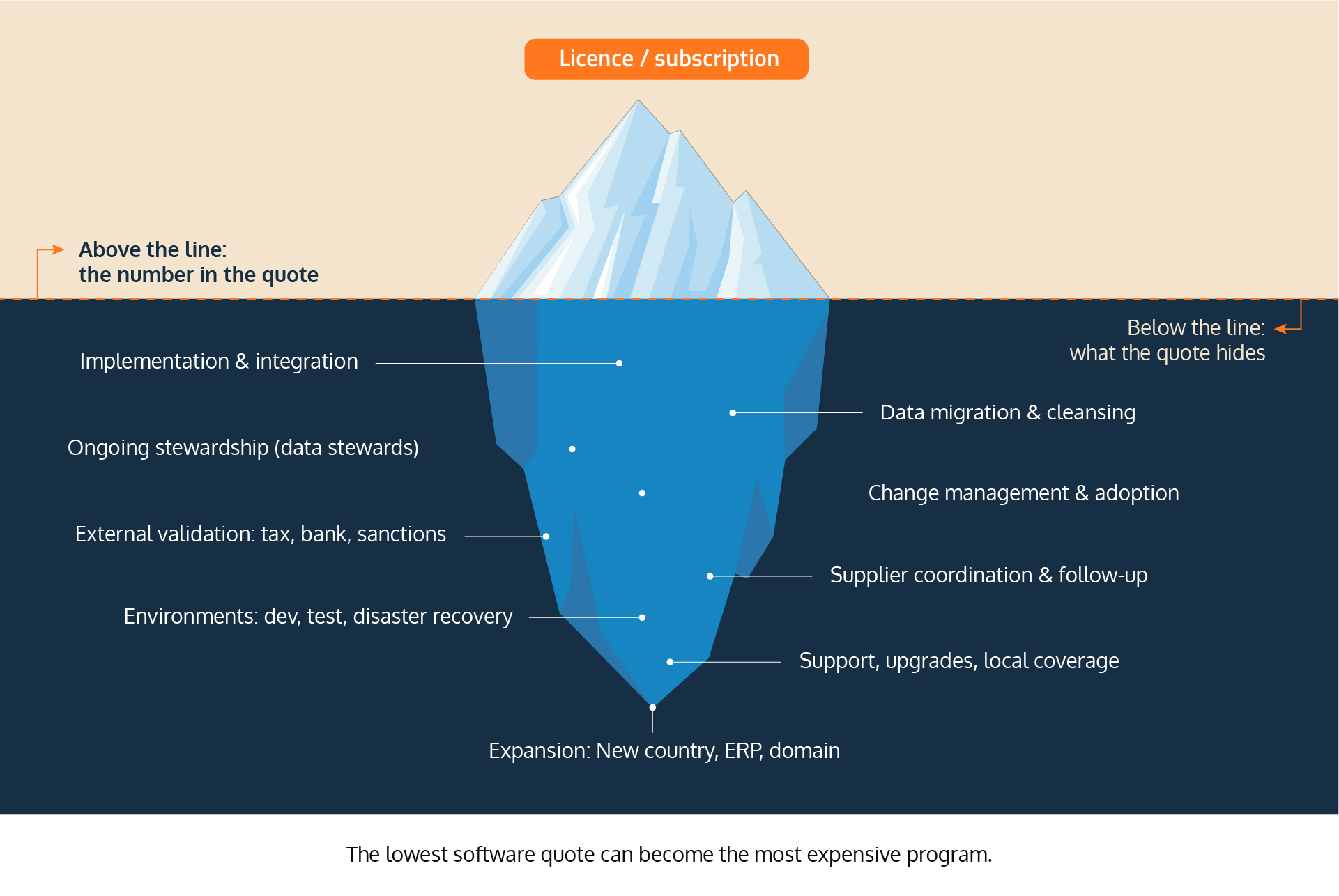
Build the commercial comparison around these cost drivers:
| Cost driver | Question to ask |
| Domains and record volume | Which domains, source records, trusted master records and relationships are included? How is growth charged? |
| Environments | Are development, test, disaster recovery and production included? |
| Integration | Which ERP, S2P, database, cloud and API connectors are included, and which need custom work? |
| Initial remediation | Who profiles, cleanses, deduplicates, classifies and enriches historical data? |
| External validation | Are tax, address, corporate, sanctions, bank or enrichment services included? |
| Stewardship | How many data stewards are required, and who operates exception queues after go-live? |
| Supplier coordination | Do the vendor or partner contact suppliers, collect missing data and follow up on documents? |
| Implementation | What is included in data modeling, rules, workflow, testing, migration, and cutover? |
| Support and upgrades | What service levels, local coverage, release support and training are included? |
| Expansion | What changes when a new country, business unit, ERP, language or data domain is added? |
The lowest software quote can become the most expensive program if the enterprise must separately fund data remediation, integration, and permanent stewardship.
Best fit by industry
Procurement data problems differ by sector, and so does the right starting point.
- FMCG and consumer goods: Catalog quality, multilingual item data and tail-spend visibility often matter more than an enterprise-wide golden record. Prioritize catalog, category and supplier data, a procurement data layer such as ewiz procure, or an S2P suite, usually gets there fastest. At a global FMCG major, ewiz procure’s data-first indirect-spend program consolidated 15,000 products to 3,000, rationalized the supplier base from 5,000+ to 500, cut non-catalog buying by 40–60%, and delivered 30–35% savings through demand aggregation, with no added procurement headcount (FMCG case study).
- Manufacturing: MRO and material-master cleansing is usually the highest-ROI first step, because poor material-master data inflates procurement spend and delays maintenance. Material specialists (Verdantis, PiLog, OptimizeMRO, Prospecta) and SAP MDG for SAP estates fit here.
- Pharma and life sciences: Approved-supplier lists, compliance documents and data lineage push buyers toward governance-heavy platforms with strong audit trails.
- Chemicals, oil & gas and utilities: Supplier compliance and plant-level material and equipment data favour asset-intensive specialists that handle both material and supplier domains (PiLog, Verdantis, OptimizeMRO).
Whatever the sector, validate fit with your own records in a pilot rather than a demo dataset.
Decision matrix: choose based on your starting point
| Business situation | Recommended direction |
| SAP is the operational core and S/4HANA is central to the roadmap | Start with SAP Master Data Governance; assess whether data remediation, supplier coordination or catalog governance requires an additional procurement solution |
| Multiple ERPs and business units need enterprise-wide multidomain MDM | Shortlist Informatica, Semarchy, Prospecta, Reltio, Ataccama, Stibo Systems and Profisee; include SAP MDG where the SAP data model is dominant |
| Microsoft Fabric, Purview or Azure is central to the data strategy | Include Profisee and compare its supplier, material, governance and non-Microsoft integration depth with other multidomain platforms |
| Material, MRO or spare-parts data is causing duplicate purchases or excess inventory | Evaluate Prospecta, Verdantis, PiLog and OptimizeMRO ,and ewiz procure on the same sample of complex industrial records |
| Supplier information must stay inside onboarding, sourcing, risk and performance workflows | Evaluate GEP, Zycus and JAGGAER |
| Procurement needs governed supplier, item/material, catalog and spend data activated in workflows, while ERP and S2P stay in place | Evaluate ewiz procure’s Procurement Data Management as a procurement-domain MDM peer, using the same matching, governance, auditability and integration tests you apply to enterprise MDM |
| Procurement needs a measurable win before an enterprise-wide MDM program can be approved | Start with a bounded, data-first assessment, a procurement data layer such as ewiz procure, and prove operational value before scaling |
| Enterprise MDM exists, but procurement data and catalogs remain unreliable | Keep the core MDM hub; add a procurement data layer such as ewiz procure for procurement-specific remediation, execution and managed governance |
| The internal team cannot sustain cleansing and exception queues | Compare the managed-service models of ewiz procure and OptimizeMRO, depending on whether the scope is broad procurement data or MRO/material data |
| Procurement data must be AI- or analytics-ready — deduplicated, classified and governed | Clean and classify first through a procurement data layer such as ewiz procure, or a material specialist for industrial data, before layering AI or spend-analytics tools |
A suggested 100-point CPO scorecard for solution selection
Use a weighted score instead of letting the longest demonstration or broadest feature list win. Adjust the weights before issuing the RFP so that every provider is evaluated against the enterprise’s priorities rather than against a retrospective result.
| Criterion | Weight |
| Supplier, material, service, category, taxonomy and catalog depth | 20 |
| Matching, cleansing, enrichment and data-quality controls | 15 |
| ERP, S2P and analytics integration | 15 |
| Governance, lineage, workflow and stewardship usability | 10 |
| Ongoing data maintenance and stewardship (continuous monitoring, exception handling, re-enrichment, decay prevention) | 10 |
| Security, deployment, hosting and data-residency fit | 10 |
| Implementation plan, time to value and regional delivery capability | 5 |
| Operating model, industry expertise and managed support | 5 |
| Three-year total cost of ownership | 5 |
| Country-specific identity, language, privacy and validation requirements | 5 |
| Total | 100 |
For the final demonstration, give every vendor the same anonymized sample: duplicate suppliers, incomplete tax identifiers, inconsistent material descriptions, multiple category codes, stale certificates and conflicting records from two ERPs. Score the output, exception handling and audit trail, not the presentation.
How to get started: Run a proof of concept on your own data
The fastest way to tell real capability from a polished demo is a small proof of concept on your own records. A workable sequence:
- Scope it and sign an NDA if the data is sensitive. Agree the sample and the success criteria up front and put a mutual NDA in place before anything leaves your systems.
- Share one anonymized sample with every shortlisted vendor. Use the same messy extract for all of them, duplicate suppliers, incomplete tax identifiers, inconsistent material descriptions, multiple category codes, stale certificates and conflicting records from two ERPs, so you compare like for like.
- Ask them to clean, classify, and enrich it. Deduplicate, standardize your taxonomy, enrich, and flag exceptions against a baseline and target your set.
- Score the output, not the pitch. Check out match accuracy, how ambiguous and low-confidence records were handled, the audit trail, and what a steward would still have to fix.
- Get the operating model in writing. What the tool automates versus what needs human review; what the vendor does versus your team; and who owns exceptions, enrichment and governance after go-live.
- Separate one-time cost from ongoing cost. Implementation and the initial cleanse are one-time; subscription and managed governance are recurring. Models for both over three years.
- Fix the timeline and the bar. Agree the date for the first clean, governed domain and the measurable targets it must hit before you scale.
Run it identically with each vendor, and the shortlist decides itself on evidence rather than presentation.
Questions CPOs should ask every provider
| Sr. No. | Questions |
| 1 | Which system becomes the source of truth for each procurement data domain? |
| 2 | Can you demonstrate supplier and material matching using our sample data? |
| 3 | How are tax, company-registration, trade-licence and bank-data changes validated in every operating market? |
| 4 | What percentage of exceptions will require a human steward? |
| 5 | Who contacts suppliers and resolves incomplete or conflicting records? |
| 6 | How does the mastered data flow into SAP, Oracle, Coupa or our current stack? |
| 7 | Can changes be reversed, traced and approved at attribute level? |
| 8 | Where will data, backups and logs be hosted, and which subprocessors can access them? |
| 9 | What does the first 90 days deliver in measurable procurement terms? |
| 10 | What team is needed to operate the solution after implementation? |
| 11 | Which license or consumption metric increases as records, domains and regions grow? |
| 12 | How will the platform improve sourcing, catalog adoption, spend analysis or supplier compliance? |
| 13 | After the one-time cleanse, how is the data kept clean: what monitoring, exception handling and re-enrichment prevent duplicate and stale records, and who runs it? |
Final recommendation
Start with the business problem and data domain, not a vendor logo.
Choose SAP MDG, Informatica, Semarchy, Prospecta, Reltio, Ataccama, Stibo Systems or Profisee when the enterprise needs a multidomain data backbone, with the shortlist shaped by the application of estate and priority domains. Choose Verdantis, PiLog or OptimizeMRO when complex industrial, material and MRO data is the dominant problem. Choose GEP, Zycus or JAGGAER when supplier information must be governed inside source-to-pay workflows. Evaluate ewiz procure as a direct procurement-domain MDM peer when the master-data scope is supplier, material, category and catalog, and the requirement also extends into spend, transactions and procurement execution.
Want to see what is actually wrong in your procurement data before selecting a platform?
Start with a sample data assessment and a 30-minute discovery call.
Source log
Market and analyst sources
- Gartner: Magic Quadrant for Master Data Management Solutions, April 2026
- Forrester: The Forrester Wave, Master Data Management Solutions, Q2 2025
- Gartner Peer Insights: MDM Solutions market
- Gartner Peer Insights: Source-to-Pay Suites market
- Microsoft: Master Data Services removed in SQL Server 2025
- Salesforce completes acquisition of Informatica, 18 Nov 2025
Review sources (used for the ratings snapshot and “What real users say”)
- Gartner Peer Insights: Reltio vs SAP · Reltio vs Semarchy
- Gartner Peer Insights: Prospecta MDO reviews · Verdantis MDM Suite reviews · PiLog MDRM reviews
- Gartner Peer Insights: GEP vs JAGGAER · Zycus Source-to-Pay Suite reviews
- G2: Profisee reviews · Capterra: ewiz procure
- Codasol: MRO data standardization (industry commentary on material-data impact)
Official vendor sources
- SAP Master Data Governance · MDG for Material · MDG for Supplier
- Informatica MDM and 360 Applications · pricing
- ewiz procure product information · beverage catalog case study
- Semarchy materials-data · vendor-data
- Prospecta MDO overview · procurement & supply chain · MDO for SAP MM
- Verdantis MDM Suite · Harmonize
- Reltio Multidomain MDM
- Ataccama ONE MDM
- Stibo Systems STEP · customer/supplier MDM implementation
- Profisee Supplier MDM
- PiLog Data Quality & Governance Suite
- GEP Supplier Management · supplier master-data capabilities
- Zycus Supplier Information Management
- JAGGAER Supplier Management & Performance
- OptimizeMRO Data Excellence · Data Transformation · MRO Data Governance
- Semarchy — MDM implementation
- Stibo — deploy MDM in under 6 months
- Verdantis — MRO data cleansing
- Leading Edge Only — MRO cleansing case study.
India and UAE regulatory sources
- India DPDP Act, 2023 · DPDP Rules, 2025 · commencement notification, 13 Nov 2025
- GST taxpayer search · Udyam verification
- UAE Federal Decree-Law No. 45 of 2021 · FTA TRN verification