
Procurement leaders keep saying the same thing: cycle times aren’t the real bottleneck — dirty data is. Poor indirect spend visibility doesn’t announce itself; it erodes quietly until a team realizes reporting on “what we buy, from whom, and at what spec” has become a monthly debate instead of a daily fact.
That was the situation for this global beverage company. Karthik Rama, known as the “Procurement Doctor,” describes that kind of environment as “the silent virus.” As he puts it: “Bad data doesn’t shout. It erodes. Slowly, quietly. Until leaders realize they’ve lost 10 or 15 percent of their visibility.”
The symptoms were concrete: fragmented product data and non-standard SKUs across geographies, no common taxonomy or image standards, heavy manual effort to update and validate entries, poor indirect spend visibility from incomplete SKUs, and risk exposure from outdated supplier information. Every misnamed SKU hid spend, blocked guided buying, and inflated compliance risk — while manual updates crawled through spreadsheets and inboxes across regions.
In today’s blog, we showcase how a global beverage company operating in 50+ countries consolidated fragmented catalogs in Coupa and unlocked measurable control over indirect spend.
The cost of messy catalogs
Every misnamed SKU hid spend, blocked guided buying, and inflated risk. Manual updates crawled through spreadsheets and inboxes across regions.
With incomplete or inconsistent attributes, reporting on “what we buy, from whom, and at what spec” became a monthly debate instead of a daily fact. That uncertainty amplified compliance risk and burned team hours.
Symptoms recognized:
- Fragmented product data and non-standard SKUs across geographies
- No common taxonomy, images, or description standards
- High manual effort to update and validate entries
- Poor visibility into indirect spend due to incomplete SKUs
- Risk exposure from outdated supplier information
The Turning Point: Procurement excellence through data enrichment and automation
Powerweave’s ewiz procure team ran a structured, four-phase program that blended AI with managed services and rigorous supplier coordination, without replacing existing system.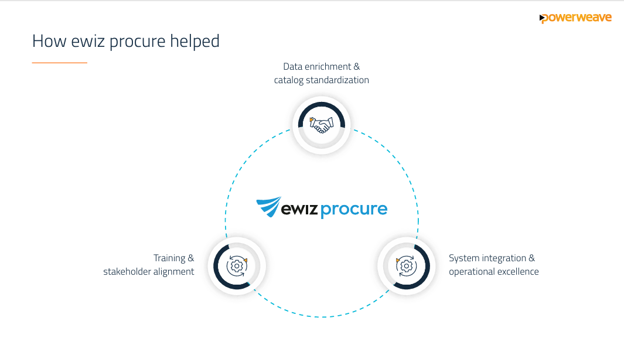
Phase 1 – Data Enrichment & Catalog Ops
- Standardized and enriched 8,496 SKUs across 274 catalogs with a locked attribute schema, naming rules, and image standards.
- Built multilingual entries (EN/ES) using an LLM enrichment pipeline with human QA gates.
- Created a reusable Catalog SOP pack: taxonomy guide, attribute dictionary, naming templates, image specs, QA checklist.
Phase 2 – Supplier Enablement & Governance
- Ran end-to-end supplier communications, follow-ups, and discrepancy resolution with documented SLAs.
- Maintained a weekly governance cadence with cross-functional stakeholders, publishing issue logs and “ready to load” sign-offs.
Phase 3 – Coupa Integration & Release Management
- Loaded enriched catalogs to the Coupa test and production, with pre-load validation, post-load smoke tests, and rollback plans.
- Produced environment-specific runbooks and a cutover checklist to ensure regional readiness.
Phase 4 – Training, Change, and Adoption
- Delivered concise video micro-lessons and role-based quick reference guides for buyers and admins.
- Held SME office hours for the first four weeks post-go-live, tracking questions to close process gaps.
The Impact: Unlocked visibility and supplier alignment
- 100% indirect spend visibility across key suppliers
- 8,496 SKUs standardized and enriched across 274 catalogs
- 65%+ SKUs mapped accurately to manufacturer data
- 70%+ SKUs simplified with clear, consistent descriptions
- 22% of previously uncategorized spend identified
The procurement operations leader from the client company puts it plainly,
“Powerweave dramatically improved our procurement catalogs’ quality and visibility. Their structured process, supplier coordination, and AI-driven approach saved us valuable time and ensured compliance across multiple markets. We now have complete clarity and confidence in our procurement data”.
Want to share the success story with your team?
Click here to download the full case study
Why it worked
- Standards before software: taxonomy, attributes, and image rules created a shared language.
- AI with guardrails: LLMs accelerated enrichment, supplier verification preserved accuracy.
- Last-mile services: supplier follow-ups, discrepancy resolution, and training kept momentum.
- Inside the ERP spine: loading into Coupa meant instant usability for buyers.
What it unlocked for leaders
CFO: defensible, real-time visibility into indirect spend and supplier exposure.
CPO: guided buying that users actually adopt, cleaner RFx inputs, and faster audits.
Category managers: precise specs, apples-to-apples comparisons, and fewer escalations.
Suppliers: clear standards, fewer rounds of “please resend,” faster catalog turns.
With data foundations in place, AI’s upside compounds: 3× sourcing productivity, up to 40% faster cycles, and 61% better supplier risk visibility are now within reach for teams that maintain continuous hygiene.
Source: AI in Procurement Guide
Want to streamline your catalogs and supplier data?
Book a call with the ewiz procure team
Discover how ewiz procure can help you find your procurement sweet spot — fast, measurable, and disruption-free.
