
Giga project procurement is now judged on a single question: can it keep the program on schedule?
In the GCC’s mega-programs, new cities, transport corridors, stadiums, tourism destinations, a milestone slip is a national, visible event. Savings still matter, but a 3% cost reduction means little if the project slips 30 days.
That shift has consequences for the systems procurement teams rely on. Most enterprise procurement tools were designed to enforce budgets and policy in a stable corporate environment. Giga projects are neither stable nor corporate: scopes move weekly, contractor counts run into the hundreds, and documentation cycles are construction-grade.
This blog lays out why legacy procurement environments fail at this scale, and the five-lever playbook procurement leaders are using to compress delivery time without triggering a disruptive, big-bang overhaul.
According to Knight Frank’s 2025 Saudi construction outlook, contract awards for Saudi giga projects alone jumped 20% in 2025, pushing total commitments to nearly US $200 billion.
In one of recent Beyond Procurement podcast with Ahmed Raafat, Head of Procurement at A.R.M. Holding, he emphasized,
“CEOs are looking for growth and are more keen about resilience, and they ask you questions like how does procurement help us faster? How do procurement and supply chain help us expand smarter? How will that protect our reputation in the market?”
And nowhere is that pressure stronger than in Saudi Arabia’s giga projects, where milestones are nationally visible and contractor ecosystems expand by the week.
So today’s edition focuses on a single question:
What must procurement leaders prioritize now to keep giga-scale programs on track, without triggering a disruptive, big-bang system overhaul?
Key takeaways
- In GCC giga projects, cycle time has overtaken cost savings as procurement’s defining measure of success.
- Legacy procurement systems break at giga-project scale because they were built for HQ workflows, not project-native execution.
- Saudi giga-project contract awards reached US$196 billion in 2025, up 20% on 2024 (Knight Frank, Oct 2025), the pace is forcing the change. Knight Frank AE
- The fix is a modular, project-native procurement layer added on top of your ERP — not a big-bang system overhaul.
- A working playbook exists: project-native structure, time compression with governance intact, a supplier ecosystem, real-time C-suite visibility, and early risk signals.
Let’s break it down.
The new C-suite mandate: deliver faster or risk the entire schedule
When CEOs and CFOs in the GCC talk about procurement today, they’re not talking about rate cards or policy documents. They are talking about the real operational blockers slowing program delivery:
- Delayed contractor mobilization
- Material deliveries slipping by weeks
- Fragmented supplier reliability
- Variation orders piling up
- Documentation out of sync with site conditions
- Cash-flow delays caused by late handover
These aren’t administrative issues. They’re schedule, revenue, and reputation risks.
Which is why the C-suite now expects procurement to:
- Compress cycle time
- Accelerate build phases
- Secure innovative, reliable suppliers
- Strengthen supply resilience
- Keep documentation audit-ready
- Reduce risk on the critical path
Ahmed Raafat captured it perfectly in our recent discussion:
“CEOs want speed, resilience, and smarter expansion. They want procurement to help them move faster, and protect the company’s reputation while doing it.”
This is the new bar.
Why legacy procurement systems break at giga-project scale
Giga projects expose gaps in legacy procurement environments because they were designed for corporate workflows rather than project-native execution.
Here’s where they break:
- Designed for cost control, not speed
They excel at enforcing budgets and fail when the priority is shaving months off delivery. Your CEO doesn’t care about a 3% saving if the project slips 30 days.
- Workflows are too rigid for construction
Design shifts. Package scopes evolve. Interfaces change weekly. Legacy tools force everything into a fixed sequence that breaks the moment the project shifts. And once the system stops matching reality, teams bypass it — and governance collapses.
- Supplier onboarding becomes a critical bottleneck
Giga projects typically engage:
- 400–600 local contractors
- 200 regional specialists
- 50+ global partners
If onboarding takes weeks, package readiness slips before work begins.
- Documentation overload destroys control
Insurance. Drawings. Safety. ESG. Method statements. Legacy tools can’t keep up with construction-grade documentation cycles.
Teams fall back to email, drives, spreadsheets, and WhatsApp. And once that happens, alignment disappears.
- There’s no predictive, real-time visibility for leadership
Most legacy dashboards show history. Giga projects demand a live understanding of:
- Supplier performance
- Variance movement
- Milestone dependencies
- Documentation risk
- Early warning signals
Reactive procurement cannot support giga-scale execution.
And the pace is region-wide — in the UAE alone, the construction market is projected to expand by 6.2% in 2025, reaching ~AED 189.6 billion.
That’s why the procurement playbook needs to shift; here’s how.
The new procurement playbook for GCC construction
Across conversations at the 100 CPO Summit and from leaders like Ahmed Raafat, a new model has emerged. Procurement leaders succeeding in giga projects are pulling four strategic levers:
- Make procurement project-native
- Compress time without losing governance
- Turn the supplier ecosystem into an innovation engine
- Give the C-suite real-time, trusted visibility
- Spot risks early and act before they escalate
And this playbook already works at scale.
Abu Dhabi–based construction firm using this exact playbook has:
- 80% paperless operations, reducing printing and courier costs
- Improved bid evaluation speed through real-time analytics and reporting
- Expanded supplier base and clearer third-party communication
It proves that a modular, project-native layer can deliver giga-scale outcomes without a big-bang transformation.
That’s precisely where ewiz procure sits.
Let’s break down the playbook.
- Project-native procurement → built around packages, milestones, and codes
What leaders need
Procurement has to map directly to the program structure — packages, BOQs, milestones, project codes — so that engineering, finance, and procurement move in lockstep.
How ewiz procure supports it
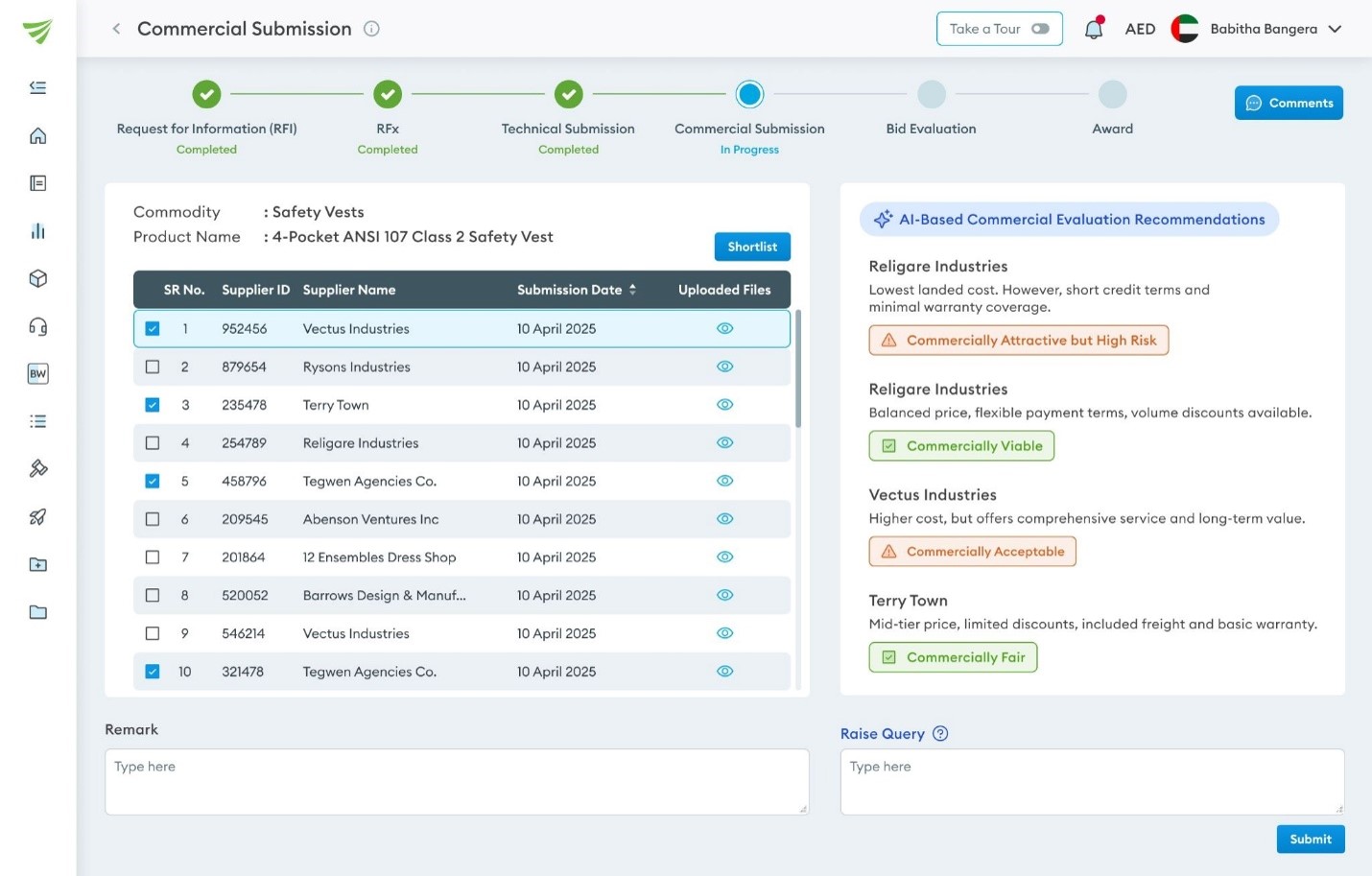
- RFx and eAuctions are structured around packages and BOQs
- Bi-directional ERP integration so project/cost codes never break
- Configurable modules that mirror each program’s hierarchy
Teams get construction-native control without touching the ERP or forcing a new enterprise platform.
- Time compression + governance → automation where delays actually live
What leaders need
Digitalization that cuts weeks and months, not just clicks. This means attacking the friction in:
- Onboarding
- Approvals
- RFx cycles
- Documentation
- PR-to-PO
How ewiz procure supports it
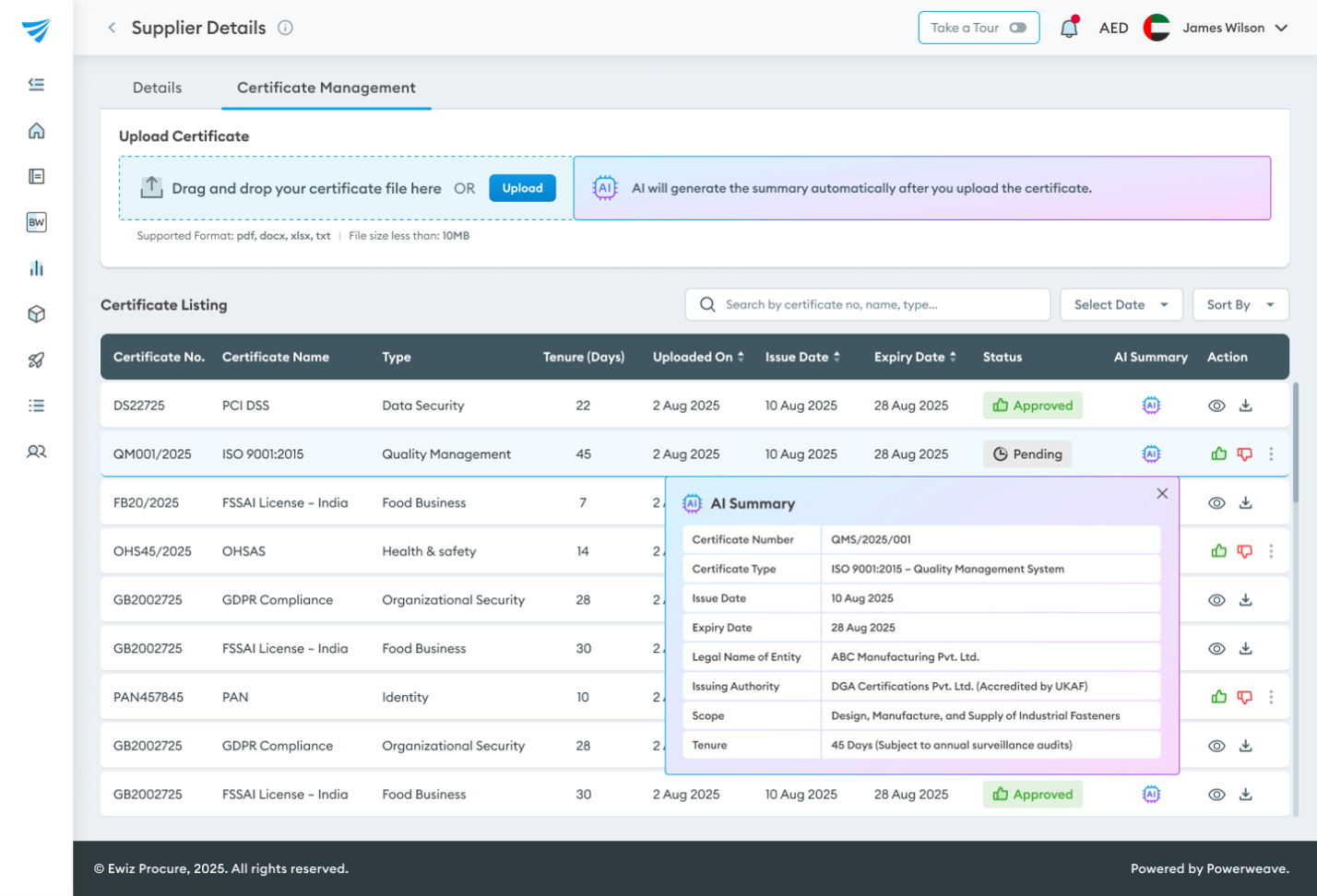
Automated AI Summary for Certificate Management in ewiz procure
- Guided workflows remove manual chasers
- Automated reminders keep approvals and documentation moving
- Straight-through PR-to-PO in stable categories
- Configurable automation to solve the highest-friction processes first
- Supplier ecosystem → performance, ESG, and innovation signals in one place
What leaders need
High-performance suppliers are the only real hedge against schedule slip. You need visibility into: reliability, safety, quality, ESG, documentation, and innovation.
How ewiz procure supports it
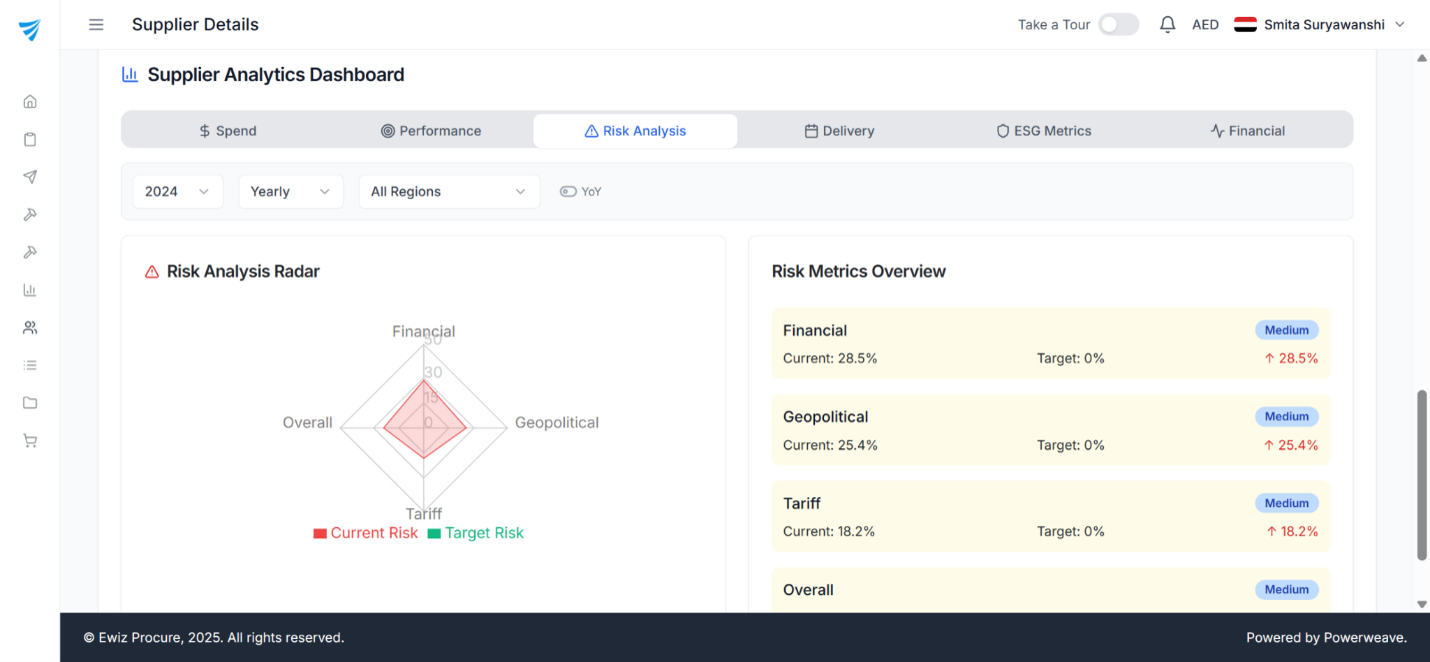
Supplier Risk Analysis Dashboard in ewiz procure
- Supplier master with real performance signals
- ESG and certifications tracked centrally
- Light, mobile onboarding for global and local partners
- Analytics that spotlight suppliers who reduce delays and improve outcomes
- Real-time C-suite visibility → one trusted view, not scattered reports
What leaders need
CFOs kept saying it at the Summit:
“If I can’t see it in one view, I can’t act.”
They want clarity on:
- Committed vs budget
- Package and supplier risk
- ESG and documentation status
- Cycle time and variance movement
- Timeline impact
How ewiz supports it
- ERP + ewiz data unified into one real-time dashboard
- Executive views for C-suite, project directors, and procurement
- Analytics covering efficiency, compliance, savings, and ESG
- Modular rollout — start small, scale fast
- Risk prevention → early warnings instead of late-stage surprises
What leaders need
In giga projects, risk first shows up in small signals — a slipping supplier, a missing certificate, an expiring insurance policy, a delivery variance.
Leaders need a system that surfaces these issues early so timelines don’t move before anyone notices.
How ewiz procure supports it
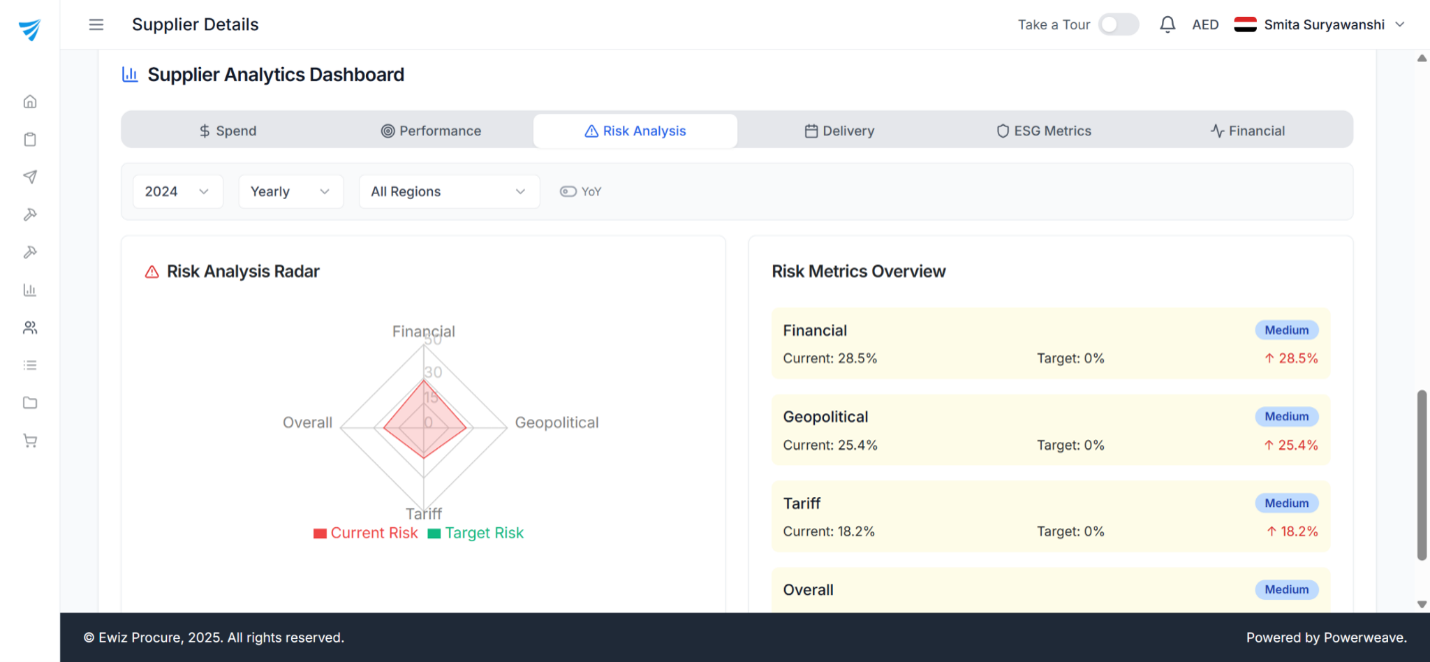
- Live supplier performance signals across delivery, quality, and documentation
- Automated alerts for expiring or missing certifications
- Variance tracking at the package and supplier level
- ERP + ewiz data combined for clearer risk flags
- Escalations that surface issues fast
This turns procurement into the first line of defense against risk, not the team discovering problems after they’ve already hit the schedule.
The takeaway: speed is the new currency
The leaders winning today aren’t optimizing the process. They’re optimizing time.
They’re shifting:
- From HQ workflows → to project-native execution
- From reports → to predictive visibility
- From tactical suppliers → to performance ecosystems
- From monolithic systems → to modular plug-in layers
Procurement is no longer a cost lever. It’s the operational engine of the giga-project delivery.
See what this playbook looks like for your program
If you want to understand where delays live inside your procurement flow — and how quickly they can be removed — join us for a short working session.
In 30 minutes, we’ll surface:
- The friction slowing your package cycles
- Where suppliers are creating hidden risk
- Where documentation is breaking the process
- And what immediate wins you can unlock within weeks
Click below to Book a Free Discovery Call.
