
Over the last few years, procurement has evolved from being primarily a cost-saving function to becoming a strategic driver of business resilience. Today, procurement leaders are expected to balance cost optimization, supplier performance, operational efficiency, risk management, and sustainability, all at the same time.
As environmental, social, and governance (ESG) regulations become more stringent across global markets, procurement sits at the center of this transformation. Regulatory bodies, investors, customers, and boards increasingly expect organizations to demonstrate responsible sourcing, reduce supply chain emissions, and improve supplier transparency.
The challenge is clear: How can procurement teams meet growing ESG and compliance requirements without slowing sourcing, increasing operational complexity, or compromising business agility?
Many organizations still approach ESG as an additional layer of documentation or manual reporting. However, leading procurement teams are proving that ESG doesn’t have to be a trade-off between compliance and speed. By embedding sustainability directly into procurement workflows, they are transforming ESG from a reporting obligation into a competitive advantage.
In this article, we’ll explore why traditional ESG approaches often fail, how modern procurement teams are integrating sustainability into everyday decision-making, and what organizations can do to improve compliance while maintaining procurement velocity.
Why ESG Has Become a Strategic Procurement Priority
The regulatory environment surrounding ESG is evolving rapidly. The European Union’s Corporate Sustainability Reporting Directive (CSRD) and Corporate Sustainability Due Diligence Directive (CSDDD) are introducing stricter supplier disclosure requirements. Meanwhile, the U.S. Securities and Exchange Commission (SEC) is advancing climate-related disclosure rules, and GCC countries are increasingly incorporating sustainability into procurement frameworks. The compliance landscape is tightening:
- The EU’s CSRD and CSDDD directives mandate detailed supplier disclosures.
- The US SEC is finalizing climate-related disclosure rules.
- GCC governments are introducing sustainability-linked procurement frameworks.
Procurement owns most of the spend categories that directly influence Scope 3 emissions, labor practices, and ethical sourcing. Yet most teams still struggle to keep pace.
Deloitte finds that 70% of organizations lack reliable ESG data from their supply chains.
Why Traditional ESG Approaches Fall Short
Despite good intentions, ESG in procurement often becomes a paperwork exercise. Teams rely on:
- Supplier self-assessments in spreadsheets
- Static surveys that are rarely updated
- Annual audits with no real-time visibility
This not only slows sourcing cycles but also frustrates suppliers and leaves leaders exposed to compliance risks. ESG ends up being seen as a burden, not a value driver.
How to align ESG with speed
High-performing procurement organizations are taking a fundamentally different approach. Rather than managing ESG through separate processes, they integrate sustainability directly into existing procurement workflows. That means:
- Automated ESG scoring tied to supplier master data and tenders
- Real-time dashboards tracking carbon footprint, diversity, and compliance scores
- AI-driven alerts that flag non-compliance or high-risk suppliers
- Guided intake workflows that nudge requesters toward sustainable options
With this approach, ESG becomes the default setting for procurement, not an afterthought.
At ewiz procure, we’ve built ESG into the fabric of the platform. Whether you’re running a tender, buying from catalogs, or monitoring supplier performance, sustainability metrics flow naturally into the decision-making process.
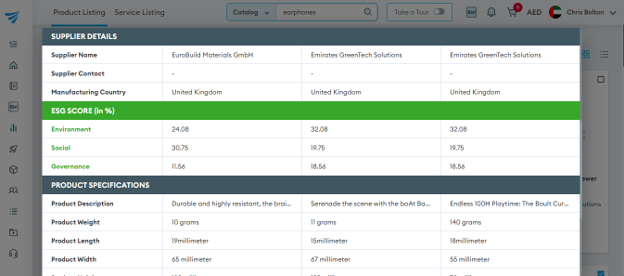
See the complete Catalog Buying module in action
Catalog buying with ewiz procure
Industry Evidence Shows ESG and Performance Go Hand in Hand
Independent studies reinforce this approach:
- By 2026, 70% of technology sourcing, procurement and vendor-management leaders will have environmental-sustainability-aligned performance objectives for their functions.
- For most companies, Scope 3 accounts for ~80–90% of total emissions, with a large share tied to purchased goods and services, making supplier engagement a primary lever for decarbonization.
- Reducing Scope 3 by ~15% by 2030 is feasible with existing technologies; innovations could enable an additional 40–50% reduction, procurement choices are central to unlocking it.
- “Digital World Class®” procurement teams (those embedding advanced capabilities across sourcing, risk, and sustainability) achieve ~2.6× higher ROI and run at ~19% lower cost than peers.
Source: IT Brief Australia | McKinsey & Company+1 | McKinsey & Company | The Hackett Group®
The message is clear: ESG is no longer optional — it’s measurable, manageable, and market-moving.
A case study in point: Leading CPG & frozen foods retailer
Using AI to Strengthen ESG and Supplier Risk Management
Global CPG and frozen foods retailer seeking tighter supplier risk control, inventory optimization, and compliance confidence.
Challenge
- Limited visibility into plant performance and heavy reliance on single-source suppliers increased exposure.
- Fragmented risk profiling missed emerging issues; demand–supply mismatches caused both stockouts and overstocking—driving cost and disruption.
- Risk, compliance, and operational signals lived in silos, making it hard for procurement to act during RFx, negotiation, and awards.
Solution
An AI-driven platform consolidated financial, operational, and ESG risks into a 360° supplier/plant dashboard, enabling real-time forecasting, inventory optimization, end-to-end risk monitoring, automated SKU rationalization, and quarterly risk briefings. Procurement used these insights to shape pre-qualification, RFx scoring, dual-sourcing strategies, and corrective action plans.
Impact
- 25% reduction in supplier risk exposure
- $14M+ in inactive inventory identified through AI-enabled analysis
- 10–15% improvement in material availability via optimized raw-material flow
- 2–5% increase in plant capacity with better performance visibility and scorecards
By surfacing ESG risk alongside financial/operational signals in the same workflow, procurement could award to best-value, lower-risk suppliers and evidence decisions for audit and sustainability reporting—without slowing down sourcing.
Source: AI in Procurement Guide
Going deeper: The AI in Procurement Guide
This is one of five enterprise-ready AI use cases featured in our new guide. Inside you’ll find:
- 10+ success stories from leaders like Siemens, Coca-Cola, and ADCE
- Insights from procurement executives at Microsoft, Johnson Controls, and Uber
- Playbooks for connecting ESG to ROI without adding friction
Download the AI in Procurement Guide
For procurement leaders
ESG is no longer just about reporting. It’s about resilience, reputation, and results.
Those who can embed sustainability seamlessly will not only meet compliance mandates but also accelerate sourcing, strengthen supplier relationships, and unlock competitive advantage.
Because the future of procurement isn’t just faster. It’s smarter and sustainable.
At Powerweave, we help enterprises rethink procurement and sustainability with purpose-built modular solutions like ewiz procure and Snowkap. Want to explore what this could mean for your team or where to start?
No pitch decks, just a real conversation.
