
Open any enterprise procurement cycle and it looks digital.
From the outside, procurement appears to be running through structured systems and governed workflows. Process maps are documented, approvals are defined, and transactions flow through the ERP. To most stakeholders, it seems like a process that is fully under control. Two clean, structured endpoints. From a leadership dashboard or steering committee deck, the process appears transparent, traceable, and tightly managed.
After all:
- A purchase requisition is raised in the ERP.
- A purchase order is returned to the ERP.
But those two points tell only part of the story.
The most commercially significant decisions in the procurement cycle happen between the requisition and the purchase order, when suppliers are invited to quote, bids are compared, prices are negotiated, and awards are made. These decisions determine cost, compliance, supplier performance, and ultimately margin.
Yet in many enterprises, this critical work still takes place across emails, spreadsheets, phone calls, and manual follow-ups.
And that’s where visibility begins to disappear, cycle times start to stretch, and value quietly leaks out of every sourcing event.
Then look at what happens between those two points.
The middle of the PR-to-PO cycle barely touches a system
Once the requisition is raised, the cycle leaves the ERP almost immediately and doesn’t come back until the PO is punched:
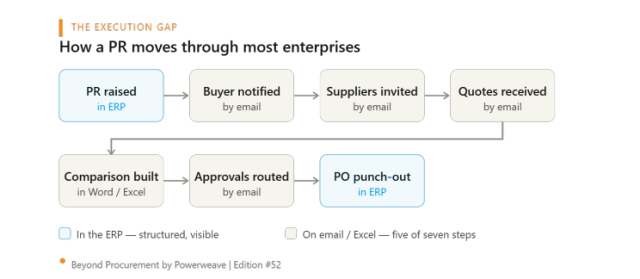
The requisition is structured. The PO is structured. Everything that happens in between- the part where the supplier is actually chosen, and the price is actually set- runs on email, spreadsheets, and follow-up calls.
That is not a small gap.
It is most of the cycle, and it is the most commercially consequential part of it.
- Which supplier got invited,
- How the quotes compared
- Why this award and not another.
All decided in the steps that never touch a system.
This isn’t a tooling gap. It’s how the work is built.
The manual middle isn’t a failure of any one team. It’s the default shape of the PR-to-PO cycle in most enterprises, and the people closest to it feel it most.
Megha Singh , Director of Procurement Transformation at Micron and previously at Novartis and Walmart, named it plainly on the Beyond Procurement podcast, talking about where the real pain sits:
As much as creating the requisitions, which has to go through a manual process, the approval process also is a very manually task.
Both ends of the cycle the ERP is supposed to own, the requisition and the approval, still run by hand. That’s not a discipline problem. It’s a design one.
What the manual PR-to-PO process quietly costs
When the deciding work lives in inboxes and spreadsheets, three things never make it into a system of record:
- No benchmarking trail –There’s no durable record of how the chosen supplier compared to the others, because the comparison lived in a file on a buyer’s laptop.
- No decision analytics –Patterns across cycles can’t be read, because each cycle was assembled by hand from scratch.
- No audit visibility –When finance or audit asks how an award was reached, the answer is reconstructed from email threads, if it can be reconstructed at all.
It doesn’t fail loudly. It erodes every cycle, adding a little more off-contract leakage and a little more spend that only becomes visible at quarter-end, when it’s too late to influence.
The fix: Automate the middle, leave the ERP alone
Faced with this, many enterprises reach for the most disruptive option: replace the suite, re-platform, run another multi-year program.
The better move is the opposite: change what is broken, not what is working.
The ERP stays exactly where it is, the system of record for the PR and the PO, with finance and material master untouched. What changes is the middle. A modular PR-to-PO layer sits on top of the suite you already run:
Closing the manual steps one by one: supplier inquiry, RFx, quote comparison, approval routing, and PO generation, all in one connected, auditable workflow.
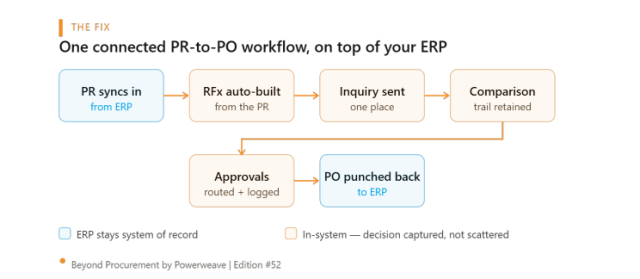
And because adoption usually determines whether any of this survives contact with a busy team, supplier onboarding, coordination, and helpdesk support come with it. The system gets used, not just deployed.
The ERP keeps its job. The manual middle becomes a managed, visible workflow.
Case study: How a chemical manufacturer closed the PR-to-PO gap
A chemical manufacturer was running its direct-procurement PR-to-PO cycle exactly this way: requisition in the ERP, then inquiry, quotes, and comparison strung across email and spreadsheets, approvals chased by phone. The ERP was sound. The middle wasn’t.
Rather than replace anything, they layered the PR-to-PO engine on top of the existing ERP and closed the manual steps one at a time:
- The requisition was synced in from the ERP, so sourcing started from the system of record instead of a re-keyed email.
- RFx was auto-populated from the PR and inquiry went out from one place, every invited supplier on the same structured request, not scattered across inboxes.
- Comparison moved in-system, so the benchmarking trail behind each award was retained instead of living in a buyer’s spreadsheet.
- Approvals were routed on configurable rules with each step logged, replacing the follow-up calls to an approver sitting on a comparison.
- The PO was punched back into the ERP with the decision captured alongside it, finance and material master untouched.
- And because adoption is what usually decides whether this survives a busy team, supplier onboarding, coordination, and helpdesk support ran alongside the rollout.
The reported outcomes, across key parameters:
- 2+ hours saved per PR-to-PO cycle
- 75 hours saved per supplier onboarding
- 80%+ of target KPIs achieved across the engagement
No re-platforming. The ERP kept its job; the manual middle became one connected workflow, and the hours buyers had been losing to chasing went back into sourcing.
What PR-to-PO automation unlocks for leaders and stakeholders
- CFO – A defensible record behind every award, leakage recovered from off-contract and uncompetitive buying, and lower process cost, with no disruption to the finance system of record.
- CPO – Value in weeks rather than a multi-year program, and a complete, queryable decision trail that stands up in a steering committee.
- Procurement Buyer – RFx populated for them, comparisons built in-system, approvals that route themselves, and an end to chasing an approver who has been sitting on a comparison for three days.
Where to start
You don’t need a transformation program to find out whether this applies to you. You need to walk one cycle.
If you want to understand:
- Where your PR-to-PO cycle actually leaves the system, step by step
- What the manual middle is costing you in hours, off contract spend, and audit gaps
- How a fix maps onto the ERP you already run, without replacing it
That’s a useful conversation to have.
Ready to scope what fixing your PR-to-PO cycle looks like?
We’ll walk you through exactly where your cycle leaves the system, what it’s costing, and how to close the gap without replacing your ERP.
