
Supplier data and supplier intelligence are not the same thing, and the gap between them is where procurement risk hides. A supplier can be fully recorded in your ERP and still be a blind spot, because the information procurement actually needs to make a confident decision, certificates, compliance status, performance history, dependency risk, is often scattered across emails, spreadsheets, folders, and disconnected systems.
This is the core contradiction facing modern procurement teams: you can have complete supplier data and still lack supplier visibility. And when that gap goes unnoticed, supplier data stops being an administrative issue and becomes a risk issue.
Key takeaways:
- Supplier records existing in an ERP does not mean procurement has real-time visibility into supplier risk, readiness, or dependency.
- 47% of procurement leaders don’t trust their supplier data, and 55% say poor supplier data increases risk exposure (Graphite Connect, 2026).
- The fix isn’t another supplier portal, it’s connecting existing data into a living, continuously updated risk and relationship layer.
- Supplier management should evolve across four areas: onboarding, continuous compliance, risk visibility, and ESG integration.
The problem: A supplier can exist in your ERP and still be a Blind spot
This sounds contradictory, but it’s common in complex procurement environments.
The supplier master sits in the ERP. Yet the information procurement needs to make a confident decision is often spread across emails, folders, spreadsheets, and different systems.
- Certificates are somewhere in email
- Compliance documents are in folders
- Capabilities are in spreadsheets
- Contracts sit in another system
- Performance history may sit with individual teams
- Corrective actions are tracked manually
- Renewals depend on someone remembering
Everything exists. But the full picture doesn’t.
And when procurement needs a simple answer, the work begins:
- Is this supplier approved?
- Are their certificates still valid?
- What are they qualified to supply?
- Are there open compliance or CAPA issues?
- How dependent are we on them?
- How critical are they to the business?
That is when supplier data stops being an administrative issue. It becomes a risk issue.
The real problem isn’t missing data, it’s disconnected data
- A supplier can be performing well today and still create concentration risk.
- A certificate can be available but close to expiry.
- A strategically important supplier can have unresolved corrective actions.
- A lower-tier supplier can have the right capabilities but struggle with documentation, onboarding, or compliance requirements.
If procurement cannot see these signals early, it usually ends up reacting after the problem appears.
This is reflected in Graphite Connect’s 2026 Supplier Data Benchmark:
- 47% of procurement leaders don’t trust their supplier data.
- 55% say poor supplier data increases risk exposure.
- Average supplier onboarding takes around 19 days, while slower organizations can take more than 90 days.
The answer is not simply another supplier repository. The real opportunity is to turn supplier data into ongoing supplier intelligence.
In one episode of Beyond Procurement, Karthik Rama, a.k.a. the Procurement Doctor, put it this way:
Bad data doesn’t shout. It erodes. Slowly, quietly. Until leaders realize they’ve lost 10 or 15 percent of their visibility.
What this looks like in practice
Consider an example from the marine industry.
A large, distributed supplier network may include vendors supporting vessels, maintenance, spares, and operations across different locations.
A supplier may be approved in the system. But when procurement needs to know whether:
- That supplier is still compliant
- What they can supply
- Whether documentation is current
- Or whether there are unresolved issues
The answer may require checking several sources and speaking to different teams. That creates friction. More importantly, it creates uncertainty.
Karthik Rama’s challenge to procurement teams cuts to the heart of it:
We are asking suppliers a million things. Are you even cross-verifying it?
A better supplier-management approach brings these signals together and keeps them current. Effective supplier management should create a living risk and relationship layer around every supplier, starting with clean, governed supplier data, then putting it to work.
How ewiz procure solves this: 4 connected areas of supplier management
At ewiz procure, we think about Supplier Management across four connected areas.
1. Make onboarding easier and faster
Supplier onboarding should not become a paperwork exercise.
Statutory checks, document collection, and validation can be built into the workflow. Information can be extracted from supplier documents, missing information can be flagged, and suppliers can be guided through the process.
For large and distributed supplier bases, adoption matters too. Mobile-friendly experiences, regional-language support, and hands-on onboarding assistance can make the difference between a process that works on paper and one that suppliers actually use
2. Move from one-time compliance to continuous readiness
Supplier readiness changes continuously.
- Certificates expire
- Licenses change
- Compliance status changes
- Corrective actions need closure
- New documents become mandatory
Automated alerts, renewal tracking, and CAPA visibility help procurement stay ahead of these changes rather than discover them during an audit, sourcing event, or disruption.
3. Risk visibility beyond the supplier profile
Knowing who the supplier is isn’t enough. Procurement needs to understand:
- How are they performing?
- What risks are open?
- Where are we dependent on them?
- How concentrated is our spend or supply?
- How critical are they to operations?
That changes the conversation from supplier administration to supplier risk management.
Now, the most useful question may be: If this supplier became unavailable tomorrow, how exposed would we be?
4. Connect procurement and ESG visibility
Supplier risk increasingly includes sustainability and ESG requirements.
Instead of maintaining separate views, procurement and ESG teams can work from the same governed supplier foundation, bringing together sustainability documentation, assessments, metrics, and compliance information.
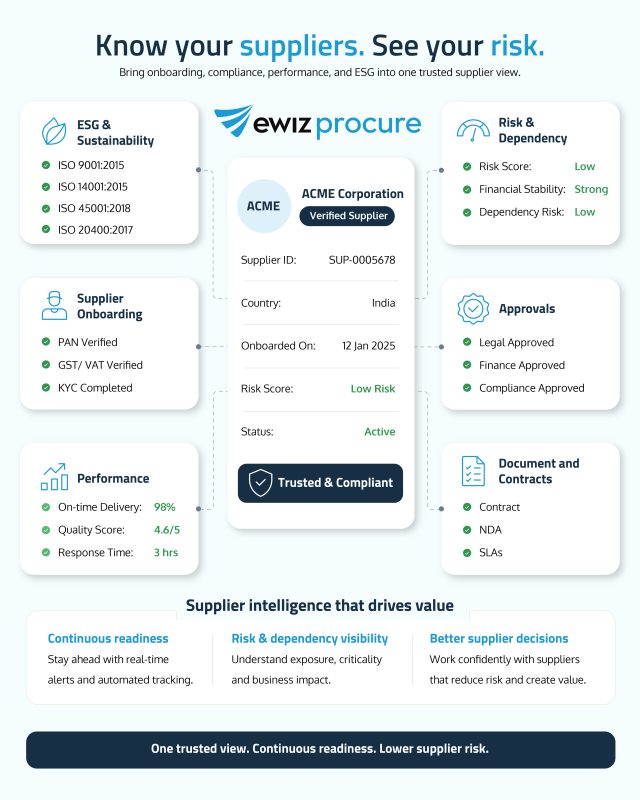
The real shift: From supplier repository to supplier intelligence
This is not about replacing one supplier portal with another. It is about changing what supplier data is used for.
| From | To |
| Supplier repository | Supplier intelligence |
| Onboarding | Continuous readiness |
| Compliance checks | Ongoing monitoring |
| Supplier master | Risk, performance and dependency visibility |
| Portal adoption | Supplier enablement |
For procurement leaders, the value is simple:
- Less time spent chasing information.
- Earlier visibility into supplier risk.
- Faster decisions.
- Better understanding of supplier dependency.
- Greater confidence when deciding where to source, where to intervene, and where to reduce exposure.
Because the goal of supplier management is not to have a complete supplier record. It is to know which suppliers you can trust, where your exposure sits, and what needs attention next.
A supplier record should not just tell you who the supplier is. It should help you decide how confidently you can do business with the
Where to start: A 5-question audit for your team
Before investing in another supplier portal, find out how much supplier information your team is still chasing manually.
Take a sample of your active suppliers and trace what it takes to answer five basic questions:
- Is the supplier approved and compliant?
- Are their certificates and documents current?
- What are they qualified to supply?
- Are there open CAPAs or other issues?
- How critical or dependent are we on this supplier?
Then track where the answers come from: ERP? Supplier portal? Email? Spreadsheets? Individual teams?
The more places your team needs to check, the greater the visibility gap.
That gap has a cost:
- It slows onboarding.
- It delays decisions.
- It makes renewals reactive.
- It makes supplier risk harder to see before it becomes a problem.
The question isn’t simply: “Do we have supplier data?”
It is: “Can procurement get a trusted view of supplier readiness, risk, performance and dependency when it needs one?”
Before adding another system or more manual effort, measure that gap. That is where better supplier management starts.
No rip-and-replace discussion. Just a practical conversation about where supplier information is fragmented today and what could be made more visible, connected and actionable.
