
Most procurement leaders already know their data is the problem. What they haven’t done is put a number on it, and that missing number is why the budget conversation keeps losing to other priorities.
Across engagements with procurement and supply chain teams in FMCG, automotive, pharma, and manufacturing, organizations running thousands of suppliers, millions of spend lines, and procurement cycles that span dozens of markets, the same pattern appears without exception. Dirty procurement data does not announce itself. It hides in the gap between the savings number on the category plan and the savings number that lands in the CFO’s report. It hides in the supplier list that has four names for the same vendor and none of the negotiating leverage that consolidation would unlock. It hides in the AI deployment that stalls at pilot because the data underneath it cannot be trusted.
The question is not whether your procurement data has a quality problem. The question is what it is costing you, in savings leakage, in compliance gaps, in AI investments that cannot scale, and what the realistic path out of it looks like
Three numbers most procurement leaders haven’t put together:
- 10–20% of targeted savings, lost to maverick buying (The Hackett Group)
- 59.5% average contract compliance vs 74.9% for top performers (Ardent Partners, 2024)
- 92% of CPOs plan to invest in GenAI. 37% are piloting or deploying. And only 4% could scale the AI deployment. (Hackett 2025 Key Issues Study.)
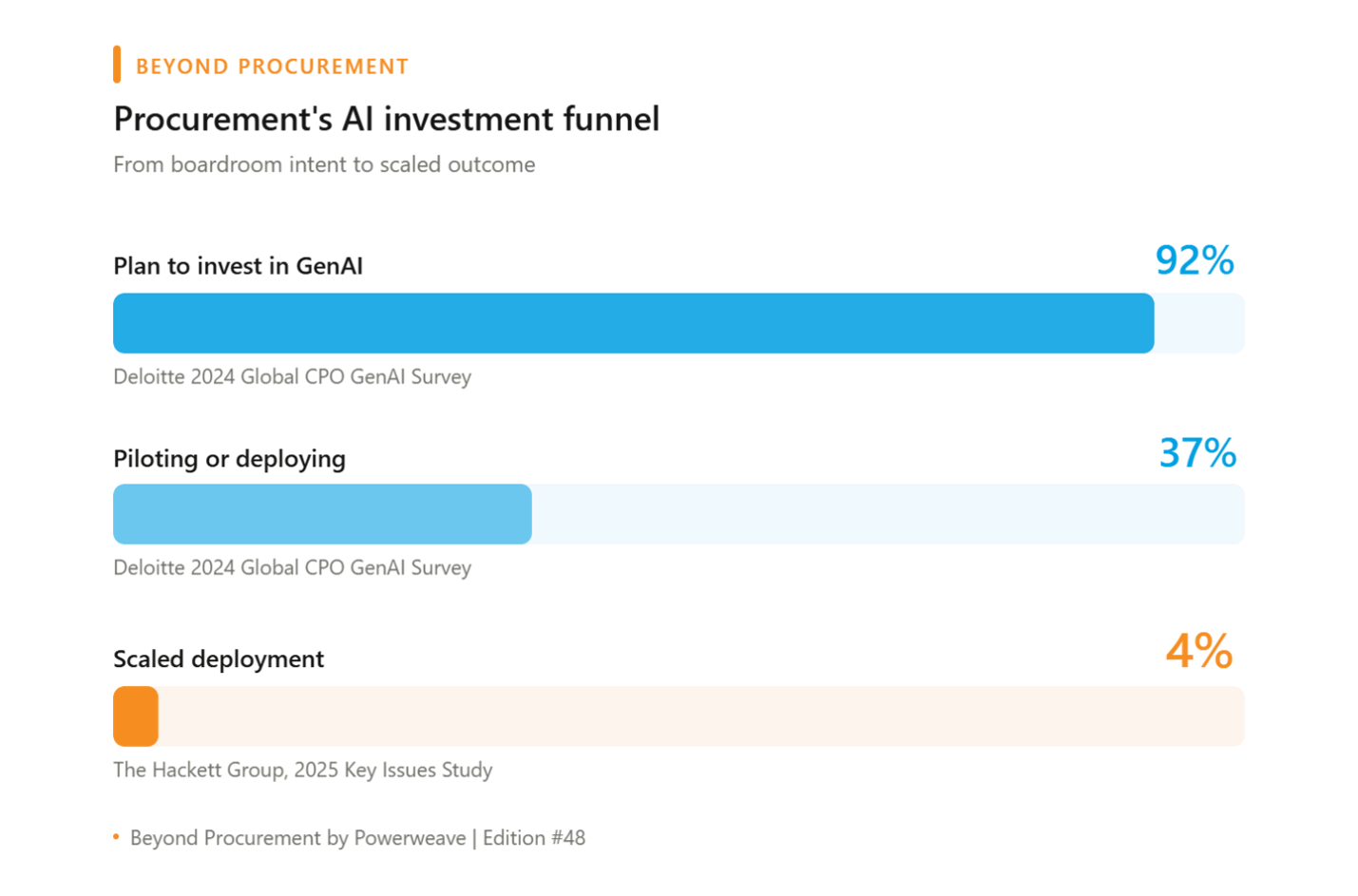
The third gap is the one your CFO will eventually ask about. The reason it exists isn’t model quality. It’s the data underneath.
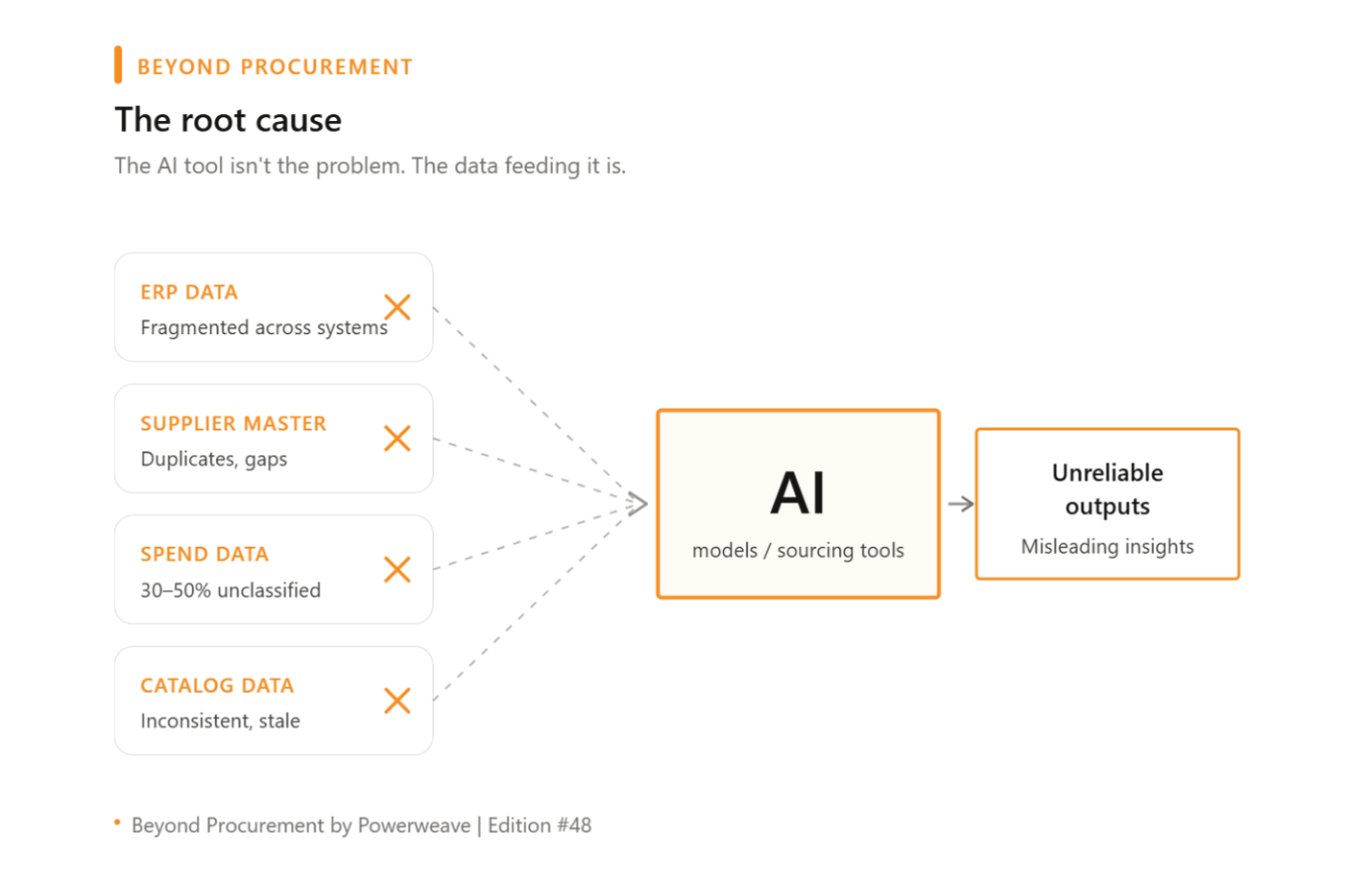
Bad procurement data isn’t one problem. It’s four.
These usually run concurrently, which is why they get diagnosed as a vague “data quality issue” and never actually fixed.
Fragmentation – Spend you cannot see is leverage you cannot use
Same supplier, four names. Spend split across systems. Negotiation leverage you’ll never use because you can’t see it. Ardent Partners estimates up to 15% of category spend goes missing this way.
Duplication – Inflated volumes that bury the truth
Duplicate SKUs and redundant vendors inflate volume and bury the truth about what you’re buying. Dataversity research finds 92% of businesses admit they have duplicate records.
Gaps – You cannot source what you cannot see
Anywhere from 30–50% of indirect spend lands in “miscellaneous.” Spend Matters’ work puts meaningful classification at only 50–70% across enterprises. You can’t source what you can’t see.
Staleness – Decisions made on yesterday’s truth
Supplier records get touched at ERP go-live and then sit. The Hackett Group finds 60%+ go outdated within 24 months. Decisions on yesterday’s truth.
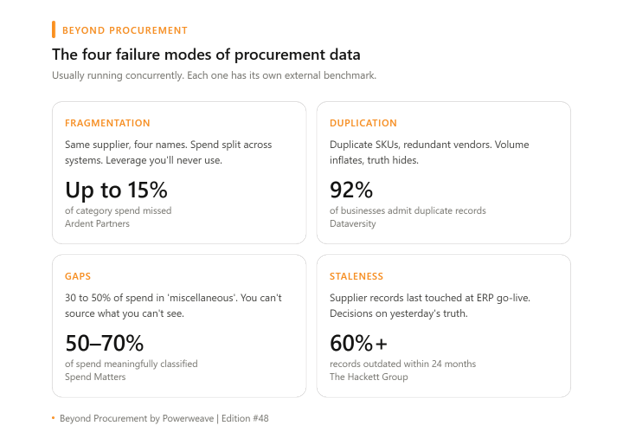
These aren’t separate symptoms. They’re the same root: data that gets created without governance and accumulates faster than anyone cleans it.
Why “let’s clean the data” projects fail, and What to Do Instead
The reflex when this surfaces is to launch a cleansing project. Run dedupe. Normalize taxonomy. Refresh supplier records. Six months later, the numbers look better. Twelve months later, the same problems are back.
Cleansing fixes the artifact. It doesn’t fix the source.
As long as buyers create unstructured requisitions, catalogs grow without governance, and suppliers get added without identity controls, the data rots again at roughly the rate you cleaned it.
This is the part most ERP-only environments don’t have an answer for. ERPs are built for control and approval, not for data hygiene at the point of creation. Source-to-pay suites can do parts of it, but only if buyers actually use them — and adoption has its own well-documented gap.
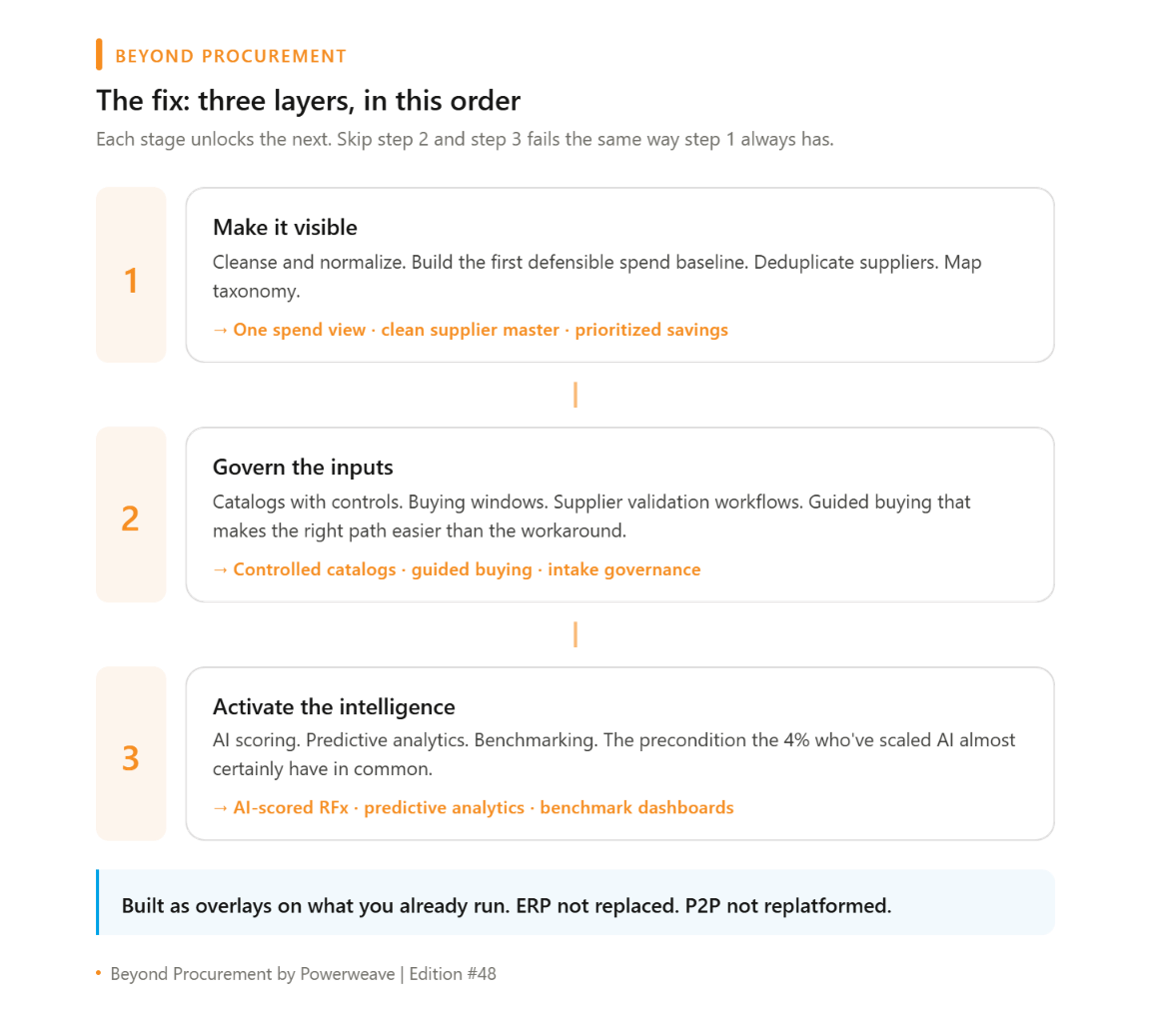
What actually works: three layers, sequenced
A modular approach works because it sequences the fix correctly. You don’t replace what you have. You overlay three layers on top of what you already run.
- Make the spend visible.
Cleanse and normalize what you have today. Build the first defensible spend baseline. Deduplicate suppliers. Map taxonomy. This is where most organizations stop — which is why the problem comes back.
- Govern the inputs.
Catalogs with controls. Structured forms, structured sourcing, or RFPs. Buying windows. Supplier validation workflows. Guided buying makes the right path easier than the workaround. This is what stops the data from re-rotting. - Activate the intelligence.
Now the AI conversation works. AI-scored RFx. Predictive analytics. Benchmarking. Each runs on data that’s actually trustworthy.
Order matters. Skip step 2 and step 3 fails the same way step 1 always has.
One example, with the numbers
A global FMCG operating across 50+ countries: 15,000+ SKUs, 5,000+ suppliers, 80,000+ manual transactions a year. Two prior digitization attempts had failed.
The work was sequenced exactly as above. SKUs consolidated from 15,000+ down to roughly 3,000. Supplier base rationalized from 5,000+ to about 500. Non-catalog purchases dropped 40–60%. Targeted-category cost savings of 30–35%. Zero product recalls in the 12 months after implementation.
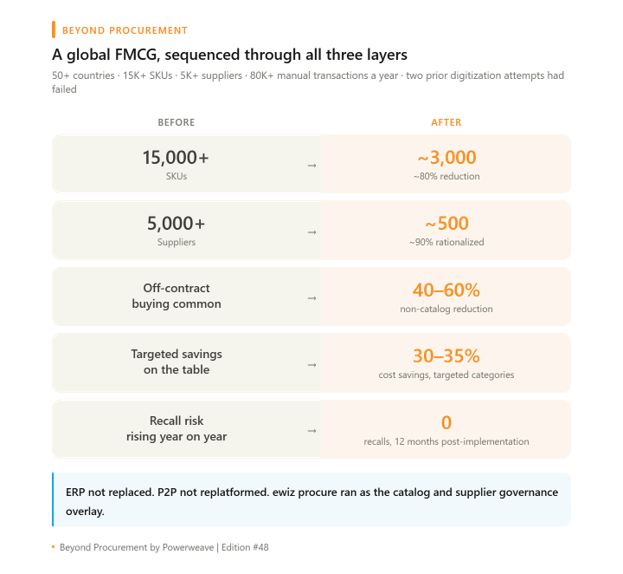
The ERP wasn’t replaced. P2P wasn’t replatformed. ewiz procure ran as the catalog and supplier governance overlay. Powerweave handled the data and supplier ops. The numbers above followed.
Where to start
The 12-month “data transformation” framing is what kills these initiatives at sponsorship. The realistic version is shorter.
Assess (4–6 weeks). Spend classification rate. Supplier duplication rate. AI-readiness baseline. You leave with a quantified picture and a prioritized roadmap.
Clean (alongside assess). Master data standardization, SKU enrichment, taxonomy mapping, supplier validation. Catalog controls designed so the problem doesn’t re-create itself.
Activate (60–90 days). Deploy on clean data. Connect to whatever you already run — ERP, S2P, analytics — or to any ewiz procure module. Prove value fast.
That’s the realistic path from “we have a data problem” to “the AI conversation is now grounded.”
The 4% who’ve scaled AI aren’t running better models. They’re running on cleaner data.
That’s the realistic path from “we have a data problem” to “the AI conversation is now grounded.”
Talk to us
Most procurement leaders we talk to know their data is the bottleneck. The hesitation isn’t diagnostic. It’s about scope, the fear that fixing data means another 12-month transformation program, another sponsorship fight, another set of numbers that won’t survive a CFO question.
It doesn’t have to be any of those things. The first useful answer is 4–6 weeks away.
Speak to us for a free Data Readiness Health Assessment
