
Most enterprises are treating December 31, 2027 as an IT deadline. That is the wrong mental model, and it is already costing procurement teams the one thing they cannot buy back: time.
We have worked with procurement and supply chain teams across manufacturing, FMCG, pharma, construction, and financial services, organizations running SAP ECC environments with hundreds of thousands of vendor records, multi-currency spend across dozens of markets, and procurement cycles that touch every function in the business. In that work, one pattern repeats without exception: the enterprises that treat the SAP ECC end-of-mainstream-maintenance deadline as a procurement data problem, not just an IT upgrade, are the ones that enter S/4HANA with clean, structured, analytics-ready data from day one. The ones that don’t are the ones paying their migration partner’s day-rate to fix supplier master data that should have been cleaned six months earlier.
This is not a blog about whether to migrate. That decision is made. This is about the procurement-specific deadline that sits a full year before the IT date, the one that closes in this fiscal year, whether or not your migration partner has sent you a kickoff deck.
The SAP ECC End-of-Support timeline: What the dates actually mean
There are two ECC deadlines, not one, and one has already passed.
SAP ECC EHP 0–5: Mainstream maintenance ended December 31, 2025. Customers in this bracket have already been in Customer-Specific Maintenance for months, no new security patches, no new regulatory or legal updates, no new corrections.
SAP ECC EHP 6–8: Mainstream maintenance ends December 31, 2027. After that, the default is Customer-Specific Maintenance at the same cost but with none of the proactive support. The alternative, Extended Maintenance, is available through December 31, 2030 at roughly a two-percentage-point premium and must be elected in advance.
Approximately 35,000 enterprises globally still run SAP ECC. For most of them, S/4HANA migration is the next major IT program. But here is what the IT framing misses:
The system does not break on January 1, 2028. The option set does.
And procurement’s deadline is not December 2027. It is now.
Why Procurement’s Real S/4HANA deadline is a full year before the IT date
Run the math backwards from December 2027:
- Migration program duration: 12 to 24 months from kickoff program to S/4HANA go-live. That puts migration kickoff between December 2025 and December 2026 for an on-time landing.
- Pre-migration procurement data work: Spend taxonomy build, supplier master harmonization, material master classification, and stakeholder alignment need to be substantially complete before the migration partner builds the migration plan. If they are not, the migration plan gets built around dirty ECC data, and the partner bills day-rate to clean it during the migration itself.
- Budget and program front-end: Budget approval, sample data extraction, stakeholder workshops, and the first phase of any serious data program consume two to three months before a single record is cleaned.
The result: the procurement data decision window is not 18 months. It is one budget cycle. For most enterprises on an Indian fiscal year (April–March) or a GCC/multinational calendar (January–December), that cycle is the one currently open.
The procurement decision window closes in this fiscal year.
The 2027 Trap: Why Waiting Costs More Than the Migration Itself
Vera Rozanova was talking about why procurement teams stay stuck in reactive mode. She put it plainly:
“Now we have the problem, now we need to fix it. But it will create tomorrow crisis. But they don’t think about this right now.”
The 2027 deadline is exactly that trap. The fire isn’t on now. The crisis is on in 2028, when the migration program lands on uncleaned ECC data, when the migration partner’s scope balloons, when the steering committee discovers that “migration-ready” was a document, not a state.
Akshara Naik Lopez at Forrester framed the related observation more plainly: “Support from SAP is ending for the product, but it does not mean that the ECC environment is, all of a sudden, going to stop working.”
The system doesn’t break on January 1, 2028. The option set does.
That’s the part most procurement leaders haven’t translated for the budget committee.
Move 1 – What “end of support” actually means
There are two ECC deadlines, not one.
- EHP 0–5: mainstream maintenance ended December 31, 2025. Already passed. Customers in that bracket have been in Customer-Specific Maintenance for months.
Same cost as before, but no new security patches, no new legal or regulatory updates, no new corrections. - EHP 6–8: mainstream maintenance ends December 31, 2027. After that, the default is also Customer-Specific Maintenance. The alternative is Extended Maintenance.
Available through December 31, 2030, at roughly a two percentage-point premium on the maintenance basis. It must be elected in advance.
The question for procurement isn’t “are we covered?”
It’s “which option has IT contracted, and what fine print does our data plan have to fit inside?”
Move 2 – The procurement runway math
Eighteen months on a calendar isn’t eighteen months in practice for a thousand-headcount enterprise.
- Migration program window: 12 to 24 months from kickoff to go-live
- Pre-migration strategic data work: 6 to 12 months
- Budget approval, sample export, stakeholder workshops: 2 to 3 months
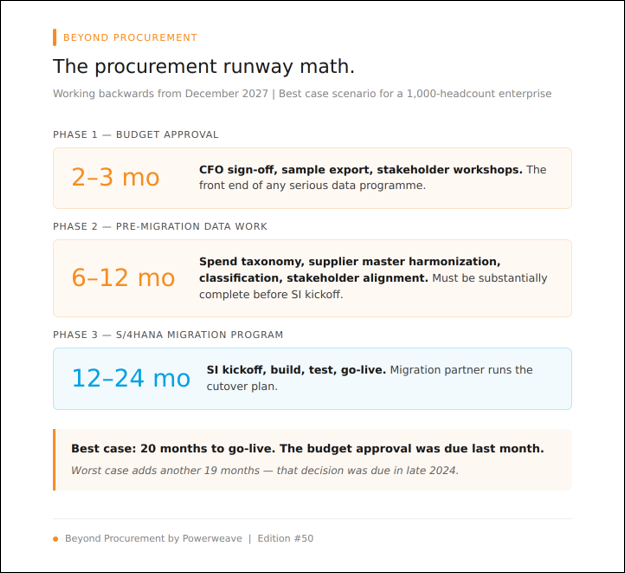
You arrive at one budget cycle, not two.
In most enterprises, the Indian fiscal year (April–March), or the GCC and multinational calendar (January–December), that cycle is the one you’re sitting in.
Move 3 – What you can start now without an IT migration date
This is the move most teams miss.
Pre-migration data cleansing doesn’t wait for the SI’s timeline. It runs on current ECC and produces standalone outcomes:
- A quantified spend baseline before any migration scope is committed
- Supplier master harmonization that holds value whether you migrate this year, next year, or via RISE in 2030
- A UNSPSC-aligned classification that the migration partner inherits instead of bills for
- A fix-first priority list that the steering committee can act on in the current quarter
The 48-hour Data Readiness Assessment is built for this exact decision point. Sample export in. Inside two business days: clean file, duplicate clusters identified, classification applied, ranked fix list.
It’s the conversation starter the steering committee needs before the migration RFP is even written.
For a deeper picture of how procurement data intelligence and harmonization work as an independent foundation, what the workstream looks like, what the deliverables are, where it integrates with your existing stack, the full deck walks through the framework end-to-end.
📥 Download the Procurement Data Intelligence & Harmonization deck
Procurement Data Intelligence & Harmonization
Move 4 – The honest counter-case
If your organization is heading toward extended maintenance or a RISE with SAP transition deal, the IT timeline shifts.
Extended Maintenance buys until 2030. SAP’s “SAP ERP, private edition, transition option” introduced in Q1 2025 for select complex customers, can stretch to 2033, but it requires a deployment change to SAP-managed private cloud and locks you into RISE commercials.
So, does that shift procurement’s deadline, too?
No. And these are the part worth pressing on with the CFO.
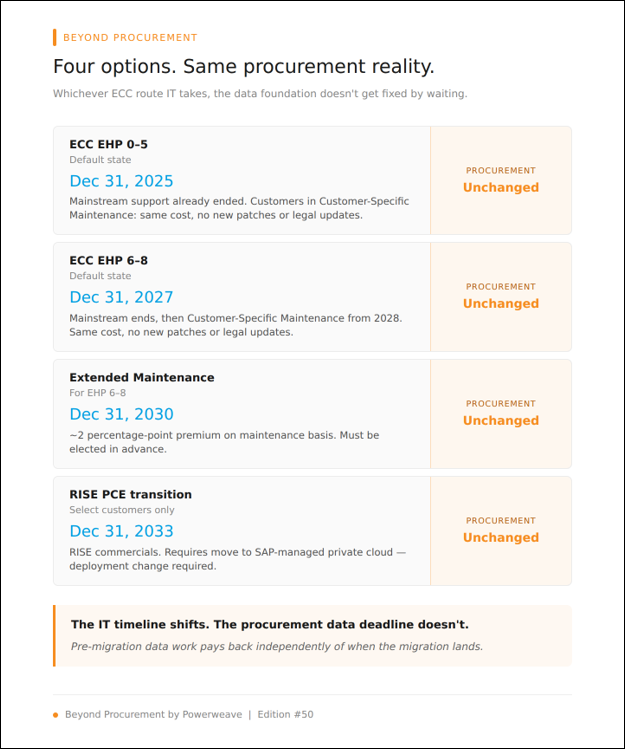
Extended Maintenance and the RISE transition option both extend the IT runway. Neither extends the value of waiting for procurement data.
The supplier master stays just as fragmented. Spend visibility stays where it is. Tail spend keeps leaking.
Each additional year on uncleansed ECC data is another year where:
- Steering committee decisions are made on incomplete spend views
- Compliance leakage continues at whatever rate it’s running today
- Onboarding cycles drag because supplier records aren’t standardized
- Pre-migration data work pays back independently of when the migration lands
- That’s why the procurement deadline doesn’t slide even when the IT one does.
What the steering committee needs next Monday
The concrete deliverable that puts this on the agenda: the 48-hour Data Readiness Assessment.
You send a sample spend export. You get back, inside two business days, a profile of the dataset, duplicate supplier clusters, UNSPSC-aligned classification, a categorized fix list, and a quantified picture of your current spend visibility. No license commitment. No SI engagement. No migration date dependency.
That deliverable does three things at once:
- Gives the CFO a defensible number to budget against
- Gives the CPO a steering-committee-ready artifact
- Gives the practitioner team a starting point that doesn’t require a 2027 migration plan to exist yet
It also reframes the migration partner conversation. Instead of “here’s what you’ll clean as part of migration,” procurement walks in with “here’s what’s already clean, your scope starts from this baseline.”
If your fiscal year 2026–27 budget is in build, this is the cycle in which the procurement data program gets approved or doesn’t.
Ready to see what your ECC procurement data actually looks like before the migration clock runs out?
To get ahead of the 2027 ECC deadline, start with a clear picture of your procurement data, what it contains, where it breaks, and what it will cost to clean during migration versus before it. Explore your options, build the business case with real numbers, and get started in the current budget cycle.
You don’t have to go it alone. As specialists in procurement data intelligence and harmonization for SAP environments, we’re here to help. Start by seeing what your ECC procurement data actually looks like with Powerweave’s 48-hour Data Readiness Assessment.
The good news, clean procurement data has standalone value today, whether your migration lands in 2026, 2028, or 2030.
No pitch decks, just a real conversation.
We’ll walk you through your 48-hour Data Readiness Assessment, no licence commitment, no SI engagement, no migration date required.
