
45% of CPOs rank AI-driven automation as a high strategic priority for the next 12 months. Barely one in ten has the data foundation to execute on it. That is not an enthusiasm problem. That is a structural readiness gap, and it has a specific, fixable cause that most procurement leaders are misdiagnosing.
Having worked with procurement teams across manufacturing, FMCG, pharma, financial services, and construction, organizations running SAP ECC environments with fragmented supplier masters, multi-system spend data, and AI pilots that have stalled at proof-of-concept, we have seen this pattern repeat without exception. Procurement AI does not fail because the vendor oversold or the team underperformed. It fails because the data foundation was never built. The tool inherited a problem nobody wanted to fix first.
The 2026 ProcureCon CPO Report puts four numbers together that tell this story plainly. This piece breaks down what those numbers mean, why the AI readiness gap and the S/4HANA migration problem are the same problem in disguise, and exactly what the 11% of procurement teams that have broken through actually did differently, before the AI ever touched their data.
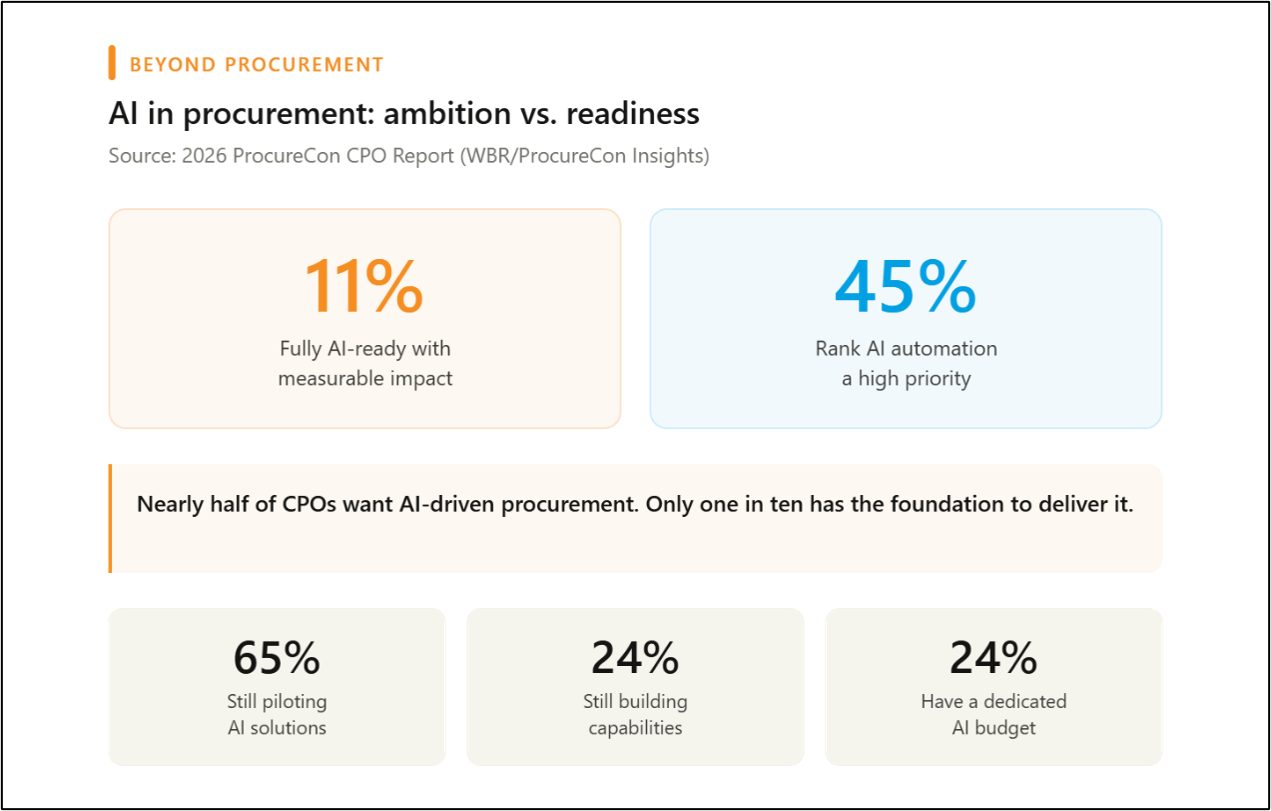
This blog is about those causes, and about what the 11% who broke through actually did before the AI ever touched their data.
The pattern behind every stalled procurement AI pilot
When the ProcureCon report asked organizations that aren’t fully AI-ready to name their biggest barriers, the answers weren’t about technology. They were about data and trust.
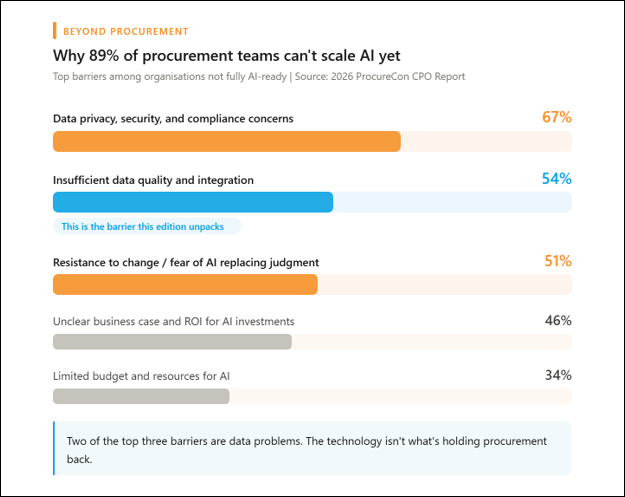
More than half of the procurement teams trying to adopt AI are working with data that isn’t clean enough to power it. And when data isn’t well-governed, every new tool that touches it creates compliance exposure. The resistance to change that shows up as the third barrier doesn’t come from nowhere either. It comes from teams who have seen tools underdeliver before because the data underneath them gave people reason to doubt them.
Megha Singh, who has led AI implementations across global enterprises, including Micron and Novartis:
“Mindset, fragmented processes, and data quality are the three big killers.”
Those three things compound. When processes are fragmented (one region on SAP, another on Excel, a third on a local system nobody documented), the data that flows into any AI tool carries every inconsistency from every workaround built over the past decade. When data quality is poor, the AI produces confident outputs that are wrong. And when that happens once or twice, the mindset shifts from curiosity to distrust. Teams go back to the spreadsheet, and the pilot quietly dies.
The ProcureCon report confirms this at scale: many procurement teams still operate with fragmented tools that don’t communicate with each other, creating data silos and manual workarounds.
The uncomfortable conclusion: most procurement AI pilots fail not because the vendor oversold or the team underperformed, but because the data foundation was never built. The tool inherited a problem nobody wanted to fix first.
The ERP paradox: Solving the same problem twice and paying for it twice
Here’s where the picture gets urgent.
Many of the same organizations running stalled AI pilots are also in the middle of ERP migration programs. SAP ECC standard support ends in December 2027. Migrations take 12 to 24 months. If you haven’t scoped data remediation yet, you’re already behind the timeline.
Both workstreams, the AI initiative and the S/4HANA migration, depend on the exact same clean data: deduplicated supplier master, classified spend, and reliable contract records. But in most organizations, they’re scoped, budgeted, and staffed as completely separate initiatives. Different teams. Different sponsors. Different timelines.
Zyad Khan, Associate Director of Procurement and Contracts at Dubai World Trade Center, frames the deeper issue:
“In spite of ERPs running around us for about 20 years, they’ve been the most underutilized software, and we all have to accept that. We have never really realized the potential that ERP presented.”
That line needs a moment. Twenty years of running SAP, and the general pattern is to use it as a transaction interface and accept what it delivers. Teams get buried in manual reporting, approvals chasing, and reactive buying, never reaching the strategic capability the system was supposed to unlock.
Now those same organizations are preparing to migrate to S/4HANA. And 30 to 40% of master data is typically found unfit for migration once extraction and cleansing actually begin.
The risk isn’t just that the AI pilot stalls. It’s that you migrate to a new platform carrying the same data gaps, the same fragmented processes, and the same underutilization. And in 18 months, someone proposes another “data quality initiative” on S/4HANA. Same cycle. Newer system.
The ProcureCon report’s own key suggestion says it plainly: address data quality, integration, and governance challenges before scaling AI investments.
What the 11% did differently
The visual tells the story. Same starting point, radically different outcomes. Here’s how the 11% took the right fork.
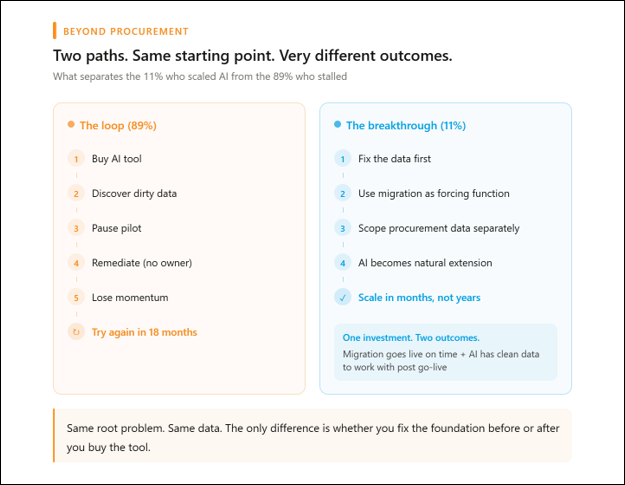
Pulled procurement data out of the SI’s scope
Scoped procurement data remediation as a distinct workstream with procurement expertise. Not as a line item inside the SI partner’s generic data migration plan. Procurement data (supplier hierarchies, spend taxonomy, contract compliance, ESG attributes) requires domain knowledge that generic ETL tools and system integrators typically don’t carry. This isn’t a criticism of SI partners. They’re outstanding at system cutover. But procurement-native data classification isn’t their core delivery model. When that scope surfaces mid-project, it becomes the most expensive surprise on the change order.
Pinned data cleanup to the go-live date
Used the migration timeline as the forcing function to finally do the unglamorous work. Supplier deduplication. Spend classification to a three-level taxonomy. Contract register construction. These projects don’t make the keynote at procurement conferences. But they are the layer that makes everything else in the procurement stack, analytics, AI, reporting, supplier intelligence, actually deliver.
Walked out of the migration with an AI-ready data asset
Designed for dual return from a single engagement. A clean data asset that makes the S/4HANA go-live happen on time, and the same clean data asset that gives AI something trustworthy to work with post go-live. Same investment. Radically different return.
Three questions to run this week
You don’t need a maturity assessment to know where you stand. These three questions will tell you.
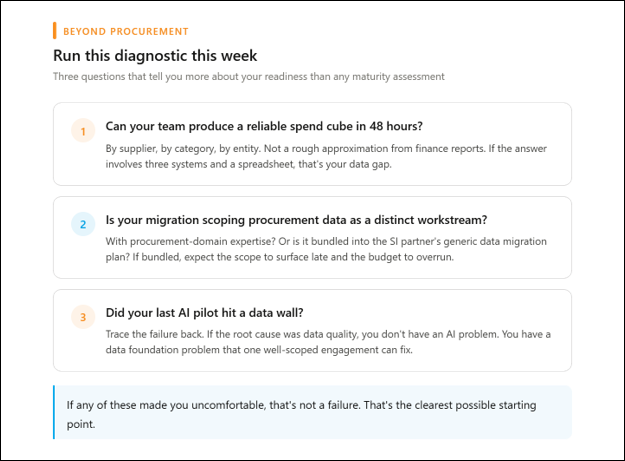
- Can your team produce a reliable spend cube in 48 hours?
By supplier, by category, by entity. Not a rough approximation from finance reports. An actual procurement-grade view. If the answer involves pulling data from three systems and reconciling in a spreadsheet, that’s your data gap.
- Is your S/4HANA migration scoping procurement data as a distinct workstream?
With procurement-domain expertise? Or is it bundled into the SI partner’s generic “data migration” phase? If it’s the latter, the phase that holds up your go-live will be the one nobody scoped properly.
- Did your last AI pilot hit a data wall?
Trace the failure back. If the root cause was data quality, you don’t have an AI problem. You have a data foundation problem that one well-scoped engagement can fix. And if timed alongside your migration, it pays for itself twice: once at go-live, and again in the AI capability you unlock afterward.
Megha Singh’s advice for anyone considering this path:
“Start small, start with the real problem. Don’t wait for the bigger data plan.”
Where to start
We work with procurement teams to build exactly this foundation: a clean supplier master, classified spend, and reliable contract data. Delivered in weeks through a fixed-scope engagement that runs alongside your existing SI partner and ERP. No rip-and-replace. No open-ended day rates.
No pitch decks, just a real conversation. Let’s get it done before AI become heavy on your procurement operations.
