
Here is a number that never appears on a procurement dashboard: the percentage of your platform your team actually uses.
Not the number of modules deployed. Not the count of suppliers onboarded. Not the go-live date circled on a project plan from fourteen months ago.
The real number, active users divided by licensed seats, pulled today, is the one most procurement leader quietly avoiding looking at.
Gartner has long flagged that the majority of enterprise software investments underperform, not due to poor functionality, but due to poor adoption. BCG puts the digital transformation failure rate at 70%, with behavioral change cited as the primary cause. And in procurement specifically, failure is quieter and more expensive than most organizations realize: you keep renewing the license on a platform your team stopped using eight months ago.
This blog breaks down exactly
- Why that happens
- What it is silently costing your business
- What the organizations that get it right do differently.
The renewal invoice that should alarm your CFO and CPO
Nobody says it in the quarterly review. But it is one of the most common patterns in enterprise procurement today.
A procurement platform launches with all the right intentions. Change management sessions are scheduled, a go-live email is sent from the CPO, and a dedicated Slack channel is created.
And then, slowly and quietly, people stop using it.
Category managers drift back to email for RFQs because it is faster than navigating a new workflow mid-quarter. The supplier portal, which took three months to configure, has only a fraction of its licensed seats actively.
The guided buying module, the one that was supposed to close the maverick spend gap, rarely gets opened after the first few weeks.
And the license fee? Still going out every year, at the same cost, no questions asked.
Zyad Khan, Associate Director at Dubai World Trade Centre and a procurement leader with 25 years of experience, said:
“In spite of ERPs running around us for about 20 years, they’ve been the most underutilised software, and we all have to accept that. We have never really realised the potential that ERP presented.”
Twenty years of the same pattern. And now it is repeated with source-to-pay platforms, AI tools, and supplier portals. Different technology, same outcome. The enterprise keeps renewing the licence.
Why platforms go dark: three structural failures
Most organisations blame their people when adoption stalls. The real problem is structural. Here are the three failure points we most often see.
- Go-live is not adoption
Most implementations treat go-live as the finish line. Procurement teams treat it as day one. The gap between those two assumptions is where the platform dies.
- Week 1: A generic product walkthrough.
- Week 2: A knowledge base with 40 articles.
- Week 3: Users try to run a real RFQ. It does not behave like the demo.
- Week 4: They are back in Excel.
BCG finds that only 30% of digital transformations achieve their intended value, with adoption and behavioral change cited as primary causes of failure.
As Vera Rozanova, MCIPS Chartered, said:
“Automation fails when people don’t see what’s in it for them.”
That is not a technology failure. It is a delivery model failure.
- Culture was never assessed before the purchase
Most procurement tech buying decisions evaluate functionality, integration, and commercial terms. Almost none assess organizational readiness before signing.
Zyad Khan identified this precisely:
“Before we actually look at functionality, the first decision we take is buying that thing. I need to know my culture before I even take that decision.”
If a team isn’t ready for change, the platform won’t get used to it. Regardless of how good the UX is.
- Everything went live at once
When sourcing, supplier onboarding, catalog buying, and contracts all activate simultaneously across regions, categories, and user groups; no one owns any of it. Change fatigue sets in immediately. There is no early win to point to.
Megha Singh, Director of Procurement Transformations at Micron Technology, was direct about this:
“Maybe you start slow, region-wise. You go local first, you go regional, and then you go global depending on the problem you’re facing.”
Organizations that ignore this principle typically find themselves 12 months later with an expensive platform and an unchanged operating model.
What non-adoption actually costs: the hidden bill your P&L never show
This is where it becomes a CFO conversation, not just a procurement conversation. Three cost lines do not appear on any dashboard.
- Strandedlicensespend
The platform fee is fixed regardless of how many people are actually using it.
For a 200-seat deployment sitting at 25% utilization, you are paying full price for a fraction of the value. That compounds with every renewal cycle, and it never shows up as a line item for anyone to question.
- Compliance leakage from maverick spend re-emergence
The guided buying guardrails, the preferred supplier lists, and the compliance controls you built into the system only work when buyers are inside the platform.
When they route around it and go back to email, the leaks back into uncategorized exceptions. Off-contract buying re-emerges.
- The savings case that never arrived
The CFO approved the budget against a business case that assumed full adoption.
If utilization is sitting at 30%, you have delivered, at best, 30% of the savings you promised. That gap is hard to explain in a budget review, and it gets harder every year it goes unaddressed.
70% of digital transformations fail to meet their objectives, often due to a lack of adoption and change management.
The fix: treat procurement platform adoption as a managed service
The organizations that break this cycle do one thing differently. They stop treating adoption as a milestone and start running it as an ongoing operational discipline, alongside the platform, permanently.
With ewiz procure, adoption is delivered as a managed service. It is built into the delivery model from day one.
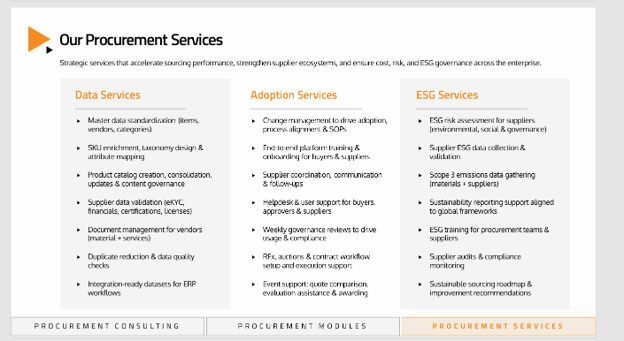
In practice, that means:
- A dedicated Adoption Success Manager from day one – Not an account manager. Someone who tracks usage weekly, flags stalled workflows, and drives re-engagement before abandonment becomes habit
- Role-specific training on real data – Not generic product walkthroughs. Category managers train on their own RFQ data. Approvers train against their own workflows. When users see the system handling their actual work, relevance is immediate
- Weekly governance reviews – Reviews that surface which modules are active, which user groups are struggling, and where compliance gaps are opening
- Phased module activation – One workflow, one region, 30 days, three KPIs. Prove value before adding complexity. Earn the right to expand
Adoption is not an executive metric alone. It is a daily user experience decision.
What sustained adoption looks like at scale
A global FMCG enterprise operating across 190+ countries had already tried to digitize its long-tail procurement, and it didn’t work.
Their first platform had weak automation, an interface buyer avoided, and no way to aggregate demand across regions. Spend kept slipping through the cracks. The ERP was untouched and, for this problem, useless.
So instead of running another multi-year transformation or replacing the ERP, they did something more targeted. They deployed ewiz procure as a guided buying layer that buyers actually wanted to use:
- A familiar Amazon-style interface
- A curated catalog of 3,000+ products consolidated from over 15,000 fragmented SKUs,
- And 5,000+ suppliers onboarded through a single centralized model.
- Over 1,000 users across 50+ countries were trained on the live system, not a demo environment.
- A helpdesk ran 10,000 support conversations a year specifically to prevent adoption from decaying over time.
- The ERP stayed exactly where it was. Buying behavior changed almost immediately.
Over seven years, $900M in indirect tail spend came under management, with 400+ purchase orders processed monthly across more than 50 countries.
Quality and compliance were enforced at the point of purchase, not after issues had already surfaced.
The full breakdown of how this program was built and sustained is in the case study.
📥Download the FMCG tail spend case study
The question worth asking this quarter
Before the next renewal invoice arrives, pull the utilization data.
- How many licensed seats are active versus dormant?
- Which workflows are your team still running over email?
- Which supplier portal pages have had no activity in the past 90 days?
That data is the real measure of whether your procurement transformation is working. Not the go-live date. Not the number of modules deployed. Adoption rate is sustained and growing over time.
If it is not moving in the right direction, the issue is not your team. It is how the platform was delivered to them.
Want to understand what a managed adoption model looks like in practice?
What would it take to get your current platform performing the way the business case promised?
That is exactly the kind of conversation we have.
