
If your supplier review is an annual event, collect data, fill scorecards, present, file away, you are managing risk on a delay. The problem is structural, not effort: a once-a-year snapshot tells you what a supplier did six to twelve months ago, not what they are about to do.
That delay is expensive. Financial instability, an expiring certification, a quality decline, or an ESG gap rarely announces itself on review day. It shows up between reviews, and by the time the annual cycle catches it, the disruption has usually already landed.
This piece sets out what replaces the annual model: continuous, risk-first, segmented supplier monitoring. It explains why the old model keeps creating blind spots, what the new framework looks like, and where to start without disrupting your ERP or S2P stack.
Key takeaways
- Annual supplier reviews only show what happened 6–12 months ago. By the time a problem surfaces, the supplier has usually already disrupted you.
- The 2026 model is continuous, risk-first, and segmented: track a few leading indicators monthly or quarterly, and evaluate risk before performance.
- About a third of supply chain disruptions now carry a cost of over $5 million each (RapidRatings, 2025) — which is why financial and compliance risk can’t wait for a yearly scorecard.
- You don’t need to replace your ERP. Continuous monitoring works as a layer on top of your existing systems, with effort focused where business impact is highest.
The supplier teams holding up in 2026 have not made the annual review better. They have moved past it. Three changes define the new model. First, monitoring is continuous — a small set of leading indicators tracked monthly or quarterly, so patterns are visible before the formal review. Second, evaluation is risk-first — financial health, compliance, and continuity are assessed before cost and delivery, because a supplier heading toward bankruptcy is a bigger problem than one that is occasionally late. Third, oversight is segmented, review intensity is matched to business impact, so human effort concentrates on the suppliers that can actually hurt you. This is the answer to carry into your 2026 supplier strategy.
What’s broken in traditional supplier reviews
Most procurement teams still review suppliers the same way they did ten years ago: a long, once-a-year exercise that ends with reports and scorecards no one looks at again until the next year.
This model has fundamental gaps that make it incompatible with modern procurement requirements:
- Only captures past performance. Annual reviews tell you what happened 6-12 months ago, not what’s happening now. By the time you identify a problem supplier, they’ve already disrupted your operations.
- Data lives in multiple systems. Performance metrics exist in your ERP. Quality complaints sit in email threads. Certifications expire in file folders. Contract terms live in a separate repository. No single view connects these signals.
- Too much manual scoring. Teams spend weeks collecting data, calculating scores, and building presentations. The effort required makes frequent reviews impossible.
- No link to risk, ESG, or compliance signals. Traditional scorecards track delivery and quality but miss financial instability, certification lapses, or ESG performance, the factors that actually create supply chain disruption in 2026.
- All suppliers are treated the same way. Strategic partners get the same review template as transactional vendors, wasting effort on low-impact relationships while under-investing in critical ones.
- Issues surface late because reviews happen once a year. When you only look annually, you discover problems after they’ve already affected production, delayed projects, or violated compliance requirements.
Why once-a-year supplier evaluations create blind spots
The procurement teams succeeding in 2026 are abandoning the annual review model in favor of a continuous, risk-first, segmented approach.
Here’s the smarter playbook for 2026:
→ Make reviews continuous, not annual
Modern digital tools now make it possible to track certain KPIs monthly or quarterly, giving procurement earlier visibility into:
- Delays
- Quality issues
- Price deviations
- Compliance gaps
- Slow catalogue updates
- Declining responsiveness
This doesn’t replace the annual scorecard; it strengthens it.
By the time the formal review arrives, procurement already knows the patterns.
As Ahmed Raafat, Head of Procurement and Supply Chain at ARM Holding, puts it:
“CFOs are looking for clarity and predictability. They care about risk exposure, risk mitigation, total cost of ownership, and reliable numbers, what can be budgeted, and how we stay within that budget. CEOs are looking for growth and resilience. They ask how procurement can help the company move faster, expand smarter, and protect its reputation in the market.”
Start with risk, not just performance
The 2026 model flips the traditional approach: evaluate risk first, then performance.
Financial stability matters more than on-time delivery if your supplier is heading toward bankruptcy.
The relevant risk factors for indirect and tail suppliers include:
- Financial stability: Unusual changes in pricing, late confirmations, repeated exception handling
- Geographic or operational exposure: Regions facing regulatory shifts, import dependencies, or operational instability that can affect supply continuity
- Quality and recall risk: Defect flags, failed certifications
- Cybersecurity posture: Especially when suppliers access enterprise systems or share digital assets
- ESG and compliance gaps: Expired certifications, missing approvals
- Regulatory risk: Category-specific rules for electrical items, packaging, marketing materials, chemicals, etc.
This makes the review forward-looking instead of reactive. For instance, ewiz procure’s real-time supplier risk dashboard that consolidates financial, compliance, ESG, and operational signals into a single view, directly inside your ERP.
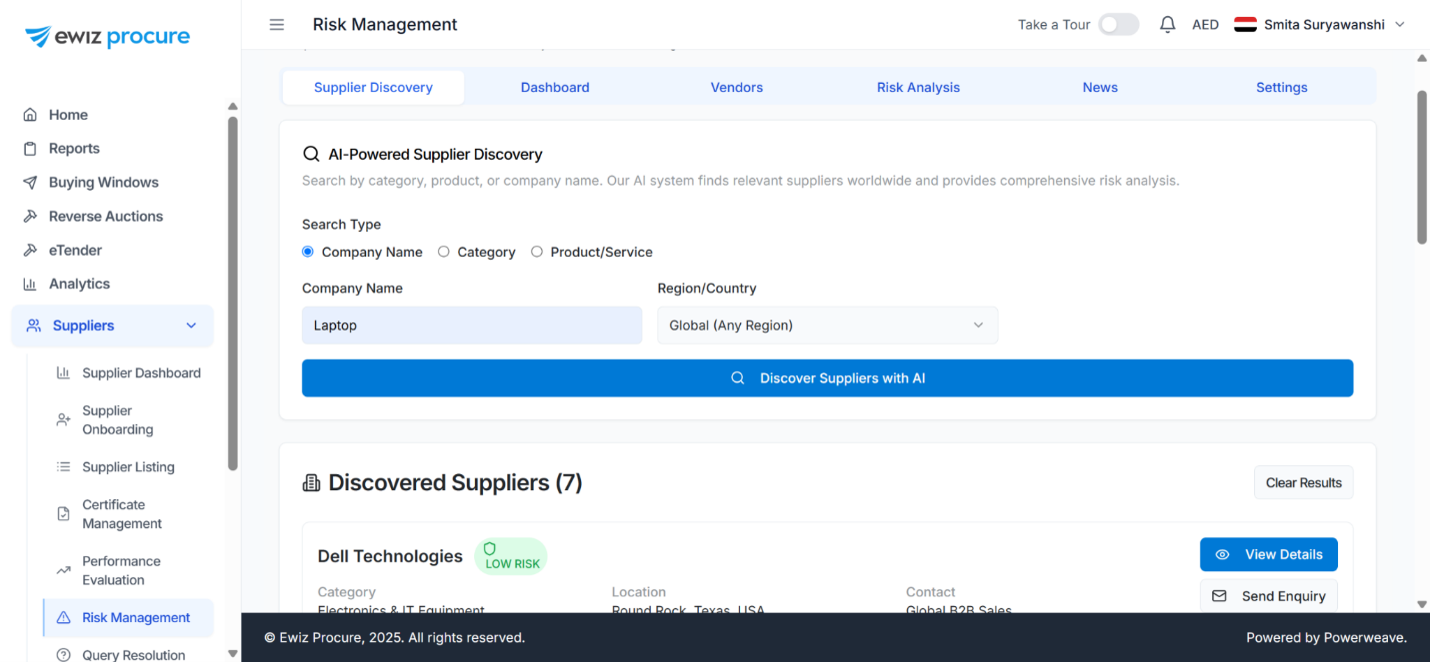
Risk Management in Supplier Management Module by ewiz procure
Click to see it yourself:
Use better data (not more data)
The problem is not the volume of data.
It’s the fragmentation.
A high-quality review should pull from:
- Supplier performance
- Category-specific requirements
- Catalog accuracy
- Pricing adherence
- Approval and certification validity
- Contract clauses
- Sustainability and compliance documents
ewiz procure’s supplier management and analytics, naturally consolidates these signals into one view while still relying on the ERP and existing S2P stack for the transactional foundation.
This is where a modular solution, as ewiz procure, combined with embedded managed services, creates a measurable impact.
And the outcomes are proven.
From the FMCG case study using ewiz procure, Powerweave’s team delivered:
- 5,000+ global suppliers trained and onboarded, ensuring compliant and verified supplier profiles
- 3,000+ active, standardized products consolidated into a curated global catalog
- 400+ purchase orders processed per month through automated, Coupa-integrated workflows
- 1,000+ company users trained, supported by 10,000+ annual support interactions across 50+ countries
- $900M in indirect spend managed over 7 years, covering ~60% of global tail-spend procurement
Want to explore how this FMCG company achieved this?
To download the full case study now
Add new KPIs that matter for CPOs
The traditional KPIs (price, delivery, service) are still important. But they are no longer sufficient. Modern supplier ecosystems need a broader view of capability and stability.
Here are the KPIs that matter most in 2026:
- Responsiveness and agility: How quickly does the supplier respond to inquiries, resolve issues, or adapt to scope changes? Responsiveness determines how quickly suppliers address inquiries or resolve issues, which directly impacts your ability to meet project deadlines.
- Data accuracy and digital maturity: Can the supplier provide structured data feeds, integrate via APIs, or support automated procurement workflows? Digital capability determines whether automation succeeds or fails.
- Contract compliance: Are they adhering to agreed terms, submitting required documentation, and maintaining current certifications?
- ESG alignment: By 2026, 70% of technology procurement leaders will have environmental-sustainability-aligned performance objectives, and 70% of companies will include ESG metrics in procurement scorecards for suppliers.
- Innovation contribution: Do they bring new solutions, suggest process improvements, or collaborate on product development?
Supplier segmentation: not all suppliers should be reviewed the same way
The biggest efficiency gain comes from segmenting suppliers and matching review intensity to business impact. Strategic suppliers make up 10-15% of your supplier database but consume the majority of procurement’s attention.
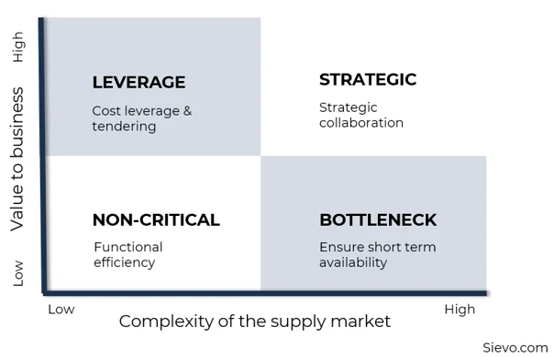
Source: based on the Kraljic matrix
Divide your supplier base into four categories:
- Strategic suppliers
High dependency, high business impact. These suppliers directly affect your competitive advantage.
- Review approach: Quarterly reviews, collaborative planning, joint scorecards, and innovation roadmaps.
- Critical suppliers
Supply continuity risk. Extremely specialized with limited alternatives.
- Review approach: Tight monitoring, early-warning risk dashboards, and deep quality controls. Even small performance issues require immediate attention because replacement options are limited.
- Preferred suppliers
Stable, reliable suppliers for standardized categories.
- Review approach: Automation-driven performance scorecards, catalog accuracy checks, and compliance monitoring.
- Tail & long-tail suppliers
These are large-volume, low-value suppliers. Tail suppliers are used for short-term or specific projects and don’t need as much attention.
- Review approach: Automation, self-service onboarding, compliance checks, and price governance. Use technology to manage these relationships at scale, focusing human effort only when exceptions occur.
This segmentation allows procurement to allocate effort intelligently, investing deeply where it matters most while automating routine oversight for transactional relationships.
Old supplier data review model vs new supplier data review model
| Dimension | Annual review (old) | Continuous monitoring (2026) |
| Timing | Once a year, backward-looking | Monthly/quarterly leading indicators |
| Starting point | Cost and delivery first | Risk first (financial, compliance, continuity) |
| Data | Fragmented across ERP, email, folders | Unified view inside the existing stack |
| Effort | Manual scoring, weeks per cycle | Automated for routine, human effort on exceptions |
| Coverage | Same template for every supplier | Segmented by business impact |
| Outcome | Problems found late | Early-warning signals before they escalate |
What 2026 requires: A smarter, layered supplier-performance framework
The new structure breaks from annual reviews to create a dynamic evaluation system
1. Risk-first evaluation
2026 requires flipping the model, starting with risk, not cost.
Evaluate suppliers across multiple risk dimensions:
- Financial health: Balance sheet strength, cash flow, credit ratings, and early warning signs like delayed payments to tier-two suppliers
- Supply continuity: Production capacity, geographic concentration, single-source dependencies
- Geographic exposure: Political stability, natural disaster risk, trade policy vulnerability
- Quality and recall risk: Historical defect rates, quality system maturity, audit results
- Cybersecurity posture: Data protection practices, breach history, security certifications
- ESG compliance gaps: Carbon footprint, labor standards, ethical sourcing practices
- Regulatory risk: Industry-specific compliance requirements, certification validity
2. Continuous, not annual monitoring
AI and analytics make monthly or quarterly supplier evaluation possible, even in real time.
Track performance across operational and compliance dimensions:
- Catalog accuracy and product data quality
- Price variance against contracted rates
- Contract compliance and adherence to terms
- Document and certification validity (insurance, quality certs, safety approvals)
- Product quality flags and defect rates
- Transaction consistency (PO confirmation, invoice matching)
- Supplier system integration readiness (API capability, automated data exchange)
Continuous tracking detects early-warning signals, a certification expiring next month, delivery performance declining over three consecutive periods, and invoice discrepancies increasing, before they become operational crises.
3. Data from multiple systems unified in one place
A modern review brings together information that traditionally lives in silos:
- ERP transaction data (orders, receipts, payments)
- Procurement suite data (RFx history, contract terms)
- Supplier certifications (quality, safety, ESG, cybersecurity)
- Sustainability frameworks (carbon reporting, ESG scores)
- Risk feeds (financial ratings, cyber threat intelligence, ESG monitoring)
This is where modular solutions like ewiz procure’s supplier management and analytics layers seamlessly integrate, creating a single source of truth within your existing tech stack.
Coca-Cola used predictive analytics to reduce supply chain risks by 30% and improve supplier performance by 25%. It shows what becomes possible when supplier evaluation moves from annual scorecards to continuous, data-driven monitoring.
Want to explore the full Coca-Cola case study?
You’ll find it inside our AI in Procurement Guide — along with 10 enterprise case studies from global leaders.
Download the AI in Procurement Guide
Closing insight
2026 is the year to transform supplier performance reviews from static paperwork into a dynamic, data-driven system that improves supplier quality, reduces risk, and strengthens business continuity.
The procurement teams winning in 2026 aren’t doing annual reviews better; they’ve moved beyond them entirely.
Lead 2026 now
Want to modernize your 2026 supplier review process without disrupting your ERP or S2P landscape?
Explore how ewiz procure can unify supplier performance, catalog quality, compliance, and analytics into one real-time view.
In 30 minutes, we’ll surface:
- The friction slowing your package cycles
- Where suppliers are creating hidden risk
- Where documentation is breaking the process
- And what immediate wins you can unlock within weeks
Book a Discovery Call with the ewiz procure team
