
For years, enterprise procurement transformation has followed a familiar pattern: implement everything at once, spend months configuring systems, train hundreds of users, and wait over a year to realize measurable value. Unfortunately, these large-scale “big-bang” implementations often introduce significant complexity, delay business outcomes, and create adoption challenges before procurement teams see any return on investment.
Today’s leading procurement organizations are taking a different path.
Instead of replacing existing ERP systems or attempting organization-wide transformation in a single phase, they are adopting a modular procurement strategy, implementing one high-impact capability at a time, proving measurable business value within weeks, and expanding only after success.
Whether it’s AI-powered eTendering, supplier onboarding, guided buying, or spend analytics, modular procurement allows enterprises to modernize procurement incrementally while keeping their ERP as the system of record. This approach minimizes implementation risk, improves user adoption, accelerates ROI, and creates a scalable foundation for long-term digital procurement transformation.
In this guide, we’ll explore why modular procurement is rapidly becoming the preferred strategy for enterprise procurement leaders, the challenges of traditional big-bang implementations, and how organizations can successfully launch a modular procurement program that delivers measurable results in as little as 60 days.
Why this matters now
“Procurement is not one process. It’s many.”
Pratik Thakore, COO at Powerweave
When categories, plants, and regions move at different speeds, one-size-fits-all programs create more friction than value. And if your procurement transformation plan still says, “phase 1–2–3” and ends in a 12–18 month cutover, you’re taking on more risk than value.
The procurement leaders we see winning are doing the opposite. They start small, prove value quickly, and scale deliberately, keeping ERP as the system of record and plugging in capabilities where they matter most.
The problem with big-bang rollouts
Monolithic, all-at-once deployments struggle because value arrives late and change fatigue sets in.
As Pratik Thakore, COO at Powerweave, put it:
“Uniform tools = uneven outcomes.”
What leaders told us (and what we’ve seen on the ground):
- Long time-to-value. Budgets go out, benefits don’t show for quarters. Momentum stalls.
- Adoption risk. Multiple portals, complex training, and policy changes in one go → resistance.
- Integration debt. Duplicated masters, brittle flows, security reviews that never end.
- Sunk-cost bias. When pilots underperform, you’re locked into the wrong design.
Net effect: the business keeps firefighting in spreadsheets while “transformation” remains theoretical.
The modular alternative that actually ships
As Pratik puts it:
“Modular is not a feature; it’s a mindset. Scale by need, not by force.”
A modular rollout reduces blast radius and accelerates proof:
- Start with one high-impact step. Examples: AI-powered evaluation, Guided Buying, or Supplier Onboarding.
- Keep ERP as the system of record. Approvals, data, and audit remain intact.
- Design for adoption. SSO, consumer-grade flows, in-app policy hints.
- Make value measurable within 30–60 days: a handful of KPIs, not a dashboard zoo.
- Expand only after proof: replicate to the next category/site once you’ve earned trust.
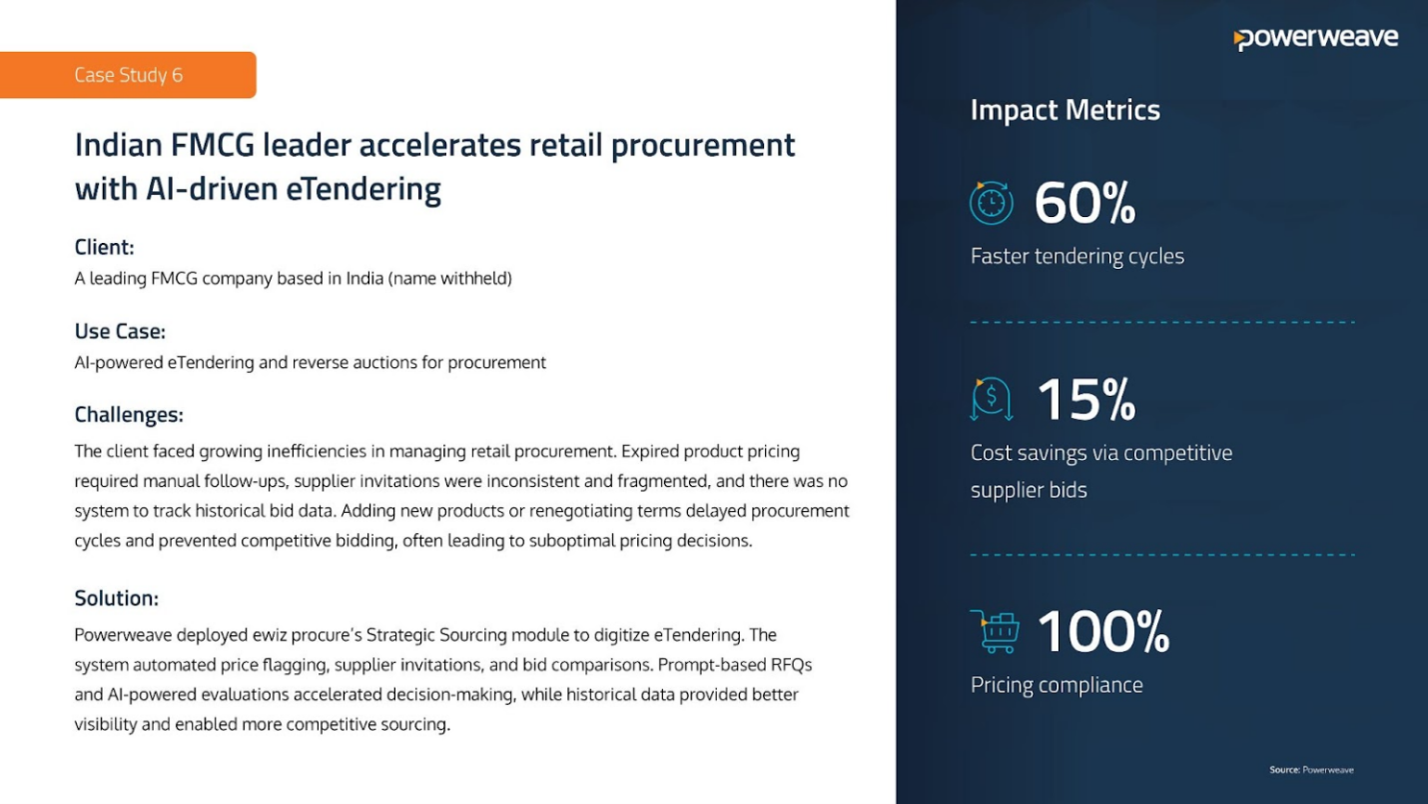
Modular adoption in action: Indian FMCG leader accelerates retail procurement with AI-driven eTendering
A top Indian FMCG player’s retail procurement was hindered by expired price lists, inconsistent invitations, and a lack of a single platform to compare historical bid data, resulting in delays and suboptimal pricing.
ewiz procure digitized eTendering end-to-end: prompt-based RFQs, automated invites, AI-powered bid comparisons, and price-flagging.
As Trishna Patel, Senior Consultant – Procurement & Sustainability at Powerweave, put it:
“We cut tendering time by 60% and unlocked up to 15% in savings by applying AI where it matters, prompt-based RFQs, smart bid evaluations, and multi-supplier sourcing. Procurement became a competitive edge, not just a function.”
Explore more enterprise-ready use cases
Automated eTendering is one of the 5 high-impact AI use cases featured in our AI in Procurement Guide.
📥 Download the guide for more enterprise-ready use cases and results
AI in Procurement Guide For Enterprise Leaders by Powerweave
How to run a 60-day modular pilot (and not lose steam)
Days 0–10 — Align on the “one thing.”
Pick one category or site and three KPIs (e.g., bid-close→award time, evaluator variance, % events with complete rationale). Freeze scope for the pilot. Align IT on “plug-in, not rip-out.”
Days 11–30 — Configure and go live.
Stand up the step (Evaluation / Guided Buying / Onboarding). Connect ERP + SSO. Run short functional sessions; invite suppliers with a two-page checklist.
Days 31–45 — Operate and observe.
Track KPIs weekly. Capture outliers. Add in-flow nudges where users stumble. Require reason-coded overrides to preserve judgment and governance.
Days 46–60 — Prove and decide.
Publish a one-page readout (before/after, lessons learned, risks retired). Decide to replicate, adjust, or retire. If replicate, roll to the next category/site with the same plan.
Common traps (and How to avoid them)
Trap: “Let’s switch on everything.”
Fix: Add one step; freeze scope for 30–60 days.
Trap: “We’ll clean data later.”
Fix: Clean just enough for the pilot; document gaps.
Trap: “Training = a webinar.”
Fix: Short sessions + in-app hints + office hours for 2 weeks.
If you’re looking for an off-the-shelf path
If you don’t want to build the scaffolding yourself, ewiz procure is ERP-native and modular.
With ewiz procure, modular adoption means:
- ERP-native integration: Add, don’t replace.
- Consumer-grade UX: Ensures adoption beyond power users.
- Embedded services: Onboarding, training, and supplier enablement so procurement teams don’t carry the burden.
- Proven ROI. First modules deliver 10–15% savings and 50% faster cycles within weeks.
Talk to our team about your first module.
We help enterprises rethink procurement and sustainability with purpose-built modular solutions like ewiz procure and Snowkap. Want to explore what this could mean for your team or where to start?
no pitch decks, just a real conversation.
