
Procurement teams aren’t short on AI investment. The budgets are approved, the contracts are signed, the software is live. And yet, across manufacturing, FMCG, construction, and energy, the same story plays out: teams revert to spreadsheets, workarounds multiply, and expensive platforms quietly gather digital dust.
The problem isn’t the technology. It’s what happens, or doesn’t happen, after deployment. Gartner reports that only 23% of supply-chain organizations have a formal AI strategy in place. More than half of the global supply chain industry is expected to adopt AI in the coming years. But adoption in name and adoption in practice are two very different things. Many companies invest in AI and implement it. True adoption only occurs when teams use it regularly and gain measurable value from it. Right now, most organizations aren’t there, and the gap between investment and impact is widening.
This blog breaks down why AI adoption stalls in procurement, what the real barriers are, and the three levers that actually move the needle.
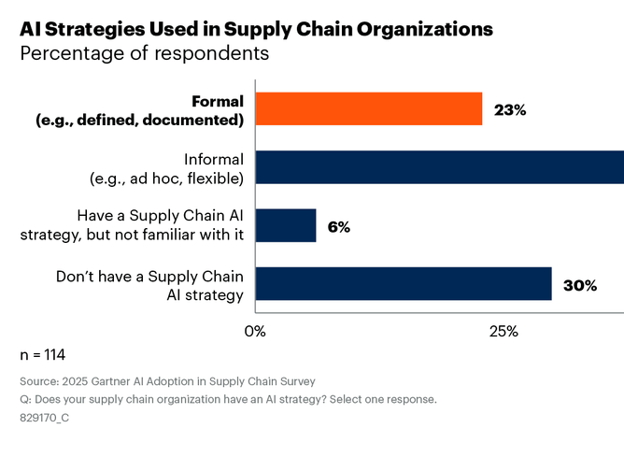
More than half of the global supply chain industry is expected to adopt AI. That sounds great, until you realize what “adopt” actually means in practice. Many companies invest in AI and implement it, but true adoption occurs only when their teams use it regularly and gain value from it. Across industries, manufacturing, construction, FMCG, and energy, companies are investing in AI-powered solutions faster than their people can adapt and start using them.
The result? Expensive software gathering digital dust while procurement teams do workarounds in the solutions they already know.
Why is this happening?
When most people say their teams “struggle with AI,” it’s rarely about ability. The real barrier is context, the “why” behind the new solution or platform. In many organizations, AI arrives as a top-down decision. The tech stack changes overnight, but the daily work doesn’t. A category manager who’s been running RFQs the same way for ten years now has an “AI sourcing assistant” that scores suppliers automatically. But nobody explained why it’s useful or how it connects to the metrics they’re actually measured on.
So, naturally, people revert to what they trust.
As Zyad Khan FCIPS Chartered, SDG Advocate, Procurement Leader, Head of Procurement at Dubai World Trade Centre, stated in recent podcast:
“Before we even look at functionality, we must understand culture. You can’t buy adaptability; you have to build it.”
You can have the most innovative platform in the world, but if your team doesn’t see how it fits into their daily workflow, adoption will be slow.
The gap: why training is procurement’s blind spot
As Vera Rozanova MBA, MCIPS Chartered, MEng (Hons) said on our podcast:
“Automation fails when people don’t see what’s in it for them.”
Most software companies offer training. But let’s be honest about what that usually means:
- Week 1: A generic webinar with 200 people on Zoom. Someone shares their screen and clicks through features. You’re supposed to remember everything.
- Week 2: You get access to a “knowledge base” with 47 articles and 12 video tutorials. Good luck finding the one thing you actually need.
- Week 3: You try to use the software for real work. It doesn’t work like the demo. You get stuck. You submit a support ticket. It takes 3 days to get a response that doesn’t actually answer your question.
- Week 4: You go back to Excel.
This isn’t a people problem. It’s a training problem.
AI adoption fails for three predictable reasons:
- No hands-on exposure: Teams don’t train with real data, so nothing feels relevant.
- No behavior change plan: Change management is left to IT.
- No staged rollout: Every module goes live at once, overwhelming the users.
The result?
Usage drops below 40% within six months of go-live, according to Gartner’s 2025 Procurement Tech Adoption Index.
The three levers that actually work
1. Hands-on training, not “Lunch and Learn”
Employees are also asking for it: in a 2025 McKinsey survey, nearly half of employees said more formal training is the best way to boost AI adoption. The difference lies in contextual learning; training teams using their own supplier, spend, and RFQ data. When users see how automation handles their daily grind —pulling bids, flagging price variances, or predicting supplier risk —they stop fearing the system and start trusting it.
2. Change management that shows “For You,” Not “To You.”
AI should never feel imposed. It should feel assistive. As Megha Singh, Director of Procurement Transformations said in her recent podcast:
“Everybody wants to implement AI. But they see success only when they tackle the fundamentals first: clean data, clear workflows. Once that’s in place, automation proves itself very fast.”
Effective change programs translate AI’s abstract promise into personal benefit, faster sourcing cycles, fewer approval delays, and cleaner dashboards.
3. Roll out in phases (Not all at once)
The most successful transformations start with one module, prove value, and then expand.
Pick one workflow. Get that working. Let people see the value. Then add the next piece.
Each phase proves value before adding complexity.
McKinsey found that incremental rollouts deliver 50% faster ROI than big-bang deployments because teams have time to absorb, test, and adapt.
Let us see what happens when you get it right: A case study
When training, change management, and phased rollouts align, AI adoption stops being a project and becomes a culture.
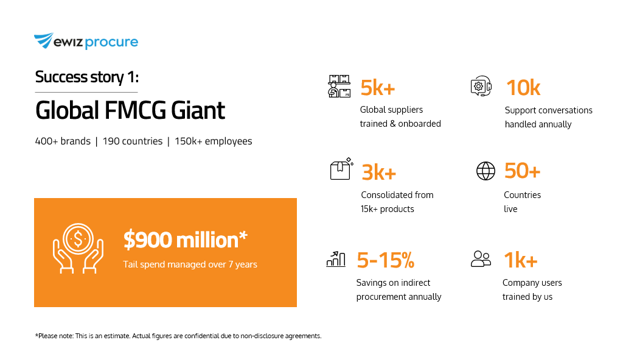
Client: Leading Global FMCG Company (name confidential)
Use case: AI-powered spend analysis for indirect procurement
The challenge: Fragmented supplier data and manual spend analysis slowed decisions. Visibility into indirect categories was poor, and consolidation across global operations was difficult.
What changed?
The client partnered with Powerweave to deploy ewiz procure’s AI-driven spend analysis and enable catalog buying and support services. Training and onboarding were part of the rollout.
Impact (measured):
- $900M tail spend managed over 7 years
- 3,000+ products consolidated (from 15,000+)
- 5,000+ suppliers trained and onboarded
We have covered more case studies and enterprise AI use cases in a comprehensive guide.
Download the AI in Procurement Guide
The ewiz procure model: adoption as a managed service
ewiz procure takes the pain out of AI adoption by blending technology, human expertise, and ongoing operations into one managed service.
Instead of making your team handle data cleanup, integrations, or model training, we bring a plug-and-play setup that delivers value fast.
How we make it work:
- AI built-in, not bolted on: Core use cases: spend analysis, supplier risk prediction, automated eTendering, contract risk detection, and forecasting, all ready to deploy.
- Run by experts: Our embedded service team manages supplier onboarding, catalog cleanup, and ESG data to keep AI insights sharp and relevant.
- Works with your ERP: Integrates smoothly with SAP, Coupa, Oracle, and others, no system overhaul needed.
- Learn as you go: Models retrain continuously on your live data, getting smarter and more accurate over time.
- Delivers fast results: Customers typically see 5–15% savings within months through automation, better visibility, and improved sourcing decisions.
With ewiz procure, AI stops being a pilot experiment and becomes part of how your procurement team runs every day, powered by people, process, and technology in sync.
The takeaway? The best AI isn’t the one with the most features, it’s the one your team actually uses.
What leaders can do right now
- Run a Digital Capability Audit – Inventory every AI solution your teams touch. Measure real usage. Anything below 50% adoption is a red flag.
- Reallocate 10–15% of AI budgets to skill-building – Training is not an add-on. It’s the insurance policy for ROI.
- Introduce “show, don’t tell” workshops – Replace webinars with live simulations using real procurement data.
- Start small, scale fast – Launch one AI feature, say, supplier risk alerts, prove its value, then expand.
- Measure adoption weekly – Dashboards, not anecdotes. Logins, completed workflows, cycle time reduction, that’s what progress looks like.
The Takeaway
The best AI isn’t the one with the most features. It’s the one your team actually uses.
Procurement AI investment is growing. The organizations that pull ahead won’t be those with the most sophisticated technology — they’ll be the ones that built the culture, process, and training infrastructure to make adoption stick.
If your AI investment hasn’t delivered the returns you expected, the technology probably isn’t the problem.
Take the first step
Powerweave’s team is offering a free 30-minute discovery call.
What we’ll cover in 30 minutes:
- Your current procurement workflow, what’s slowing you down
- How digitization and AI could make an immediate impact
- Honest answers to all your questions
