
Most enterprises do not have a tail spend management problem because they lack systems. They have one because buyers’ route around the systems they already own. When catalogs are confusing and the interface feels slower than email, “just this once” becomes the default, and spend disappears into thousands of small purchases procurement never sees until the cost has already built up.
A global FMCG leader operating in 190+ countries had a stable ERP, a live P2P platform and compliance frameworks in place, and was still losing control of nearly $900M of indirect spend flowing through long-tail categories over seven years. As Vera Rozanova, former CBO and global procurement transformation leader, put it on the Beyond Procurement podcast:
“Procurement teams get trapped in firefighting, not because they lack systems, but because the system doesn’t fit how people actually work. When adoption breaks, governance breaks right after.”
The outcome of one tail spend management program:
- ~$900M indirect spend brought under management over 7 years
- 50+ countries, roughly 60% of global long-tail spend
- 5,000+ suppliers onboarded, 1,000+ users trained, 3,000+ products curated
- Achieved without replacing the ERP, re-platforming P2P, or a multi-year transformation
Here is how that organization fixed it, and what a similar buyer can take from it.
The cost of unmanaged tail spend
This organization had already invested heavily in enterprise procurement platforms. The ERP was stable. P2P was live. Compliance frameworks existed.
Yet tail spend kept slipping through the cracks.
A prior digitization effort failed due to structural gaps:
- Automation that could not handle long-tail variability
- A non-intuitive UX that buyers avoided
- No effective demand aggregation across regions
- What followed was not chaos overnight, but erosion over time.
When tail spend breaks the system:
- Failed or low adoption of tail-spend digitization due to UX and automation gaps
- Poor consistency across global product catalogs
- Limited visibility to manage and optimize tail spend
- High operational complexity from an oversized supplier base
- Quality control gaps are increasing standards and recall risk
With nearly $900M of indirect spend flowing through long-tail categories over seven years, this was an operating risk.
Despite having a mature ERP backbone and a global P2P platform in place, the organization lacked control where it mattered most: the daily buying behavior of hundreds of end users.
Simply put, the ERP was not the problem. But it was not the solution.
The Turning Point: A guided buying layer, not an ERP overhaul
At this stage, many enterprises reach for the most disruptive option: replace the ERP, re-platform P2P, or run another multi-year transformation program.
This organization did the opposite.
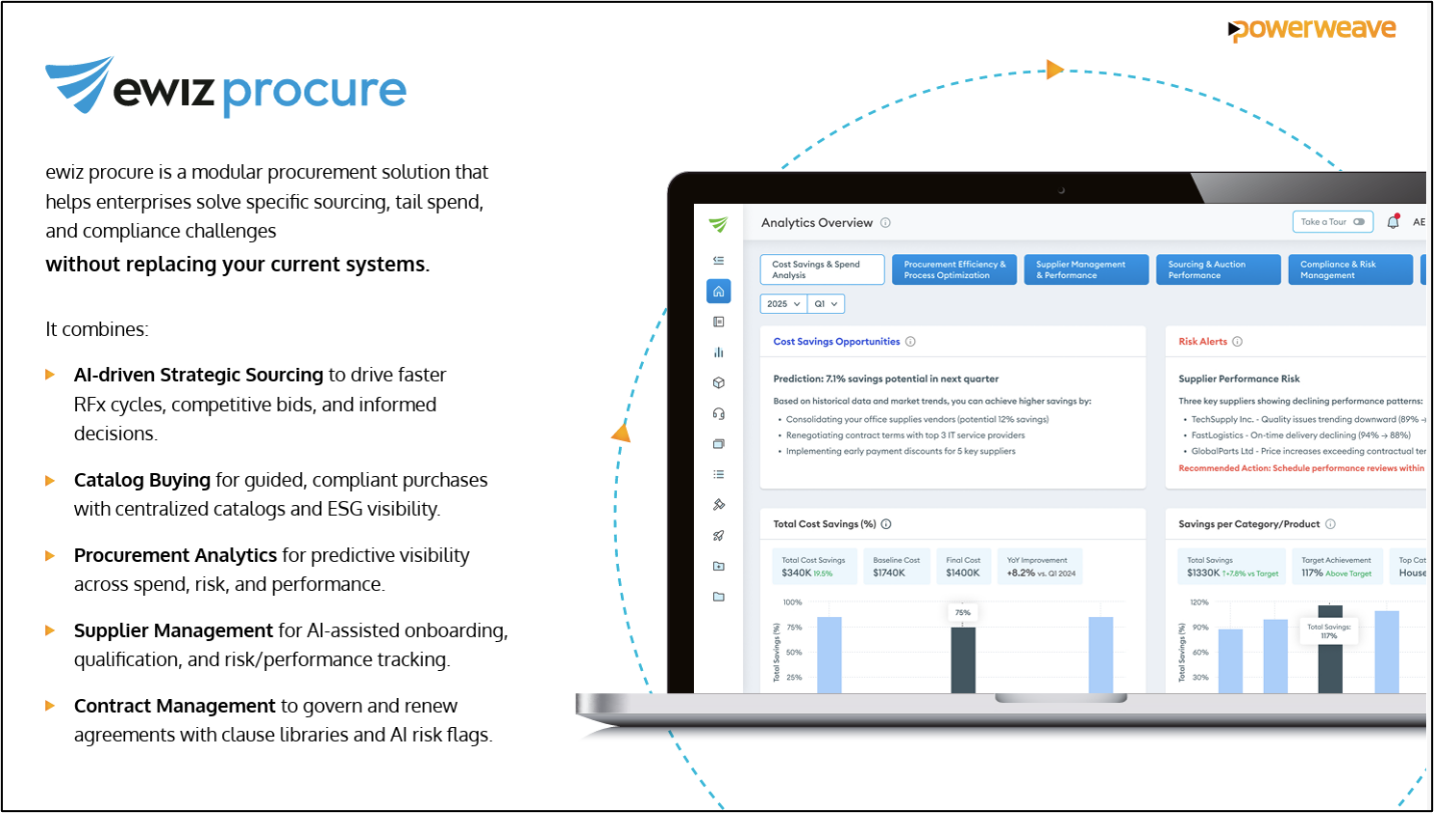
Rather than replacing the ERP, the organization introduced ewiz procure as a modular guided buying layer that buyers would actually use, supported by integrations and managed services to keep suppliers, product data, and quality continuously governed.
The ERP remained untouched.
Behavior changed immediately.
The Program: 5-phase execution model
Powerweave’s team executed a structured, four-phase program focused on adoption first, control second, and scale by design.
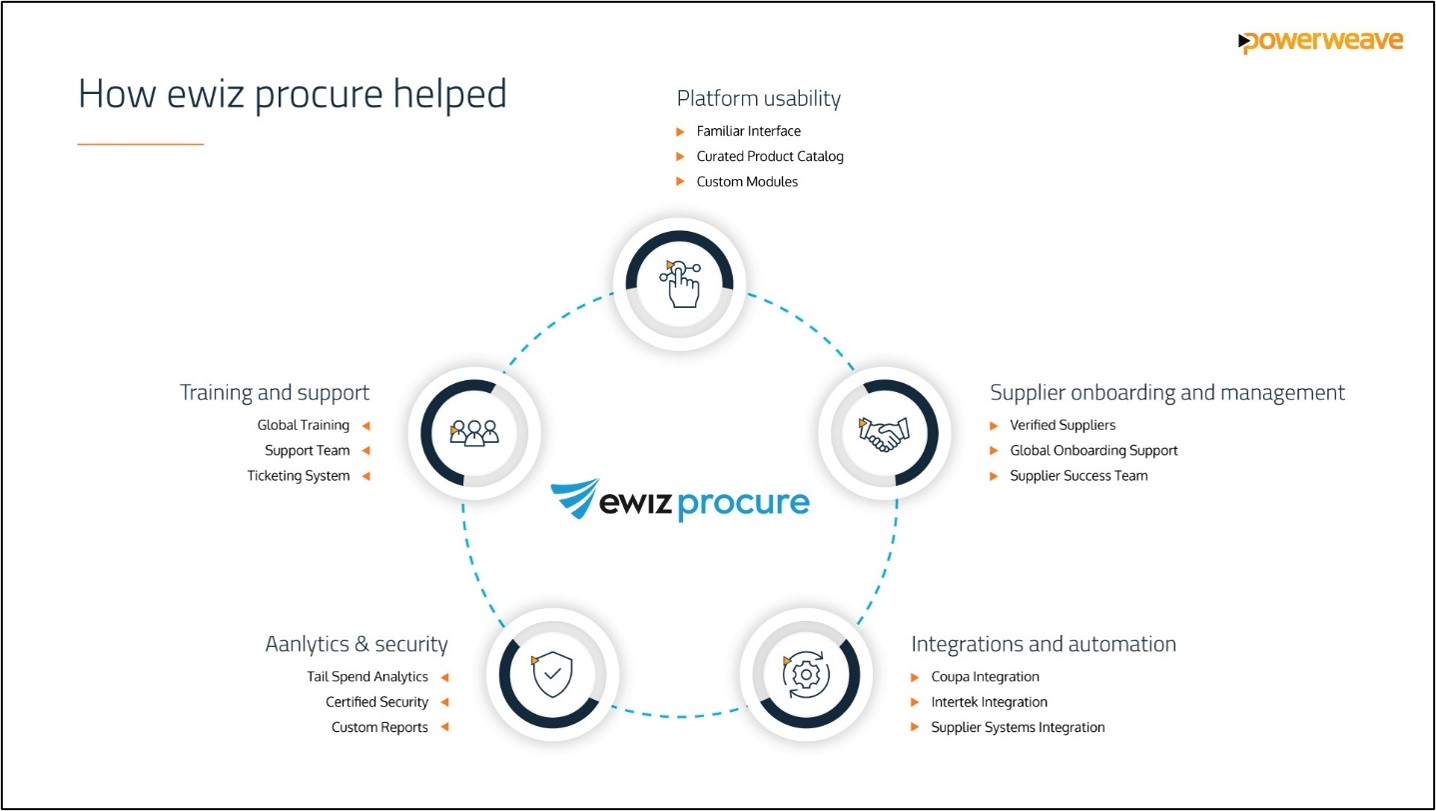
Phase 1: Platform usability and adoption by design
- Launched a familiar, Amazon-like B2C buying experience to reduce resistance
- Rolled out a curated global catalog with 3,000+ products to standardize tail buying
- Introduced custom modules for bespoke and complex items, reducing exceptions and rework
The immediate impact was fewer workarounds and higher compliance at the point of purchase.
Phase 2: Supplier onboarding and enablement factory
- 5,000+ suppliers onboarded and verified through a centralized model
- Global onboarding support as new countries rolled into the program
- A dedicated supplier success team to sustain enablement and adoption
Supplier governance shifted from episodic to continuous.
Phase 3: Integrations and automation (without disruption)
The guided buying layer is integrated directly with Coupa, automating order processing and PO creation without altering downstream finance workflows.
Quality and compliance were embedded through Intertek, ensuring certification checks occurred in-flow rather than after issues surfaced.
The ERP stayed exactly where it was.
Its effectiveness improved dramatically.
Phase 4: Analytics & security
Control without visibility doesn’t scale.
- Advanced tail spend analytics to track spend concentration, leakage, and buying patterns
- Dashboards for compliance, adoption, savings, and supplier performance KPIs
- Custom reporting for global and regional governance
- Certified security standards to protect transactions, data, and integrations
- Continuous monitoring to reduce risk and improve control over time
Tail spend shifted from opaque to measurable, secure, and governable.
Phase 5: Training, support, and governance
Sustained change requires reinforcement.
Over 1,000 users across 50+ countries were trained to ensure consistent buying behaviors.
A centralized support desk handled nearly 10,000 support conversations annually, preventing adoption decay and regional drift.
Custom reporting gave leaders visibility into:
- Spend concentration and leakage
- Supplier performance and consolidation opportunities
- Compliance, savings, and adoption KPIs
Tail spend moved from being invisible to being governable.
The Impact: Scale, control, and sustained savings
This is what execution at scale looks like.
- $900M indirect spend managed over 7 years
- 50+ countries, ~60% of global long-tail procurement spend
- 400+ POs per month processed
- 3,000+ products active
- 1,000+ users trained
- 5,000+ suppliers onboarded
- 10,000 annual support conversations handled
One procurement leader captured it best in a verified Capterra review:
“In a matter of minutes, you can see your investment optimized and improve the productivity of your activities.”
Want to share the success story with your team?
Click here to download the full case study
Why it worked
Several factors distinguished this program from typical tail-spend initiatives.
- Adoption came first: A familiar interface and curated catalogs reduced maverick buying at the source.
- Automation was applied where it mattered: The integration with Coupa streamlined ordering and PO processing without adding complexity.
- Quality was built in, not bolted on: Intertek integration ensured standards and compliance were enforced during buying, not after issues surfaced.
- Enablement was treated as an operating model: Supplier onboarding, user training, and a live support desk sustained behavior change over time.
Most importantly, none of this required replacing the ERP. It respected the enterprise’s existing architecture while fixing what those systems could not.
What it unlocked for leaders
The value of the program extended well beyond procurement.
- CFO: Defensible savings trajectory and lower process costs through standardized tail execution.
- CPO: Higher compliance via guided buying, fewer exceptions, and a scalable rollout playbook.
- Category managers: Cleaner data, better comparability, and stronger leverage across fragmented categories.
- Quality teams: Traceability and adherence through integrated certification checks.
- Suppliers: Clear onboarding paths, fewer escalations, and faster enablement.
Ready to prove tail spend savings without a big program?
If you’re a CPO/Procurement Ops Lead/Category Head managing thousands of low-value purchases that consume outsized time and supplier effort, you already know the gap between transaction volume and procurement capacity.
Book a call with the ewiz procure team
Let’s look at your current tail spend model and identify:
- Where non-compliant buying is happening most often, and why
- Which categories and suppliers are inflating cost-to-serve (and how to fix it fast)
- What integrations you actually need (Coupa, quality checks, supplier data feeds) versus what you can leave untouched
- The smallest change that moves buying into a guided front door, not email and spreadsheets
