
Last week we looked at the manual middle of the PR-to-PO cycle — the deciding work that runs on email and spreadsheets while the ERP holds clean endpoints at either end. This week we go one layer under that, to the data those steps run on, and whether your team still trusts it.
Because on a large GCC build, the thing that quietly stalls a project is rarely a system going down. It is a number no one can trust.
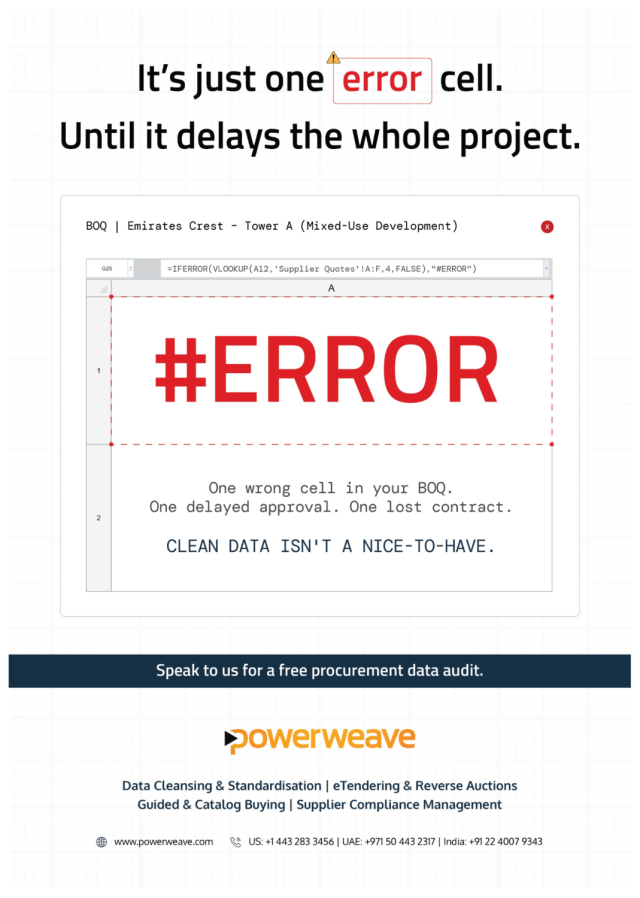
Clean data isn’t a nice-to-have on a capital project. One wrong cell in a BOQ is all it takes to stall an approval.
Featured in The Procurement Ledger, in the edition with A.R.M. Holding’s Ahmed Raafat — a past Beyond Procurement podcast guest — on procurement as a value function.
👉 Read the edition –
One broken cell, three lost days
A new tower is going up. Procurement is running dozens of contracts at once, and a single bill of quantities pulls together pricing from several contractors, revised more times than anyone has counted.
One morning a line in the BOQ stops calculating. A supplier code was renamed upstream; a lookup can no longer find its match, and the total it feeds back returns an error. The approval that depended on that total is not rejected. It just sits, while everyone assumes someone else is holding it.
By the time the broken reference is traced and fixed, three working days have gone. There was no incident and no outage. Nothing that would show up in a report. In a program where the handover date incurs delay penalties, three quiet days are not a rounding error.
This isn’t a spreadsheet problem. It’s a trust problem.
The broken cell is the symptom. The real issue is that the team has quietly stopped trusting its own supplier master.
Most teams already know the master is not fully reliable. So they check it by hand before any award that matters, and keep a private spreadsheet they trust more than the system. None of it is logged. It becomes habit, and habit is invisible, which is exactly why it never gets fixed.
Where the cost actually hides
When the supplier master can’t be trusted, the cost shows up in three places that never make it into a report:
→ Approval cycle time – Every reviewer quietly re-checks what they’ve been handed before a contract goes out, so each award takes longer than the workflow says it should.
→ Supplier onboarding – A new subcontractor who should be set up once gets entered, corrected, and chased across teams.
→ Spend categorization – The cost picture a CPO carries into a project review is wrong before the conversation begins, because the records underneath it are wrong.
It doesn’t fail loudly. It surfaces as time, usually a slipped date on a program where the schedule carries penalties. The better a team gets at working around bad data, the longer the bad data survives.
Data does not replace judgement, it strengthens it.
— Ahmad Raffat , Head of Procurement & Supply Chain, A.R.M. Holding, in The Procurement Ledger
How we help: clean it up, and keep it clean
A one-off clean-up doesn’t hold. It decays back within a quarter, because new bad data arrives on the next load. So we don’t run a clean-up and leave. We run a structured approach that makes clean data the default state, and it doesn’t start with you handing over a tidy file. The messy export is the starting point.
Here’s how the work runs, and most of it is ours to carry, not another project for your team to staff:
→ We start by understanding your world. Short sessions with procurement, IT and finance to map where your data is created, where it breaks, and what “clean” has to mean for your reporting. Like finding your supplier list lives in three places at once (the ERP, the procurement team’s spreadsheet, and the quantity surveyor’s own file) and they don’t agree. No engineering begins until that’s agreed in writing.
→ We check every field in your spend export to see what’s actually there: duplicate records, blank or vague categories, a BOQ line returning #ERROR, a rate keyed in the wrong currency, a negative quantity, two purchase orders sharing one number.
→ We turn the mess into usable fields, reading descriptions written in different languages and styles and breaking them out at scale. A single line reading “ready-mix C40, supplier ref and delivery note mashed together” comes back as separate fields for material, grade, supplier and quantity.
→ We collapse the duplicates into one trusted record per supplier and item, with our team confirming the doubtful cases and a full trail of what was merged and why. “ABC Steel”, “ABC Steel LLC” and “A.B.C. Steel Trdg” resolve to one supplier; the same rebar grade entered under three codes becomes one item.
→ We sort everything into one consistent category structure that matches how you report, so concrete, steel, mechanical and electrical, and finishes each roll up the same way across packages and across projects.
→ We put governance around it with agreed naming rules and quality checks that run on every new load, so the clean-up holds. A new subcontractor can only be added through one approved route, instead of being typed fresh into a BOQ each time. You keep the quality without needing us permanently.
It sits on top of what you already run, whether that’s SAP, Coupa, Ariba, or a plain spreadsheet export. The ERP stays the system of record. Nothing gets ripped out.
Our full data-cleansing approach is laid out here:
What a first pass usually finds
You don’t have to take this on trust. A proof of concept runs the whole approach on a sample of your real purchase-order data, the messier the better, and needs one category or data lead for about four hours. Within a few weeks you get a quality scorecard for your own data and a list of the surprises that always turn up. On first-time client data, these are typical, and they vary by sector and data maturity:
- 8–15% of rows carrying hidden duplicate spend
- Currency and formula errors sitting inside exports everyone assumed were clean
- 85–95% field-extraction accuracy on the records processed in that first pass
These aren’t guarantees. They’re what the first look reliably surfaces, and they’re usually enough to size the problem in numbers a CFO will accept.
What it unlocks for leaders
CFO – A spend picture that holds up under scrutiny, duplicate and leaked spend surfaced in numbers you can defend, and no disruption to the finance system of record.
CPO – Project reviews built on records that stand up in a steering committee, and a clean data foundation in weeks rather than a multi-year program.
Buyer – A supplier master you can act on without a manual re-check, and onboarding that happens once instead of three times.
Where to start
You don’t need a transformation program to find out whether this applies to you. You need to look at twenty rows.
Pull a 20-row sample from your supplier master and read it carefully. Count how many records are duplicated, wrongly coded, or out of date. Twenty rows will tell you more than a dashboard will, because the dashboard is built on the same records.
If you want to understand:
- What your supplier master and spend data actually look like at the first audit
- Where the duplication and miscoding concentrate in your spend
- How a fix maps onto the ERP you already run, without replacing it
That’s a useful conversation to have.
